
Simple yogurt making for complicated people
Richard Law, UTC 2026-02-21 07:22
A day comes in almost everyone's adult life when they resolve to make their own yogurt. Perhaps in the supermarket, standing in front of shelves and shelves of variations on something which may or may not contain even a sniff of actual yogurt. 'If the nomads of the Steppes can do it, so can I', you say to yourself.
Well, sort of. You need lactating beasts of some sort – Yaks are the old-school choice here – and the dried stomachs of the unfortunate ones who have been slaughtered and eaten. Pour some milk (warm from the mum) into a stomach, tie up each end and hang it up to fester in a warm tent. Shove it in the baby's cradle if there is a chill in the air. In a few days you can swish away the flies and maggots from the stomach, scoop out its contents and enjoy your meal. For well over three thousand years the healthy option.
If you live in a one-bedroom flat in some great metropolis the old-school method is not to be recommended, unless of course all your neighbours are doing it.
So you go searching for information about yogurt making on the modern digital bedlam, the internet. There are hundreds of web pages telling you how to make your own yogurt. I can't say I have visited them all, but some of the ones I have seen are either complete nonsense, many more are partial nonsense and most are so specific that they are no help in your own particular situation. Most of them hope to sell you something from Amazon.
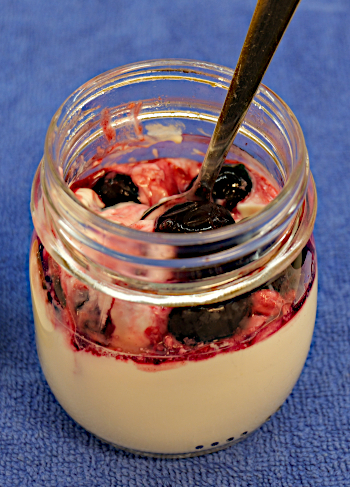
Homemade yogurt and fruit: 'So shines a good deed in a naughty world.' (©Shakespeare, 'MoV') Image: FoS
In essence, to make your own yogurt, you need milk, a starter culture, a suitable container and a warm place to let the bacilli work their silent ministry (©Coleridge). Each of these things is customizable to your needs, so here are some general guidelines to get you started. You can, of course, buy one of the many dedicated yogurt making machines which are on the market these days and stop reading here.
Milk
The yogurt-making fraternity is infested with wackjobs that believe there is some magical, health-giving property of milk straight out of the udder. If you think about it for only a moment, you will realise that there is a reason that the modern chain of supply does not distribute untreated cows' milk – when it is good, it is very, very good, but when it is bad it may kill you, agonizingly. There is a modern delusion that if you wallow in filth you acquire immunity. Perhaps so, but don't forget the being ill stage in between. Immunity comes from the illness, not the filth.
If you know a helpful farmer who can supply milk straight from the udder, you are still going to have to pasteurize/sterilise it before using it in yogurt. Consider this: if there are any bad bacteria in the milk then they are going to be incubated into a full-strength brew whilst you think you are incubating yogurt bacilli. You have to sterilize the milk by bringing it up to at least 80°C [176°F] for a few minutes and then covering it and letting it cool to a temperature that won't kill the yogurt culture when you add it.
I have a website to write, so I cannot be bothered faffing around sterilising milk, letting it cool and then washing up the milk pan. Some pre-heating Puritans say that the pre-heating process makes a better yogurt. It didn't for me when I tried it. Some also say that the pre-heating works some magic on the lactose molecules in the milk. I never noticed any difference. The solution is simple: UHT milk. Use milk only from a freshly opened bottle or packet. I use full-fat milk. For one portion of yogurt per day there is no conceivable reason to use low-fat versions – you will not die after the first spoonful; you will probably experience a flush of happiness.
UHT milk has been flashed very briefly to a high temperature. It is sterile, which is why it usually has a very long sell-by date. I personally cannot taste any difference, but the decision whether to keep it simple with UHT milk or spend half an hour sterilising milk and scrubbing the pan is yours.
Sterilisation
I repeat: you must make sure that all containers and utensils are spotlessly clean and sterile, otherwise you may be culturing some very bad things. The process is also more critical than it is in jam making, where the very high temperatures of the jam can do their bit. It takes me about 15 minutes to make a batch of yogurt; it takes me about 30 minutes before that to sterilise everything: containers, mixing jug, whisk and spoon. And no, a dishwasher does not sterilise its contents, certainly not enough for this purpose.
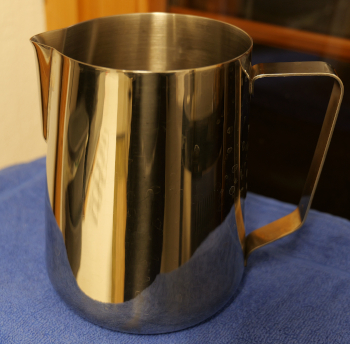
Stainless steel 2 litre mixing jug, easy to sterilise. Image: FoS
For containers I use glass jars, which I can blast in my small convection oven for five minutes; the stainless-steel mixing jug and the metal utensils then get a five minute blast while the glasses are cooling down. The jars I use cannot cope with much heat stress – they have to cool down before you can pour the cold mixture in them. A full-size oven would use a lot of energy, in which case you will need to work out your own sterilisation procedure. The lids of my jars are aluminium but the seals are silicone and would be damaged by oven heat, so I use a small steamer to sterilise these.
Containers
At this point in the tale you are on your own – get your thinking cap on.
I make a bit over a litre of yogurt at a time – that is, one litre packet of milk. I could make this in one large jar or container, keep it in the fridge and spoon out yogurt on demand. I prefer to use single-portion jars of 250 ml. A standard supermarket single-portion yogurt contains around 150 ml.
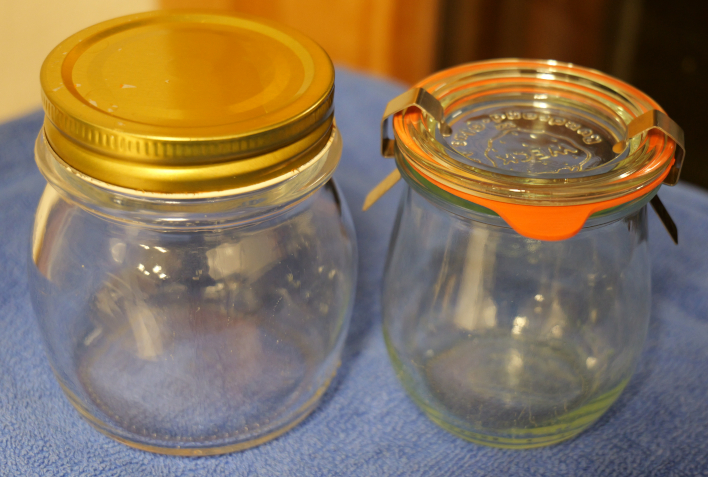
Left: the 250 ml portion jar. Right: the 100 ml starter jar. Image: FoS
Why are my 'single-portion' jars so over-sized? Because I like to add fresh fruit to my yogurt – grapes, pineapple segments, clementine segments, dried prunes, cherries etc. I put about 150 ml of yogurt in each jar, leaving the 100 ml space above free for the fruit. That means 6 jars @150 ml = 900 ml plus one smaller jar for the yogurt that will be used as the starter for the next batch = one litre of milk.
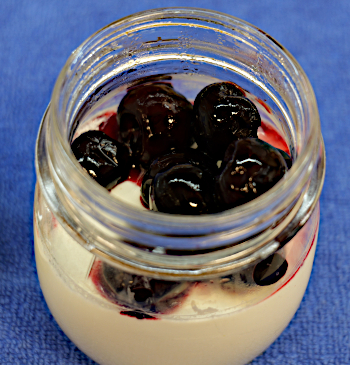
The space left at the top of the jar is the place to dump the fruit of your choice. At the time of writing, in February, the choice of fresh fruit is a bit limited, so I am using deep-frozen fruit such as mixed berries, blueberries or, in this particular case, cherries. They can be given a 20 second defrost in the microwave or just stirred in frozen and given five minutes to thaw in the yogurt. Image: FoS
An important factor is whether all the containers from the one batch of yogurt will fit into whatever incubator you are going to use. My six + 1 jars fit perfectly into my sous-vide machine.
The mixture
The starting mixture for the yogurt couldn't be simpler: milk + starter yogurt. Choosing your very first starter from the supermarket offer can be a bit of a trial, since labelling is not always as clear as it should be. You have to be sure that the plain yogurt contains a live culture and has not been sterilised (to give it a longer shelf life) and contains no sugar or artificial sweetener, or any other muck such as gelatine. I started with a bifidus yogurt which announced its live bacteria on the label. The bifidus bacillus is apparently very good for the gut. Who knows?
I also add three heaped tablespoons of milk powder: the bacteria enjoy this extra boost and reward me with a particularly thick and rich yogurt. You can get a very rich result by replacing some of the UHT milk with condensed milk (unsweetened).
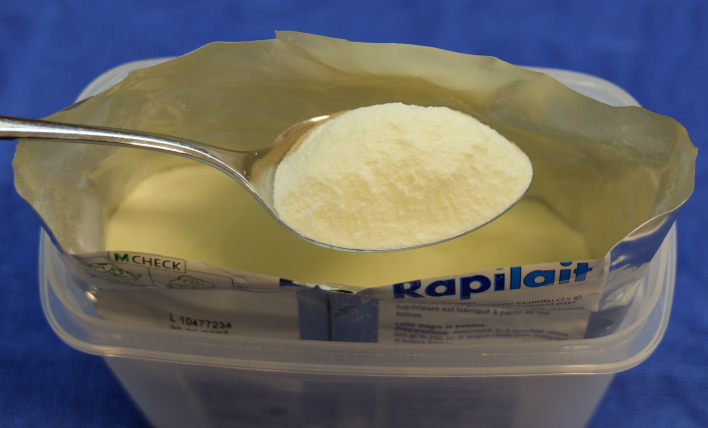
Just in case someone can't work out what a heaped tablespoon of milk powder looks like, here it is in all its glory. Image: FoS
Incubation
Some people seem to incubate yogurt successfully in a cardboard box insulated with scrumpled up newspaper. I have a sous-vide machine (waterbath) for general cooking jobs. I use this also for incubating yogurt. The slight disadvantage is that the lowest temperature I can set is 45°C [113°F], which for my feeling is a bit on the high side. Incubation temperatures can range between 25°C [77°F] and 45°C [113°F]. I incubate the mixture for between 12 and 14 hours, usually overnight.
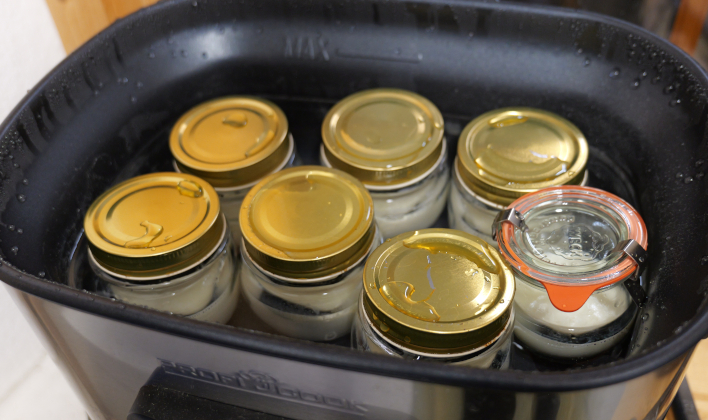
The sous-vide machine, filled with jars and pre-heated water, ready to roll for 12 hours. NB: if you use a sous-vide machine, do not start it with cold water — pre-heat the water on the stove to a temperature above the incubation temperature, e.g. about 60°C [140°F] in my case. The cool jars and their contents will rapidly cool the load to the operating temperature. It is always more efficient and economical to pre-heat the water in a sous-vide to near operating temperature than wait for an hour or so while the machine comes up to temperature on its own. Image: FoS
Now comes the science bit.
At the start of the incubation, the bacilli in the starter wake up and start feeding and reproducing. The bacteria feed on the lactose, a sugar, in the milk. They 'digest' the lactose and leave behind lactic acid. Their number will increase exponentially as each bacillus feeds for a while and then splits into two. Over time the bacilli will eat up all the lactose, leaving behind lactic acid. As the food runs out, the bacilli cease to reproduce (let's call this the end-point). There is, therefore, a correlation between three factors: 1) the temperature of the mixture (within obvious limits), 2) the number of bacteria present at the start of the incubation and 3) the duration of the incubation.
Factor 2) can be neglected in practice. A small population in otherwise optimal conditions will soon get up to speed. The relationship between 1) the temperature and 3) the duration has to be found out by trial and error. If the incubation is run near to or beyond the end-point the yogurt will taste more acidic – not in a bad way, 'tangy' is probably the best description, but anyone with a sweet tooth may find the taste a bit challenging. If the incubation time ends well before the end-point, the yogurt may be rather bland. Some people suggest as little as four hours of incubation; I once went to 18 hours and found the result not bad at all. Chacun à son goût.
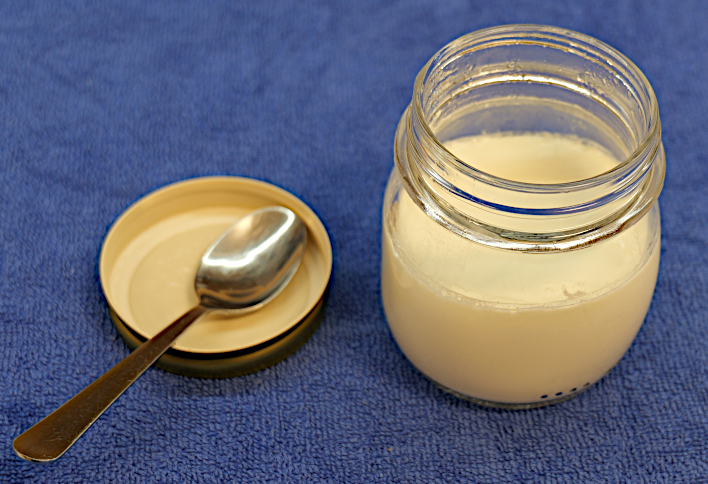
A portion of yogurt whispering 'eat me'! Image: FoS
The way to determine your individual incubation optimum and amaze your friends with your sagacity is, starting at say 9 hours, to remove a jar every hour, note the time or just a sequence number on the lid and put it in the fridge. You will then have six samples of incubation times between 9 and 14 hours and can taste test the yogurts at your leisure. None of them will be inedible.
There is a quiet pleasure in taking the jars out and seeing the effects of that secret ministry – beautiful, firm yogurt, as nature intended.
At the end of the incubation period I take the jars out and let them stand in a tray of cold water for half an hour or so. This means that they are already cool when I put them in the fridge – suddenly introducing a mass of more than three kilograms at a temperature of 45°C [113°F] will give your fridge quite a bit of work to do. As the yogurt cools, the bacteria will have a much needed rest and the ones in the starter jar will gather their strength for the next batch in a week or so.
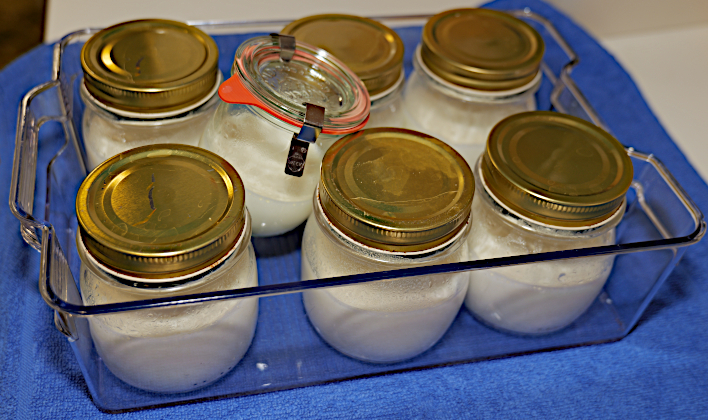
Six individual portions and starter pre-cooled, dried and ready for the refrigerator. Image: FoS
That's it. It took me a few attempts to get things the way I wanted them. I hope I have given you a starting point to get you on your yogurt journey. It is really worth a bit of trouble – ask the Tatar hordes from the east.
0 Comments
Server date and time:
Browser date and time:
Input rules for comments: No HTML, no images. Comments can be nested to a depth of eight. Surround a long quotation with curly braces: {blockquote}. Well-formed URLs will be rendered as links automatically. Do not click on links unless you are confident that they are safe. You have been warned!