
Bah, humbug!
Richard Law, UTC 2025-12-14 10:23 Updated on UTC 2026-05-12
In the Western mind, Saint Nicholas, already half-mythological like most of the early saints and martyrs, has morphed into the fully mythological Father Christmas, a.k.a. Santa Claus, the process driven by the cultural and commercial dominance of the United States.
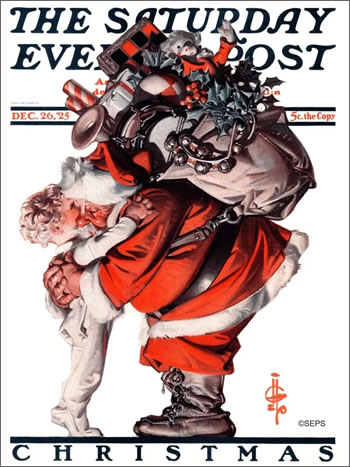
The masterful and very successful illustrator J.C. Leyendecker (1874-1951) for the cover of the Saturday Evening Post, 26 December 1925. The little child is human, the Santa is not a human in costume, but the 'real' Santa.

Haddon Sundblom (1899-1976), an advertising illustration for Coca-Cola 1956. The little deer is a clever touch.
Santa is a kindly chap who keeps his elves slaving at their benches making presents in his year-round sweatshop.
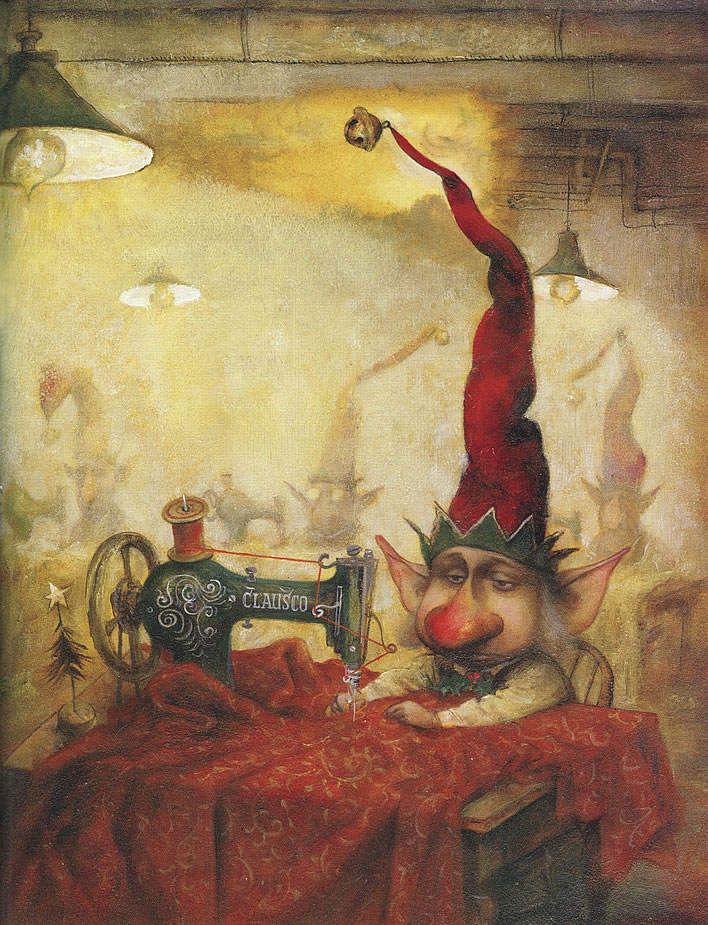
Richard Thompson's (1957-2016) depiction of Santa's Sweatshop, full of amusing details. Image: from The Art of Richard Thompson (2014).
This used to be in Lapland, but is nowadays in China. He distributes these presents around the world using his reindeer-drawn sleigh during the night of Christmas Eve. The tale is so absurd that the only question is, how long it takes a child to grasp that the story is a complete crock.
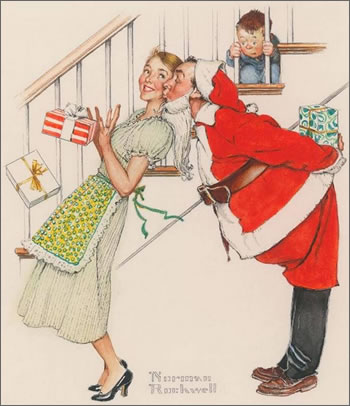
Norman Rockwell: An all-too-human Santa and the end of a child's illusion. We can only admire Rockwell's mastery of composition.

J.C. Leyendecker's famous illustration in the American Weekly of 19 December 1948 of a moment of enlightenment about Santa for a family's children. The painting lacks Leyendecker's trademark finishing touches, but it is nevertheless a terrific cover illustration.
Santa's modern image has been marketed around the world. It is an iconography that seamlessly encompasses the mythological Santa and his human imitators.
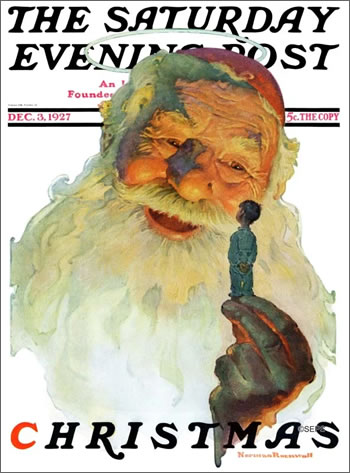
Norman Rockwell (1894-1978) for the cover of the Saturday Evening Post, 3 December 1927. More than a little scary – IMO a rare misstep by Rockwell, a work now characterised as the 'King Kong Santa'.

Norman Rockwell's portrait of an exhausted Santa on Christmas Day, which takes the mythological Santa and adds human qualities.
But the Swiss and German traditions are even more crazed and even more complicated.
In Switzerland Sankt Nikolaus visits families on his feast day, 6 December. In the German-speaking regions of Switzerland he is known as Samichlaus. He brings modest presents for the children – mandarin oranges, nuts, chocolates and pastries.
In most variants of the tale he is accompanied by Knecht Ruprecht, 'Manservant Ruprecht', who carries a bundle of birch twigs with which he can beat children who have been naughty. This rarely happens, a fact which explains the moral and cultural decline of Switzerland over the past fifty years.
It's not all bad. This year a neighbour surprised me with a box of fine mint chocolates for Samichlaus – clearly, being grumpy is no disqualification at all. Next year I shall probably get a visit from Knecht Ruprecht. It's all harmless fun at a modest price.
There are many versions of the Nikolaus/Ruprecht show, each having its own features. In some places Ruprecht is replaced by (the) Krampus, a much more demonic and violent figure, who would not be out of place in the bloodthirsty fairy tales of the Brothers Grimm. Whereas Knecht Ruprecht usually turns up as the companion and helper of Nikolaus, the Krampus is often said to visit on 5 December, the day before Nikolaus comes, perhaps to avoid polluting the saint with the presence of such a berserk figure in the role of his helpmeet. In a more general sense, this dark, demonic figure is ill-suited to the mood of the 'season of light' (St. Lucy's Day being 13 December).
After his visit on 6 December, Nikolaus has done his job for that year. When Christmas finally arrives the presents are brought by some being called the Christkind, the 'Christchild'. Traditionally, presents are opened on Christmas Eve, avoiding the mad goings-on in Anglo-Saxon families in the early hours of Christmas morning.
This particularly Teutonic complexity of the Christmas festivities arose from the religious divisions of the Reformation. Switzerland to this day is a patchwork of communities, some Catholic, some Protestant. Germany is also a patchwork, but with larger patches. Austria has its Protestant localities, but they are overwhelmed by the Catholic regions. Each to his own.
Catholics take Sankt Nikolaus' Day, 6 December, as a serious saint's day. The visitation of Nikolaus and his servant Ruprecht may be entertainingly bonkers, but it rests on a liturgical tradition and has largely avoided commercialisation – there is not much money to be made from little sacks of nuts and a few oranges.
It was Martin Luther who invented the gift-delivery service on Christmas Eve. The idea of a venerated fourth-century saint as a gift-bringer was inimical to Protestant thinking, so a new bringer of gifts had to be invented: the Christkind. We can understand and forgive illiterate peasants for making up religious nonsense in their superstitious brains, but it comes as a bit of a shock to find Martin Luther at it, too. We strain to think of a reason for hiding the identity of the giver behind the Christkind proxy, but there isn't one, apart from more superstitious mumbo-jumbo.
The whole concept of the Christkind is odd, since the name suggests the baby Jesus himself, an example of Lutheran creative ambiguity. The Christkind can be whatever you want he/she/it to be, most take he/she/it to be some sort of angel. Since angels can just appear and disappear (so I am told), the Christkind doesn't need external props such as wide chimneys, sleighs and reindeer and Amazonian delivery logistics.
When you have survived all that and seen the New Year in you still have to brace yourself for Dreikönigstag, 6 January, the feast of the Heilige Drei Könige a.k.a. the 'Three Wise Men', a.k.a the Sternsinger, because in some places the leader of the procession holds a stick with a large illuminated star on top. My alpine village ran out of children for this task some years ago, thank goodness.
The tradition is reminiscent of the carol singing in the Anglosphere, which has been detached from any theological meaning and which can take place anytime during the Christmas season. For Dreikönigstag three or more children dress up as oriental kings and go from house to house in the evening of 6 January performing songs and/or reciting doggerel.
Their victims are expected to answer the door to them and patiently listen to the performance with enchanted expressions, then hand over sweets, chocolate or, best of all, money (this is Switzerland, after all). In return, the singers will chalk on the lintel of your door something like 'C+M+B' (Caspar, Melchior, Balthazar) plus the year, which will keep the evil eye away from your dwelling for the rest of the year.
The event is another example of an inversion of the original tale. The Biblical Three Kings brought gifts; their modern representatives come with empty hands and with an air of hidden menace: 'Nice house you've got there - pity if something happened to it'. Best have something ready for when they call.
Before the tradition died out in my village, each year I would stock up with junk food snacks and a pile of the impressive Swiss 5-Franc coins. Better safe than sorry.
Until recently it was traditional for the singers to slap on some make up – at least one singer would get a black face and another might be yellowish (Europe, Africa and Asia, geddit?). But since those innocent days just a few years ago, when the kids (as all kids do) would enjoy putting on some slap, the spoilsports have taken over, uniformity in diversity has triumphed, so the singers these days are usually hideously white, like the rest of us up here. Or non-existent. Some larger villages and towns allow you to pre-order a visit from the three kings, turning the event into just another seasonal business opportunity by adding some efficiency to the extortion.
Yes, it is all bunkum. Yes, it is all quite unbelievable and stupid. But we would miss it in this darkening time of the year if it weren't there. Humans have metaphoric minds and metaphoric moods and emotions. Factually foolish as they were, I still recall the sights, sounds and smells of childhood Christmases long gone. It is all bunkum, but entertaining bunkum which livens up the dark time of the year.
Update 12.05.2026
Whilst spring cleaning in the early website I stumbled across an illustration from a German schoolbook from the early twentieth century (exact date unknown to me) that was used to contrast life then and now. It is an engaging depiction of a German family receiving a visit from Sankt Nikolaus on 6 December.

As in the other images in the series, this illustration is full of interesting details, particularly in the differing reactions of the children, from the oldest (polite handshake with eye-contact) to the youngest (safe under the table); Granny has been supervising them during their evening playtime; Nikolaus is carrying a sack stuffed with toys, some dolls are even hung around his belt. We are just given a glimpse of his Rute, the bundle of twigs he carries for the ritual punishment of badly behaved children. It is unlikely he will use it, though even if he does, a bundle of twigs will hurt no one.
0 Comments
Server date and time:
Browser date and time:
Input rules for comments: No HTML, no images. Comments can be nested to a depth of eight. Surround a long quotation with curly braces: {blockquote}. Well-formed URLs will be rendered as links automatically. Do not click on links unless you are confident that they are safe. You have been warned!