
Where is your brother?
Richard Law, UTC 2026-02-22 18:09 Updated on UTC 2026-03-14
Today, 22 February 2026, is the eighty-third anniversary of the first executions of the members of the White Rose resistence by the Nazis. We commemorated this event in a previous article on this website eight years ago: 22 February 1943: the White Rose.
The 'resistance' amounted to a series of flyers and scrawled slogans around the University of Munich. It was put down with extreme brutality by the Nazi authorities. Over a period of a few months in 1943 all the members of the group were tried, convicted and guillotined without delay.
Three members of the White Rose resistance group, Hans Scholl (1918-22.02.1943), his sister Sophie Scholl (1921-22.02.1943) and Christoph Probst (1919-22.02.1943) were tried, convicted and sentenced to death. They were executed hours after their conviction by guillotine in prison in Munich.
Three further members of the White Rose, Professor Kurt Huber (1893-13.07.1943) and Alexander Schmorell (1917-13.07.1943) were convicted and guillotined in July 1943; Willi Graf (1918-12.10.1943) was convicted with them but his execution was delayed to give the Gestapo some time to try and torture more names out of him (they didn't succeed).
There are people who wonder why the population of Germany didn't rise up against the National Socialist regime. Well, now you know.
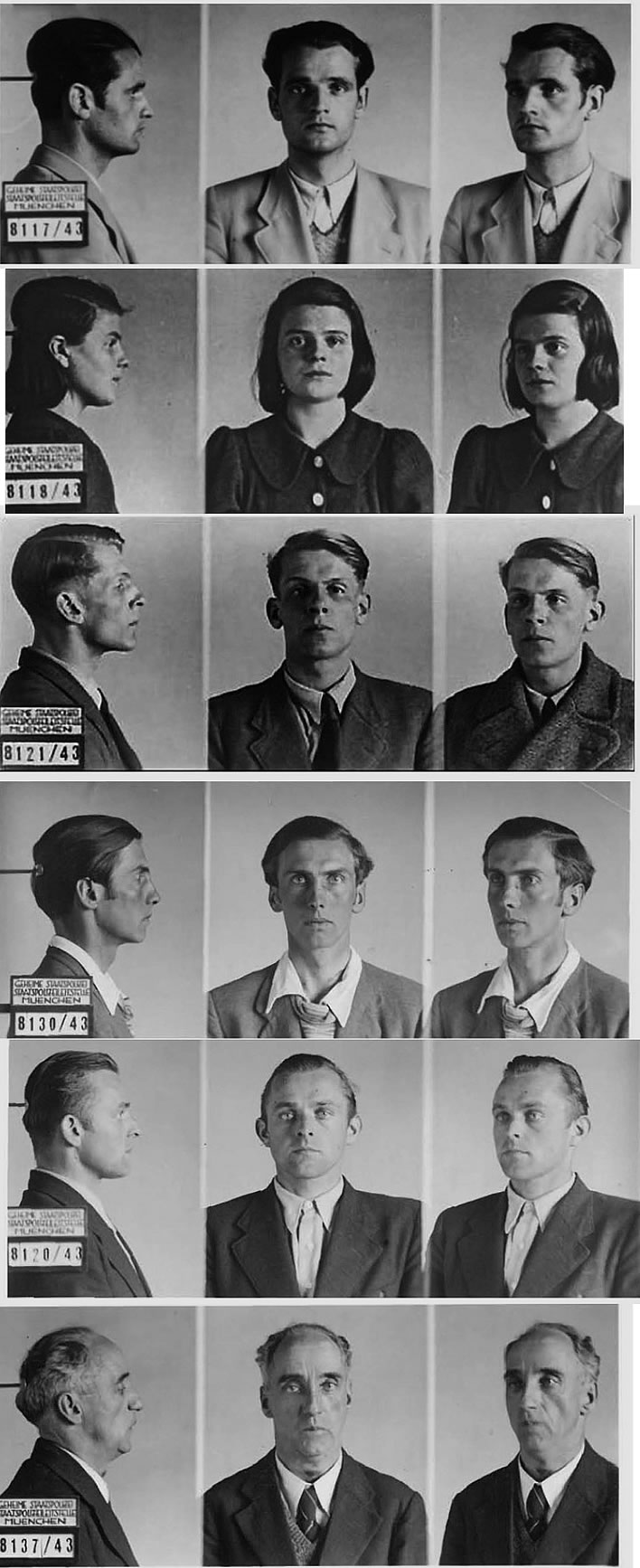
Die Weisse Rose members as photographed on arrest by the Gestapo. From top to bottom: Hans Scholl, Sophie Scholl,Christoph Probst, Alexander Schmorell,Willi Graf, Kurt Huber.
Nearly seventy years ago, on 8 March 1956, 10 years after the end of the war, the German writer Heinrich Böll (1917-1985) gave a speech on the occasion of the fifth annual Woche der Brüderlichkeit, which in that year took place in Bonn. The event was a forum aimed at furthering Christian-Jewish dialogue and Holocaust research. Böll had served in the German army almost throughout the war.
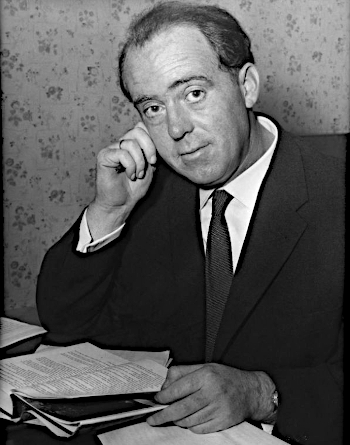
Heinrich Böll, ND.
At the time of the speech Böll was still some years away from being awarded the prestigious Georg Büchner Prize (1967) and the even more prestigious Nobel Prize for Literature (1972).
Here are some extracts from Böll's address.
The individual in history
Where is your brother, then? Was he murdered in Auschwitz, fallen in battle or hanged as a deserter, shortly before the fifth minute after twelve ended? […] History should be the record of what happened. To the question directed at us – 'Where is your brother?' – we must not permit ourselves the non-commital answer: My brother was lost in history. Where, at what point in this history was he lost? Was he murdered in Lublin-Majdanek, starved to death in a prisoner of war camp, killed fighting in Russia, or was he hanged as a deserter? History happens everywhere and our brothers, our sisters are nothing more than the uncounted dead, who now are part of the great history.
Wo ist denn dein Bruder? Ist er ermordet worden in Auschwitz, gefallen oder erhängt als Deserteur, kurz bevor die fünfte Minute nach zwölf sich vollendete? […] Geschichte sollte die Aufzeichnung dessen sein, was geschehen ist, und die Frage, die an uns gerichtet wird - »Wo ist dein Bruder?« -, auf diese Frage sollten wir uns nicht die unverbindliche Antwort erlauben: Mein Bruder ist in der Geschichte verlorengegangen. Wo, an welchem Punkt dieser Geschichte ist er verlorengegangen? Ist er in Maidanek ermordet worden, in einem Kriegsgefangenenlager verhungert, in Rußland gefallen, oder ist er als Deserteur erhängt worden? Geschichte ist überall geschehen, und unsere Brüder, unsere Schwestern, sollen sie nichts weiter gewesen sein als das Material für diese Geschichte, nichts weiter als die ungezählten Toten, die nun einmal zur großen Geschichte gehören!
The true memorials are the sacred places all around us
Here, perhaps on that tree that stands in front of the door, my brother was hanged. Here, from that railway platform, on which today splendidly and with all the dignity that a young nation deserves, foreign guests of honour are welcomed; from that platform, from whence with my return ticket I have often journeyed home, from there he was transported to the death camp and murdered as an administrative act.
Historical places, historical monuments? There are enough of them: The tree where today the sign hangs 'Maximum Speed 60 km', that is the tree on which my brother was murdered. The next heap of rubble: Perhaps a Jewish family lived there, about whom no one asks, because none of them survived. That happened, it is history. And in the question of historical places we should not be overcome by embarrassment: Every street, every house is an historical place, the halls in which the men of the 20th July [assassination attempt] were hanged on meat hooks, they are historical places, not the monuments we erect, in order to distract attention from the particular to the general.
Hier, vielleicht an dem Baum, der vor der Tür steht, ist mein Bruder erhängt worden – hier, von dem Bahnsteig aus, an dem heute prunkvoll und mit all der Würde, die ein junger Staat sich schuldig ist, ausländische Ehrengäste empfangen werden, von diesem Bahnsteig aus, von dem ich so oft mit meiner Rückfahrkarte nach Hause zurückgefahren bin, von dort aus ist er in das Vernichtungslager transportiert und auf dem Verwaltungswege ermordet worden. Historische Stätten, historische Denkmäler? Es gibt deren genug: Der Baum, an dem heute das Schild hängt »Höchstgeschwindigkeit 60 Kilometer«, das ist der Baum, an dem mein Bruder ermordet wurde, der nächste Trümmerhaufen: Dort mag vielleicht eine jüdische Familie gewohnt haben, nach der niemand mehr fragte, weil niemand von ihr überlebte. Das ist geschehen, ist Geschichte, und auf die Frage nach historischen Stätten sollte uns keine Verlegenheit überkommen: Jede Straße, jedes Haus ist eine historische Stätte, die Hallen, in denen die Männer des 20. Juli an Fleischerhaken aufgehängt wurden, sind historische Stätten, nicht die Denkmäler, die wir uns errichteten, um die Aufmerksamkeit vom Einzelnen auf das Allgemeine zu lenken.
Lost in rounding down
Those who have crossed the threshold [of life] are those who still know that which their eyes have seen and their ears have heard. They are those who have not fallen into dull indolence, which is the fertile ground for the new murdering. Those who – when asked about the brother, the sister – still remember and do not submit to the interpolations which are gladly practised in history books. In them the numbers are rounded down: Where is your brother, then? He is hidden behind the zeroes which stand at the end of the large numbers. The number plays an important role: the surviving murderers argue whether four or six million Jews were murdered; such arguments contain barbarism, which murders on unabated. Rounded down numbers squash the individual, they are spoken so quickly: six million – only the six remains in the memory; these large, crude numbers force events into the astronomically unverifiable, but the murder did not happen on the Moon. Auschwitz is not very far from Austerlitz. Austerlitz has a secure place in our history books. Let us hope, let us make sure, that Auschwitz also has a secure place and let us guard against the many zeroes which follow the numbers in the history books, our brothers are hidden behind the seven zeroes of an eight-figure number: an entire people of the dead, whose princes are its murdered children. Historians like rounding down, unlike merchants, who like rounding up. My brother, my beloved perhaps, was the one that even the most reliable research could forget: one who could turn the seven at the end of an eight-digit number into an eight: No one should be lost in the generous interpolation: an infant, killed by bombs, a Jewish child from a Galician village, despised by his murderers, one single Russian boy perhaps, who ended up in the death mills.
Diejenigen, die den Sprung über die Schwelle wagen, das sind die, die noch wissen, was ihre Augen gesehen, ihre Ohren gehört haben, die nicht in die dumpfe Trägheit fallen, die der beste Vorbereitungsboden für den neuen Mord ist. Die sich, wenn sie nach dem Bruder, nach der Schwester gefragt werden, noch erinnern und sich nicht der betrügerischen Interpolierung unterwerfen, die in Geschichtsbüchern gern betrieben wird. Dort wird abgerundet: Wo ist denn dein Bruder? Er ist hinter den Nullen verborgen, die in den Geschichtsbüchern am Ende der vielstelligen Zahlen stehen. Die Zahl spielt dabei eine wichtige Rolle: Die überlebenden Mörder streiten sich darum, ob vier oder sechs Millionen Juden ermordet worden sind; in solchem Streit lebt die Barbarei, die sie ermordete, unvermindert fort. Abgerundete Zahlen erdrücken den einzelnen, sie sind so schnell ausgesprochen: 6 Millionen, da bleibt nur die Sechs im Gedächtnis; diese großen groben Zahlen verschieben das Geschehen ins Astronomisch-Unkontrollierbare, aber der Mord ist nicht auf dem Mond geschehen, hier, nicht sehr weit entfernt: Auschwitz liegt nicht sehr weit entfernt von Austerlitz. Austerlitz ist der Platz in unseren Geschichtsbüchern gesichert. Hoffen wir, sorgen wir dafür, daß auch für Auschwitz der Platz gesichert wird, und hüten wir uns vor den vielen Nullen, die in den Geschichtsbüchern am Ende der Zahlen stehen, unsere Brüder sind verborgen hinter den sieben Nullen einer achtstelligen Zahl: ein ganzes Volk von Toten, dessen Fürsten die ermordeten Kinder sind. Die Geschichtsschreibung liebt es, nach unten abzurunden, wie die Händler es lieben, nach oben abzurunden. Mein Bruder, mein liebster vielleicht, war der, den selbst die zuverlässigste Forschung vergessen könnte: der aus der Sieben am Ende einer achtstelligen Zahl eine Acht machen würde: Keiner darf verlorengehen durch die großzügige Interpolierung: ein Säugling, durch Bomben getötet, ein jüdisches Kind aus einem galizischen Dorf, verachtet von seinen Mördern, ein einziger russischer Knabe vielleicht, der in die Todesmühlen geriet.
The fusion of Cain and Abel; the ordinariness of evil
We who are gathered here are not fully Cain nor fully Abel: We have not raised our hand to strike dead our brother, nor have we been struck dead. We are survivors – co-survivors – and the surviving Cain lives among us. Cain, this name awakens the image of bloodthirstiness, but the mark of the modern Cain is not his bestiality: he is harmless, gentle, an average person, one of those who would not hurt a fly: it is inconceivable, indefinable, it is a mistake to believe that the Devil is great or grand, that he has stature. He squats in the average, that is his appropriate costume.
Rudolf Hoess, one of the commandants of Auschwitz, who admitted that under his reign in Auschwitz almost as many Jews were murdered as there were inhabitants in Berlin, Rudolf Hoess stated in his interrogation in Nüremberg: 'You can be assured, that it was not always a pleasure to see this mountain of bodies and to breathe the ever-present stink of burning flesh. But Himmler had ordered it, he had even declared that it was necessary and, to tell the truth, I have never much thought about whether that was good or evil. It appeared to me to be a necessity, that is all'. 'I am completely normal', Hoess said. 'During my liquidation work I led a normal family life…' But he was puzzled, was quite astonished, that his wife rarely felt the need to embrace him, after she had found out about his work.
Wir, die wir hier versammelt sind, sind nicht ganz Kain, nicht ganz Abel: Wir haben nicht die Hand erhoben, um unseren Bruder zu erschlagen, noch sind wir erschlagen worden. Wir sind Überlebende, Mit-Uberlebende, denn mit uns zusammen lebt der Überlebende Kain. Kain, dieser Name erweckt in uns die Vorstellung von Blutrünstigkeit, aber das Kennzeichen des modernen Kain ist nicht seine Bestialität: er ist harmlos, sanft, ein Durchschnittsmensch, einer von denen, die keiner Fliege etwas zuleide tun können: er ist unfaßbar, undefinierbar, es ist ein Irrtum zu glauben, der Teufel sei groß oder großartig, er habe Format. Er hockt im Durchschnitt, das ist das ihm angemessene Gewand. -
Rudolf Hoess, einer der Kommandanten von Auschwitz, der zugab, daß unter seiner Herrschaft in Auschwitz fast soviele Juden ermordet worden sind, wie Berlin Einwohner hat, Rudolf Hoess sagte bei seiner Vernehmung in Nürnberg: »Seien Sie sicher, daß es nicht immer eine Freude war, diese Berge von Leichen zu sehen und den ewigen Gestank des verbrannten Fleisches zu atmen. Aber Himmler hatte es angeordnet, er hatte sogar erklärt, daß es notwendig sei, und ich habe mir, um die Wahrheit zu sagen, nie viel Gedanken darüber gemacht, ob das gut oder böse sei. Es erschien mir als eine Notwendigkeit, das ist alles.« »Ich bin vollkommen normal«, sagte Hoess. »Während meiner Liquidierungsarbeit führte ich ein normales Familienleben…« Aber er wundert sich dann, war sehr erstaunt, daß seine Frau nur noch selten das Bedürfnis verspürte, ihn zu umarmen, nachdem sie sein Handwerk entdeckt hatte.
Do not judge the nameless dead
The honour of each of the dead is untouched. Each of the dead has his or her sovereignty, his or her dignity, the honour of the dead is untouchable, whether it is that of the murdered young Jew from Lemberg, or the young SS-soldier of the same age, who was led astray. We know nothing, nothing do we know, we may not judge the dead, apart from those who wanted to write their own names in what we call the book of history. We have their speeches, their letters, their books. They created a state which promulgated laws that forbade allowing Jews to enter the bomb shelters during an air-raid alarm; which forbade giving bread to the starving if they belonged to a race that had been declared inferior; which forbade housing fleeing people. Entire families died for this state, which executed the Scholl siblings, which hanged the men of the 20th July on meat hooks; which killed entire peoples not in battle but in administrative process. In the official pathos of official memorials – funeral marches, slow marches – and in the worn-out rhetoric of those who pursue historical abuse of the dead. Are our brothers there?
Nicht die Ehre eines einzigen Toten ist damit angetastet. Jeder Tod hat seine Hoheit, jeder Tote seine Würde, die Ehre eines Toten ist unantastbar, die des ermordeten jungen Juden aus Lemberg, die des gleichalterigen jungen SS-Mannes, der irregeführt war. Wir wissen nichts, nichts wissen wir,wir sind nicht befugt über die Toten zu richten, ausgenommen die, die ihren Namen unbedingt in das einschreiben wollten, was sie das Buch der Geschichte nannten. Wir haben ihre Reden, ihre Briefe, ihre Bücher. Sie bildeten einen Staat, der Gesetze erließ, die es verboten, Juden während des Fliegeralarms in die Schutzräume zu lassen; der es verbot, Hungernden, falls sie einem für minderwertig erklärten Volk angehörten, Brot zu geben; der es verbot, Fliehenden Obdach zu geben. Ganze Geschlechter sind für diesen Staat gestorben, der die Geschwister Scholl hinrichten, der die Männer des 20. Juli an Fleischerhaken aufhängen ließ; der ganze Völker nicht etwa im Kampf schlug, sondern auf dem Verwaltungsweg ermorden ließ. Im offiziellen Pathos amtlicher Feiern - Trauermärsche, langsamer Schritt - und in der abgenutzten Rhetorik derer, die mit den Toten geschichtlichen Mißbrauch treiben: sind dort unsere Brüder?
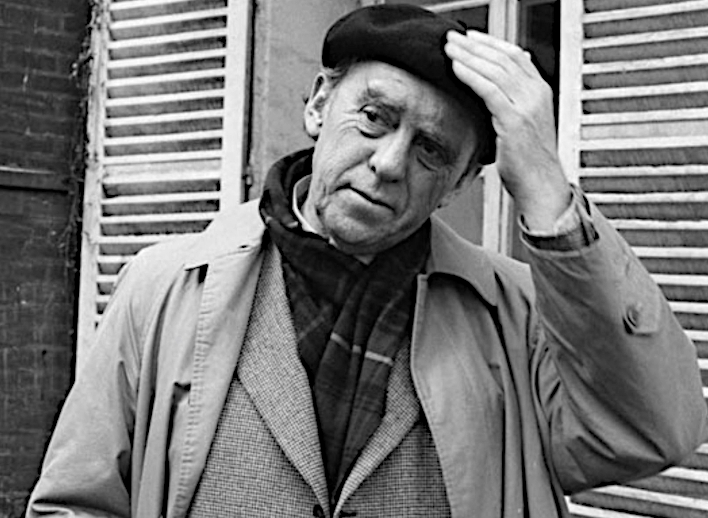
Heinrich Böll, ND.
German text: Heinrich Böll, 'Wo ist dein Brüder?' in Heinrich Böll Werke: Essayistische Schriften und Reden 1 (1952-1963), Kiepenheuer und Witsch, Köln, first published in Geist und Tat : Monatsschrift für Recht, Freiheit und Kultur, 1956
English translation ©Figures of Speech.
Update 14.03.2026
Some context for Böll's speech that may be useful for our readers.
The German invasion of the Soviet Union in mid-1941 marked the beginning of the end for the Axis powers. For the Germans, from that moment on through three more long years of 'Total War', one catastrophe followed another until, at the ceasefire in April 1945, the country emerged in ruins.
Many Germans felt that they were the victims: thirty years after the end of the war many of the older generation were still telling stories of their sufferings, the soldiers dead, mutilated or interned and the civilians dead or mutilated, desperate from hunger and cold. There were tales of mistreatment by the troops of the Allied occupiers.
The south German region where my family and I were living in the seventies had been occupied by the French, not the British, so we could join in the chorus blaming them for everything. To be fair, the occupiers had no idea who they were dealing with – simple German civilians, local nutjobs, partisans wanting to avenge Adolf, fleeing former SS-men, whole battalions which might be hiding in the forests – we can understand their initial paranoia.
The German media at the time used carefully crafted formulaic phrases to refer to the Nazi period that were repeated again and again in news bulletins and discussion programmes, such as the NS-Gewaltherrschaft, the 'National Socialist reign of terror/despotism', phrases which allowed some space for the German people to be oppressed victims, too.
It is understandable that many Germans wanted to forget the whole mess of the Nazi period and World War II and just get on with the rebuilding of their country – they had surely suffered enough. The younger ones in particular, who had played no part in the rise and fall of Nazism, had acquired the Gnade der späten Geburt, the 'grace of late birth' as Helmut Kohl famously told the Israelis in 1983.
As for the genocide of the Jews: During Carneval in February, young boys armed themselves with small bangers they called Judo-Fürze, 'judo-farts'. When I enquired about this strange term I was told in a confidential voice that they used to be known as Judenfürze, 'Jew Farts', but that word… ahem… was now history.
Our next-door neighbour, at the end of the war a very young teenager living in northern Germany, had been drafted into the SS in the final weeks of the war. At the first opportunity he stole a bicycle and rode all the way to his home in southern Germany. We talked about many things, but never the Jews.
Many German writers preferred to write about other things, their readers had had enough of Total War and Trummer, 'rubble' – leave the stones of the rubble unturned. There were some exceptions, one of the most outstanding being Heinrich Böll.
Böll described as no other the trauma of the war and the double moral standards in the period of the 'Economic Miracle'.
[…]
The experience of war and German guilt stand in the midpoint of all his writings. What distinguishes him from the other founders of [the literary association] 'Group 47' is above all his Catholicism and his insistence on moral questions. In his earlier stories, some of which were only published after his death in 1985, he took as an unmissable theme, in contrast to almost all the other contemporary writers, the German mass murder of the Jews.
Böll beschrieb wie kein anderer das Trauma des Krieges und die Doppelmoral in der Zeit des »Wirtschaftswunders«.
[…]
Die Kriegserfahrung und die deutsche Schuld stehen in all seinen Texten im Mittelpunkt. Von den Gründern der Gruppe 47 unterscheiden ihn vor allem seine katholische Prägung und sein Insistieren auf moralischen Fragen. In seinen frühen Erzählungen, die zum Teil erst nach seinem Tod 1985 veröffentlicht wurden, thematisiert er im Gegensatz zu fast allen Gegenwartsautoren unmissverständlich den deutschen Massenmord an den Juden.
From: Helmut Böttiger, Die Gruppe 47, ©2012 by Deutsche Verlags-Anstalt, München, ISBN 978-3-421-04315-3, p. 123.
It took quite some time for the Shoah, the Holocaust, to become a thing for the German public; not just the starvation and disease, the death camps, the gas chambers and the ovens, but the indescribably callous and brutal murder of millions of Jews, particularly in the east (for example in Babi Yar).
When it became clear and irrefutable that the genocide of the Jews was a deliberate political programme, as anyone who read one of the millions of copies of Hitler's Mein Kampf would/should have known, there were no excuses any more.
0 Comments
Server date and time:
Browser date and time:
Input rules for comments: No HTML, no images. Comments can be nested to a depth of eight. Surround a long quotation with curly braces: {blockquote}. Well-formed URLs will be rendered as links automatically. Do not click on links unless you are confident that they are safe. You have been warned!