
Scrapbook for February
Richard Law, UTC 2026-02-01 02:01
25.02.2026 – More website changes
In what is called a 'world-wide-web' it is a surprise how many websites give no indication of their general location or the time zone under which they operate. Most website visitors choose sites in their own region and their own language bubble, so it probably shouldn't be a surprise.
Practising what we preach, visitors to Figures of Speech will now find two date-times displayed in the comments heading at the bottom of each article page, where they will probably be most useful. They are the times when the page was loaded, meaning that they only change when the page is reloaded.

The first of these is the 'Server date and time'. Since the server is in Switzerland this will give you Central European Time, but without a Daylight Savings Time (DST) adjustment.
The second of these is the 'Browser date and time', which will display the visitor's local time, usually with DST.
These date-times are not recorded or stored anywhere. They are formatted in the standard ISO format (a.k.a 'Swedish style') YYYY-MM-DD HH:MM, which avoids the month first USA confusion.
16.02.2026 – And so to Chur
Most things I have written about Switzerland recently have just turned out to be tedious grumbling. That gives the wrong impression, since I can think of no other place that I would rather live.
Today was a good lesson for me in cheerful calm – Gelassenheit, that great Enlightenment virtue – and the Victorian art of counting one's blessings.
I was required to present myself this morning in Chur ('kooor'), the capital of the Canton of Graubünden/Grisons, to carry out some administrative obligations. I have no car, but the journey is easy with public transport: 3 minutes from my house to the Postauto waiting in the village; 20 minutes to the train station; 35 minutes by train to Chur – altogether a little over an hour gliding through a beautiful winter landscape.
Captain Scott sets off
There had been over half a metre of snow overnight, so, setting off at nine-thirty with snowflakes still whirling down, outside my front door I sank up to my knees. It turned out that the 20 metres from my door to the lane were the worst part of the journey – the village streets had already been cleared, as had the road to civilisation down the hillside.
Getting in the bus I must have looked like a man on a mission, since the driver asked me whether I would be taking the train. He radioed ahead to inform the Controller that the train should wait for one of his passengers to arrive; a couple were on their way to the ski-lift station, so he radioed on about their bus connection, too. The whole transport clockwork in this remote region was being tweaked to meet the needs of its passengers.
Despite the slippery road, the chains on the bus, the still whirling snow and dodging the snowploughs doing their job on the narrow mountain road, we arrived at the train station, punctual to the minute. As it happens, there were only ten metres between the bus and the train.
The train hung around for an extra few minutes for other stragglers, then we slid off through the snowy landscape of the Rhine Gorge. Tourists pay good money for this level of sightseeing.
Some spiritual uplift (included in the ticket price)
The world is indeed full of wonders. There are many awe-inspiring, precipitous gorges and canyons, but few of them entwine with a railway line so intimately, on such a domestic scale, as the Ruinaulta, the Rhine Gorge, few are an intimate part of a half-hour journey and few come with such pre-historical drama.
Somewhere between 14'000 and 12'000 years ago, as the last Ice Age faded, the glacier that had completely filled what is now the valley of the Anterior Rhine at the glacial maximum 40'000 years ago had withdrawn to a point past the side of the mountain beneath the Flimserstein. The rock not only lost its support but the permafrost holding the rock was weakening in the warmer climate. A moment finally came when a huge avalanche of shattered limestone slid down into the valley.
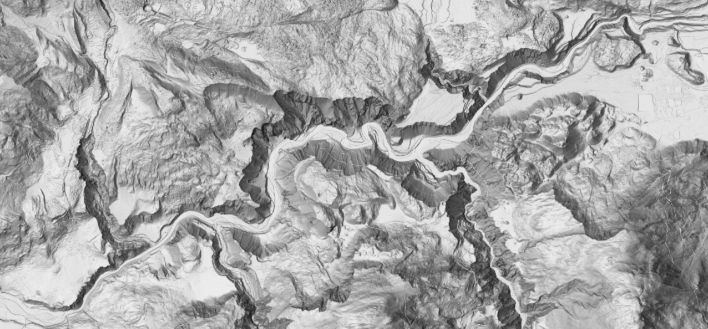
A terrain map of the Rhine Gorge. The meandering Rhine is criss-crossed by the train line. Image: map.geo.admin, data©swisstopo.
The fact that the vanguard of this material ended up some way up the opposite side of the valley suggests that the slide – by far the largest known rockslide in Switzerland – was catastrophically rapid. Any postglacial colonisers who happened to be hanging around there at that time would have stood no chance at all.
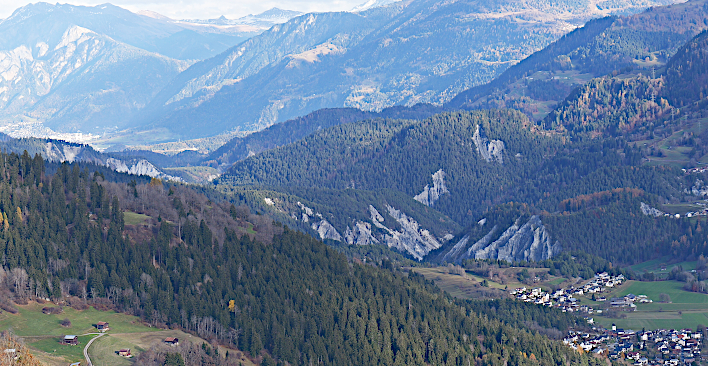
The Rhine Gorge cutting through the humps of the rockslide that occurred about 12'000 years ago. The soil is too dry for agricultural use, only trees can flourish on its surface. Thus it became the great forest that marked the division of the valley into two regions (and linguistic groups): the Surselva, above – i.e. upstream – from the forest and the Sutselva, below – i.e. downstream – from the forest. Image: FoS.
The rockslide had dammed the Anterior Rhine, so that much of the valley upstream was turned into a lake that existed for about 1'000 years afterwards. Over that period the water worked its magic, scraping a meandering channel through the rubble, leaving the landscape as we see it today from our train carriage. Motorists have to drive up over the northern flank of the rubble and experience nothing of the Ruinaulta's geological mystique, whereas we train passengers meander alongside the turbulent, grey-green river, on its way to Rotterdam. Today, though, Chur is far enough for me.
We arrived in Chur, also punctually to the minute. I had a ten minute walk to my meeting, the pavements had been cleared to a few patches of slushy remnants. The meeting lasted 20 minutes. I had time to do a bit of shopping. The journey back was much the same. Buses and trains were all spotlessly clean and comfortably less than half full. I got back to my door at two o'clock precisely.
The journey went like Swiss clockwork, as though there had been no snow. The journey cost me about ten Swiss Francs each way. I love this country.
12.01.2026 – Citation function improvements
On Figures of Speech, content can be easily cited and linked, from entire articles to individual elements in articles. The citing function has been reworked to make it faster and easier to use.
Citing articles
In order to cite an entire article, just double-click on the article's title. The title will fade briefly to show that the citation has been created. The citation will be saved directly to the clipboard, from where it can be pasted in as required.
[Scrapbook for February]
https://figures-of-speech.com/2026/02/scrapbook.htm
Figures of Speech, 'Scrapbook for February', Richard Law, UTC 2026-02-01 02:01
Citing content blocks
Text content can be cited with a link directly to a block element such as a paragraph. Simply select a range of text in the block with the mouse. The text at the beginning of the citation is the text that was selected. The text element will fade briefly to show that the citation has been created. The citation will be saved directy to the clipboard, from where it can be pasted in as required.
[Text content can be cited with a link directly to it]
https://figures-of-speech.com/2026/02/scrapbook.htm#ilCvNo9Vu9J
Figures of Speech, 'Scrapbook for February', Richard Law, UTC 2026-02-01 02:01
Citing non-text elements
A single click on images and most other non-text elements will save a citation to the clipboard. Note that the link goes to the part of the document containing the element, not the element itself. What gets written to the text field is a mystery beyond all human understanding.
[Image]
https://figures-of-speech.com/2026/01/month.htm#ilCkH5ItaBx
Figures of Speech, 'Au Moulin de la Galette, Madeleine', Richard Law, UTC 2026-01-01 04:21
Citation formats
It would be possible to offer citations in standard formats such as MLA, but because there are so many different formats, doing this would introduce too much complexity. The generic citation style used on this website can be easily re-formed into any of the popular citation formats.
A keyboard-only version of this function may be available soon.
0 Comments
Server date and time:
Browser date and time:
Input rules for comments: No HTML, no images. Comments can be nested to a depth of eight. Surround a long quotation with curly braces: {blockquote}. Well-formed URLs will be rendered as links automatically. Do not click on links unless you are confident that they are safe. You have been warned!