
I've got a little list
Richard Law, UTC 2026-05-17 07:13 Updated on UTC 2026-05-26
The Mikado (first performed in 1885) was the most successful musical play produced by the partnership of Arthur Sullivan (1842-1900) and William Schwenck Gilbert (1836-1911), arguably the most successful musical play altogether.
I saw it performed when I was a child and two or three times since. The songs of The Mikado, and of most of the other Savoy Operas, are rattling around my head to this day.
One thing has always puzzled me in the play. It occurs in the first part of the famous 'little list' song, performed by Ko-Ko, the Lord High Executioner. Up until now it has popped into my head whenever I have had no time to investigate it – until now. Here is the libretto for this section, followed by two classic performances, each about one minute and twenty seconds long:
As some day it may happen that a victim must be found,
I've got a little list — I've got a little list
Of society offenders who might well be underground,
And who never would be missed — who never would be missed!
There's the pestilential nuisances who write for autographs—
All people who have flabby hands and irritating laughs—
All children who are up in dates, and floor you with 'em flat—
All persons who in shaking hands, shake hands with you
like that—And all third persons who on spoiling tête-à-têtes insist—
They'd none of 'em be missed — they'd none of 'em be missed!
Chorus. He's got 'em on the list — he's got 'em on the list;
And they'll none of 'em be missed — they'll none of 'em be missed.
There's the nigger serenader, and the others of his race,
And the piano organist — I've got him on the list!
And the people who eat peppermint and puff it in your face.
They never would be missed — they never would be missed!
Then the idiot who praises, with enthusiastic tone,
All centuries but this, and every country but his own;
And the lady from the provinces, who dresses like a guy,
And 'who doesn't think she dances, but would rather like to try';
And that singular anomaly, the lady novelist—
I don't think she'd be missed—I'm sure she'd not be missed!
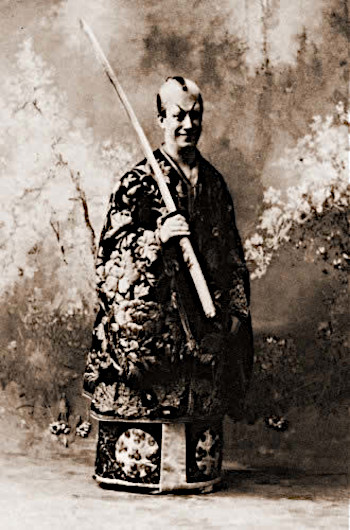
Walter Passmore (1867-1946) as Ko-Ko in 1907. He took over from the very first Ko-Ko, George Grossmith. The samurai sword carried by the executioner is a reminder that it was apparently such a sword hanging in Gilbert's study that gave him the idea for The Mikado in the first place.
Performed by Walter Passmore in 1907.
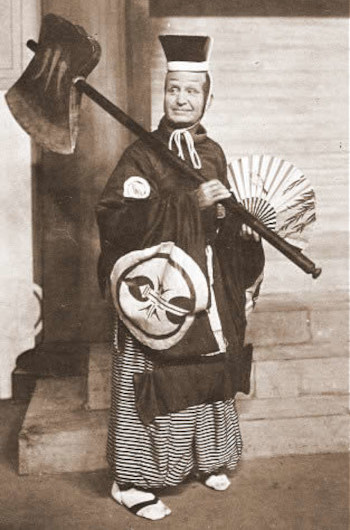
Passmore's successor Henry Lytton (1865-1936) as Ko-Ko in 1926. The samurai sword is gone, giving way to a stupidly oversized axe.With Gilbert now only fifteen years in his grave, the buffoonery he so detested has already begun. Modern productions of the Savoy Operas are generally unwatchable clowning.
Performed by Henry Lytton in 1926.
Did you spot my problem? No, it's not Passmore's replacement of the canonical 'the lady novelist' by 'the lady motorist', or Lytton's variant 'the prohibitionist'. The items in Ko-Ko's list always offered scope for updating. Lytton's recording was done by the American RCA Victor corporation (the G+S operas being very popular in the US) and so included the topical allusion to prohibition. Nor is it the line 'the nigger serenader, and the others of his race', which I shall leave untouched for the moment.
My problem is with this: 'And the lady from the provinces, who dresses like a guy'. A fine solution to a metrical conundrum, but what does it mean? This?
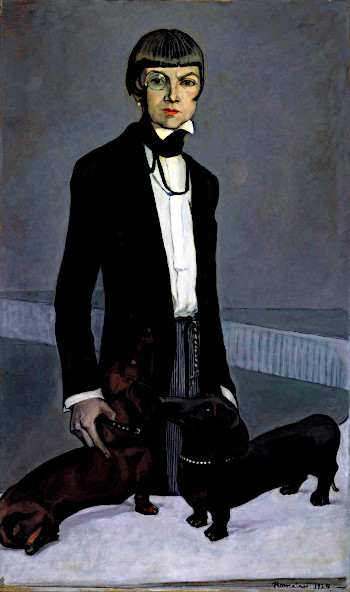
Romaine Brooks, Una, Lady Troubridge, 1924 Image: Smithsonian American Art Museum.
Probably not. There was plenty of this going on at the time, but because it was restricted to the upper classes, no one bothered. Whether Romaine (lesbian) painted Una (lesbian) with love or contempt has never been established.
This cross-dressing stuff is anyway not something we would expect from a 'lady from the provinces' so let's leave it at that.
The American slang term 'guy', now universal, was just beginning to become popular in the 19th century, but we can throw out that meaning of 'guy' along with the cross-dressing stuff, except to note that it would be reasonable for American audiences to assume that 'guy' here was the ubiquitous term for a chap, as in 'Guys and Dolls'.
The OED to the rescue
The Oxford English Dictionary gives us the solution. British speakers would have suspected some connection with Guy Fawkes (1570-1606) and his failed attempt in 1605 to blow up the Houses of Parliament. The OED notes that the traditional usage, which they date as first recorded in 1796, is that guys were the stuffed effigies of old clothes that were paraded on 5 November in Britain to commemorate the deed:
The effigy is typically a scarecrow-type figure, dressed in cast-off clothing or rags, and sometimes accompanied by other similar effigies (representing unpopular people) which are sometimes also referred to as guys.
Being British, I knew all about Guy Fawkes and Bonfire Night and 'penny for the guy' extortion rackets, but never enough to solve the problem properly. The OED does that for me. For a period between 1800–1921 the word guy became applied to:
Guy 1.b. 1800–1921 † disparaging or derogatory. A person with a comically ugly or untidy appearance, esp. a badly-dressed person; a person dressed in clothing regarded as showy or garish. Also: a foolish or ridiculous person; a figure of fun. Obsolete.
OED.
According to the OED, this meaning of guy achieved currency in the nineteenth century, but faded out in the 1920s and is now considered to be obsolete.
Turning to Merriam-Webster we find that the American view of things is much the same, just rather broadbrush:
…The human likenesses burned on the fires came to be called guys. The verb guy 'to ridicule' is derived from this story also. The use of the word was extended to similar figures and then to a person of strange appearance or dress. In the US, the word came to mean simply 'man' and in time 'a person of either sex.'
Gilbert could not have foreseen that his use of 'guy' as the clever solution to his metrical problem would fall into desuetude only a few decades later. That's about it. One more puzzle solved, one more blank filled in:
… so it really doesn't matter!
— So it really doesn't matter.
— So it really doesn't matter.
— So it really doesn't matter, matter, matter, matter, matter!
Ruddigore (1887), the 'patter-trio' with Robin, Despard and Mad Margaret.
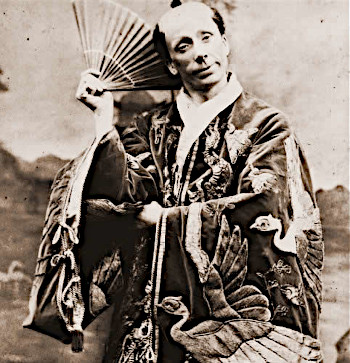
George Grossmith (1847-1912), the first Ko-Ko. His diminutive stature probably caused some amusement in the role of the Lord High Executioner. Grossmith is particularly remembered for his sublimely amusing book The Diary of a Nobody (1892). There is a very fine (and free!) reading of the book by Martin Clifton on Librivox.
Unless otherwise noted, all the Mikado images on this page are from the Gilbert and Sullivan Archive.
Update 26.05.2026
'Nigger serenaders'
At the time The Mikado was created, the term 'nigger serenaders' referred to the topical craze for 'Nigger Minstrels', a term which even I remember hearing in nineteen-fifties Britain. 'Nigger Minstrels' were small musical groups of white men in blackface, playing popular tunes on some assortment of instruments, the music interspersed with jokes and general silliness. For some reason, the alternative to 'nigger' seems to have been 'Ethiopian'.
British readers of a certain age may remember the final manifestation of the genre on British television, The Black and White Minstrel Show, a glamourised and professionalised version of the genre which ran very successfully for 20 years. The men were all in blackface, but not the women; a lot of effort went in to costumes and staging – we are a very long way from the plantation. The show was very popular right until its end in 1978, when its blackface heritage, its USP, finally became culturally insupportable.
Gilbert's dislike of the blackface 'nigger serenaders' of his day is probably genuine. It was low-level stuff, with little skill and poor comedy. No – or almost no – genuine blacks took part. It is worth noting, though, that the 'nigger minstrel' travesty of black culture is not that much different from the Gilbert and Sullivan travesty of Japanese culture in The Mikado itself. The day may yet come when the cultural appropriation crowd will come for The Mikado.
However, the word 'nigger', along with all the other words of ethnic or racial caricature, has become toxic in public discourse – so toxic that it almost impossible for moderns to imagine a time when the word was often used in a neutral sense with no offence intended. According to Colin Jagger, the editor of a recent edition of The Mikado that is based on Sullivan's autograph score, 'nigger serenaders' survived in the D'Oyly Carte performances until 1948, when protests from the lucrative American market over the use of the word 'nigger' became overwhelming.
In 1948 the D'Oyly Carte company commissioned the noted English humourist and writer A. P. Herbert (1890-1971) to suggest alternatives to the toxic passages. His changes were incorporated into the canon, until the copyright on Gilbert and Sullivan works expired in 1961 and D'Oyly Carte lost control; since then the libretto, the music and the staging have been a free-for-all. Herbert's solution of 'banjo serenaders' is worthy of him: it sanitises the 'nigger' whilst not veering far from the original meaning – one or more banjos were a feature of nigger minstrel bands; the thought of a 'banjo serenade' is amusing in itself, being probably the last thing a gal wants under her balcony in the twilight.
In his autograph edition, Jagger has also purged 'nigger serenaders', despite this being part of the autograph text. This took me by surprise, but he reasons that his edition is intended as a score for performances and thus no one nowadays is going to be singing of 'nigger serenaders'. He does discuss the text change in his comments in the complete version of his edition.
Although I understand and agree with his reasoning, the present article has no such restrictions, so I have reverted to the text as originally written, 'niggers' and all. It irritated my pedant's soul having a text which deviated so much from the early sung versions.
For completeness we should mention that 'nigger' also occurs in Act II, No.6 of The Mikado, in which the Mikado goes through his own list of persons suitable for punishment:
The lady who dies a chemical yellow,
Or stains her grey hair puce,
Or pinches her figger,
Is blacked like a nigger
With permanent walnut juice.
'Nigger' is once more used in a descriptive rather than an offensive way. The sanitised version is quite an elegant solution: 'Or pinches her figure, / Is painted with vigour / With permanent walnut juice'.
As recounted elsewhere on this website, in the 1950s, your author, then about seven years old, was conscripted into a variety show put on by the local church as one of a group of nigger minstrels. We wore blackface, striped flannel pyjamas and belted out 'Way down upon the Swannee Ribber' and 'De Camptown Races' etc. These days an arrestable offence.
[I would like to thank Professor Colin Jagger for his extremely prompt and comprehensive response to my amateur enquiries, saving me many hours of research. Colin's vocal score is available for free download from IMSLP and his full score from your usual book source, e.g. Amazon.]
0 Comments
Server date and time:
Browser date and time:
Input rules for comments: No HTML, no images. Comments can be nested to a depth of eight. Surround a long quotation with curly braces: {blockquote}. Well-formed URLs will be rendered as links automatically. Do not click on links unless you are confident that they are safe. You have been warned!