
Mecklenburg-Vorpommern, Berlin takeaways
Richard Law, UTC 2026-09-20 18:40 Updated on UTC 2026-09-21
A two-for-one offer in the German elections department today, 20.09.2026: a state election in Mecklenburg-Vorpommern and a state/city election in Berlin. Let's pour a cup of chamomile tea to steady our nerves and take them one by one.
Mecklenburg-Vorpommern
As with Sachsen-Anhalt, which voted two weeks ago, Mecklenburg-Vorpommern is former DDR territory. It has two pronounced geographical characteristics: the roughly 2'000 km (it's very ragged) coastline with the Ostsee, the Baltic Sea; it is also the German state with the lowest population density.
Its pre-DDR history is complex and not really relevant here, but we should note that the historical Pomerania, particularly during its time as a Prussian province, was traditionally regarded as an educationally and culturally backward region – female servants and menials were often stereotyped by city-dwellers (especially in Berlin) as Pommerinnen, people aus der Provinz 'from the Provinces'.
So let's see where they put their crosses. The first exit poll results:
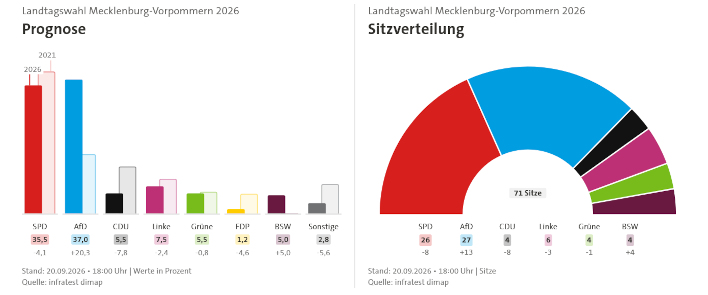
In the early prognosis (18:01) the AfD is ahead, the CDU has only just made it over the 5% bar (meaning big trouble for Chancellor Merz), everyone else, apart from the AfD and Sahra Wagenknecht's BSW has lost votes. In this scenario, the AfD only needs a few seats to be able to form a government, most obviously those of the BSW (a similar situation to Sachsen-Anhalt). Wagenknecht is a mad lefty of the first chop, but opposes mass migration and fighting for Ukraine, making the BSW an improbably good fit for the AfD. She has shown herself in the past to be erratic, so we shall see.
UPDATE 21.09.2026 07:05
During the night some small changes have led to some big changes:
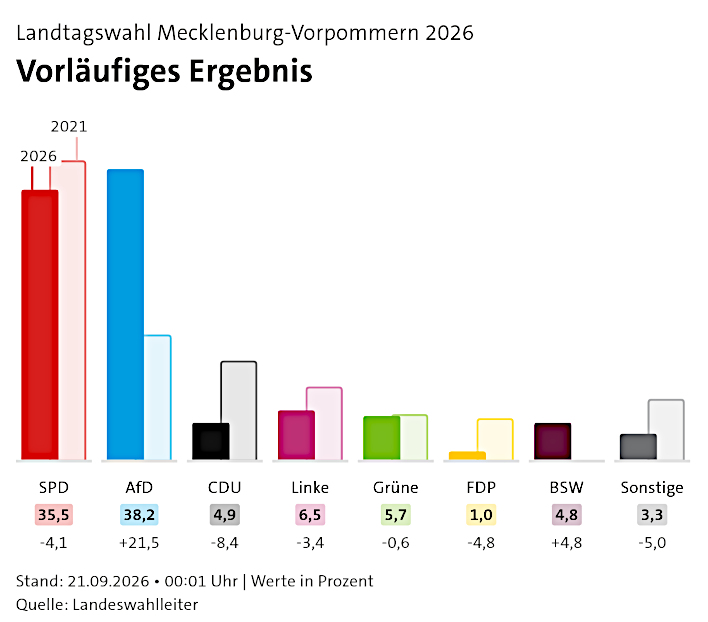
The AfD vote has increased a little. The SPD vote remains the same. The CDU vote has shrunk, so much so that the once great party has failed to cross the five percent hurdle to enter parliament at all. Bang goes the AfD's wish to form a coalition with the CDU. The FDP is now even more humiliated, but most significantly, BSW has also fallen below the hurdle, meaning that a potential AfD-BSW fallback coalition is now off the table.
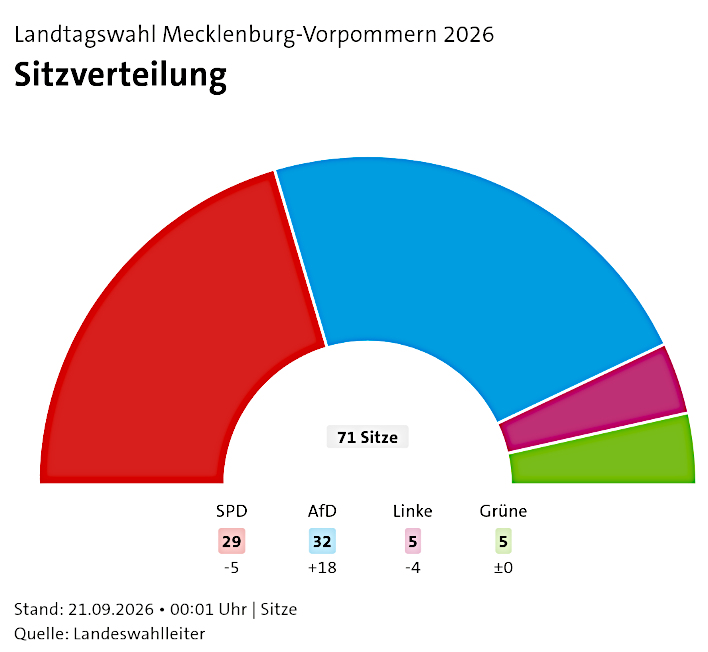
So German coalition politics wins again: The AfD may try to form a minority government but this will be pointless since no other party will ever support them, whereas the SPD could form a coalition with Die Linke and the Greens.
So, a massive turnout of 78.1 percent produces a coalition that is inimical to the wishes of the majority. Thank you, German constitution!
Just to wallow in the misery, let's take a look at the way the Gemeinden, administrative communities, voted:
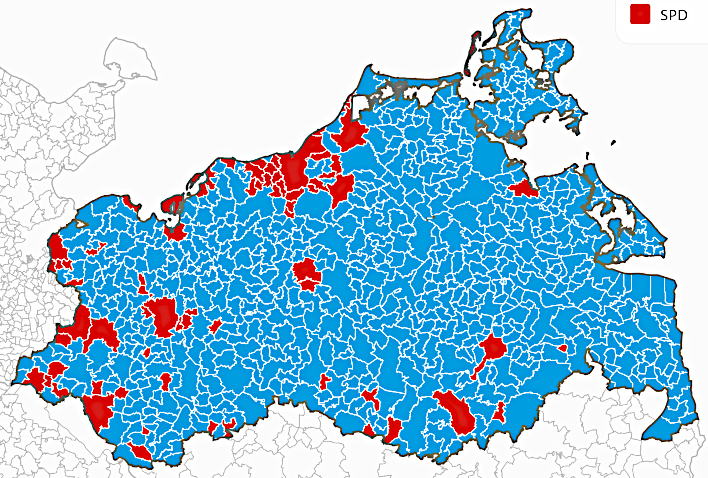
The rural communities want the AfD; the populous communities (red) on the sea coast and the western border with civilisation are old school socialists who will continue to call the tune in this state.
Berlin
The accidental contrast in today's election pair: as already noted, Mecklenburg-Vorpommern is the German state with the lowest population density (c. 70/km²) while Berlin has by far the highest population density (c. 4'214/km²). We can expect a marked division between city and country politics. The theory of overcrowding in rat cages leading to aggression and deviant behaviour holds good in the teeming bedlam of Berlin. Still, let's not be beastly to the Berliners.
Berlin is in big trouble. After the German reunification, which completed in 1990 and in which Berlin became once more the capital of a united Germany, taking over from the sleepy, provincial Bonn, hopes were high and a financial and cultural boom began. It didn't take long before the wheels came off the boom. Without having to write a long-winded and depressing analysis of what went wrong, suffice it to say that the current state of the city, under the control of a black (CDU) and red (SPD) government, is verging on catastrophic.
Almost every aspect of administration and government in Berlin is deeply dysfunctional: traffic is a nightmare, made worse by road closures for major events, frequent demonstrations, state visits and so on; the city centre in particular is disgustingly dirty, with the subway in particular and even the S-Bahn a dirty and dangerous mode of travel, full of druggies and beggers; the dealing and consumption of drugs is open and goes unpunished; the shortage of flats has driven up rents – for those who can find a property – dramatically; the lefties in the Government and administration – of whom there are an awful lot – are now buying up flats into public ownership, making the situation much worse; to cap it all, the deep red mindset has metastasized into an aggressive antisemitism, causing what was a substantial Jewish population after reunification to pack their bags and go somewhere safer.
It is fair to say that extreme left-wing politics has been the motor for this dysfunction. The CDU has been a part of the coalition running Berlin, but – as almost everywhere else in Germany – has given in to the red-green wave.
Here is how they voted. The first exit poll results:
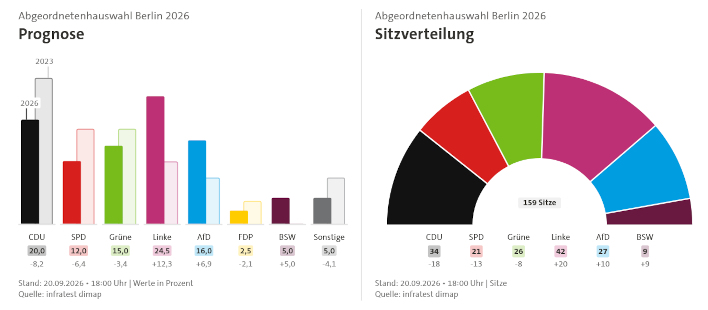
The ungovernable chaos that is Berlin in two simple charts. The Linke will have the first crack at forming a coalition (God help Berlin and God help the Jews), which they can do easily with the SPD and the Greens; everyone else is irrelevant. The AfD has made a good showing in difficult territory. It will have a significant presence, but will simply be ignored or shouted down.
We'll take another look at the situation when the calculated prognosis is available around 20:00.
UPDATE 21.09.2026 07:05
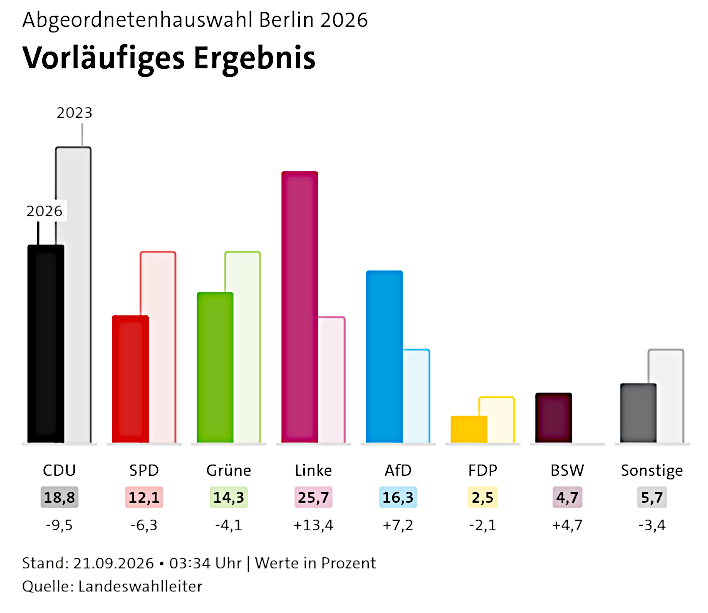
Almost nothing has changed. Die Linke can form a government of all the lefties. The CDU is not needed for this coalition of the crazies; no one will speak to the AfD anyway.
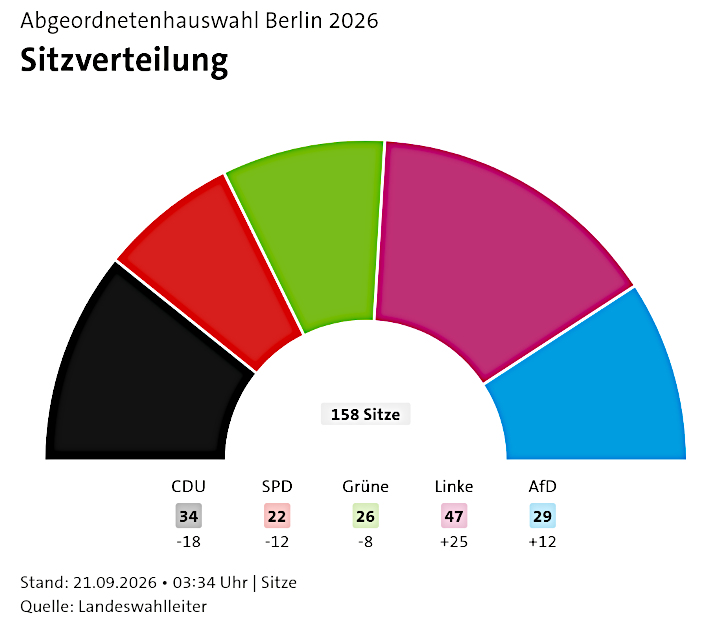
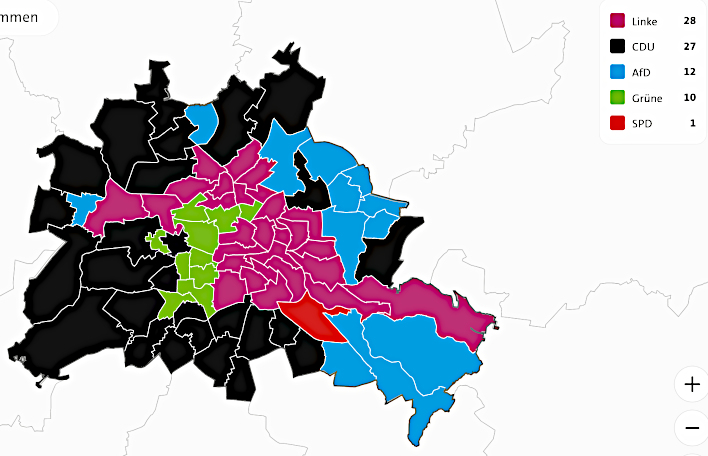
Another five years of lunacy and disintegration in Berlin. The following chart shows the red-green hegemony in the metropolitan core and the CDU/AfD outer ring.
Conclusion
The FoS First Law of German Politics – nothing important ever changes – receives yet one more confirmation. Let us remember that the federal government can soldier on for at least three more years. Even after the present disaster for the CDU, Chancellor Merz, unless shame finally gets to him, can also soldier on regardless. Berlin's cultural and political lunacy is already factored in, so no change there. Even if – if – the AfD manages to get control of Sachsen-Anhalt or Mecklenburg-Vorpommern, those are just two small states which will have no effect at the federal level.
The discontent among the populace will continue and grow. The next federal election may come too late to save the country even if it could.
Charts from ARD.de.
Update 21.09.2026
Revised results as noted in the text.
0 Comments
Server date and time:
Browser date and time:
Input rules for comments: No HTML, no images. Comments can be nested to a depth of eight. Surround a long quotation with curly braces: {blockquote}. Well-formed URLs will be rendered as links automatically. Do not click on links unless you are confident that they are safe. You have been warned!