
AfD progress at the local elections in Niedersachsen
Richard Law, UTC 2026-09-15 10:22
The local elections in Niedersachsen (Lower Saxony) took place on 13 September. Unlike federal or state elections, the results come in from numerous disparate sources and normally take several days to firm up into reliable figures.
Although the FoS First Law of German Politics – almost nothing ever changes – still applies, the results now emerging in Niedersachsen deserve our attention for the following reasons:
- Unlike Sachsen-Anhalt, Niedersachsen is not an ex-DDR state. It has always been a major part of the Bundesrepublik. Also unlike Sachsen-Anhalt, it is a big and important state: it is the second largest state in terms of area and the fourth largest in terms of population. It includes many historical industrial (e.g. VW) and cultural (e.g. Göttingen) centres of excellence. It might be the weather vane which tells us which way the wind blows.
- Politically it has always been regarded as mainstream in the traditional German sense, a stodgy cartel of the CDU and the SPD swapping power.
- The current rapid industrial decline of Germany has left its mark on Niedersachsen, whereas Sachsen-Anhalt arguably never arose enough after reunification to be able now to decline.
- The left-field warfare of the established parties against the AfD was continued with a vengeance for this election. Three AfD candidates were excluded from direct election for lacking Verfassungstreue, 'loyalty to the constitution'; the AfD as a whole was declared to be legally gesichert rechtsextremistisch, 'ascertained as extreme right-wing'. By the time the AfD appeals have been heard, the election will be ancient history.
So what happened on last Sunday, 13 September? This:
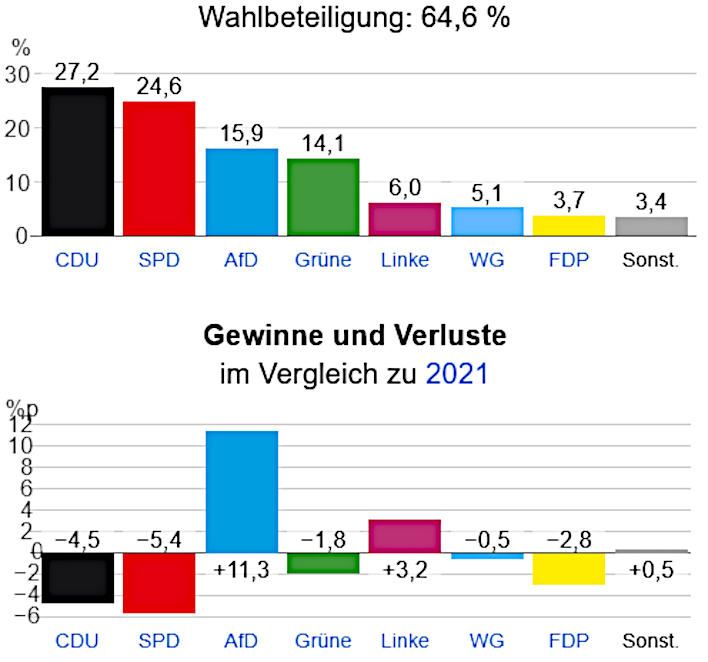
The two political elephants are still there, but sinking towards irrelevance, both suffering marked losses; the FDP, the traditional coalition dealmaker since the Bundesrepublik began, has been obliterated here as it was in Sachsen-Anhalt; the Greens are stuck with their loyal fanclub; the AfD, up to now marginalised in the former West German states as merely a manifestation of grumbling, ungrateful Ossies, has gone from near-irrelevance to become a contender.
The second chart is more illuminating than the first.
I don't believe that it is legitimate to fantasise the 'state of mind' of the electorate from voting patterns, but it is impossible to ignore the discontent with traditional black-red-green politics that have brought once mighty German states to the verge of financial, social and cultural ruin. 'There's a lot of ruin in a country' stated Adam Smith famously – the once great states of Germany are beginning to find out (FAFO as the Americans say), particularly Niedersachsen, home to the once mighty Volkswagen and all the many companies that depend on its business, now reduced to a laughing stock that has almost run out of ruin.
Germans could once be justifiably proud of what their country achieved after the Stunde Null at the end of the Second World War. Now, no one likes being part of a country that dedicated itself politically to the pursuit of ruin.
There are five years more of economic and social decline in Germany before the next Kommunalwahlen in Niedersachsen, which strikes one as a lot ot time and a lot of ruin. Perhaps one day the FoS First Law of German Politics may be seriously tested for once.
0 Comments
Server date and time:
Browser date and time:
Input rules for comments: No HTML, no images. Comments can be nested to a depth of eight. Surround a long quotation with curly braces: {blockquote}. Well-formed URLs will be rendered as links automatically. Do not click on links unless you are confident that they are safe. You have been warned!