
Sachsen-Anhalt, some takeaways
Richard Law, UTC 2026-09-07 10:22
The result of yesterday's election in Sachsen-Anhalt (recte 'Saxony-Anhalt' in English) was eagerly awaited. The polling turned out to be pretty spot on in the most important respects. Unusually for recent German politics the result was relatively unambiguous – the usual suspects will be scribbling their deep thoughts in the media today, to which I add my tuppence ha’penny in the form of a few thoughts here.
1— Well done, Alternative für Deutschland!
The AfD's great result in the Sachsen-Anhalt election is a major step on the party's road to power. The three-party hegemony in Germany – CDU/CSU (rightish), SPD (linkish) and FDP (supposed fiscal responsibility) – arose at the founding of the German Republic and squatted down on the political life of the country (the figure of the grotesquely fat German eagle on the wall of the main chamber of the German parliament is a very apt metaphor for this period. It also looks like a bird that has just encountered a car windscreen on the Autobahn).
The first crack in this stolid passivity was created by the founding of the Green Party in 1980. In the period since, it has gone through several mutations and name tweaks. Despite the continuing internal debate between its Fundis and Realos and its modest roles in coalitions, it has been massively influential in shaping German environmental and energy policies, where it has often been pushing at an open door. Every 'normal' political party and politician has felt the need to decorate itself with the green miasma. The result of forty years of the influence of the party can be seen in Germany's current desperate economic mess.
The second crack in the German consensus was the emergence of the AfD in 2012 and in the Federal Election of 2013. There were a number of other movements which flowed into the AfD, such as PEGIDA, but that's too much detail for the moment. On that occasion it narrowly missed crossing the five percent hurdle to enter parliament. [Do not consult Wikipedia either in German or English on the subject of the AfD, where you will find Wikipedia's extreme left-wing bias in every sentence.]
Just like it was with the Green party, in the early days of the AfD the party was shaken by ideological arguments, but unlike the Greens, the AfD has had to face an almost uniformly hostile media and a state that has used every lever it possesses against it, even having the party investigated by government spooks for being 'an enemy of the constitution'.
In the cause of getting a quick sniff at the doings of this opposition, this morning I took a quick look at the left-wing, Swiss Tages-Anzeiger, which serves the generally red-green population of Greater Sodom, a.k.a. Zurich. There were about 90 comments on the results of the Sachsen-Anhalt election, almost all of which reached a level of derangement that surprised even me. I just looked again now, only to find that the website had wisely switched off the comment function, displaying a note that:
The commentary function has be disabled for this article. For certain subjects we repeatedly receive inappropriate comments, so that despite considerable editorial effort no reasoned exchange of views takes place.
Die Kommentarfunktion ist bei diesem Beitrag deaktiviert. Bei bestimmten Themen erhalten wir wiederholt unangemessene Kommentare, sodass trotz erheblichem Moderationsaufwand kein sachlicher Austausch zustande kommt. Tages-Anzeiger
One of the main reasons that German politics is so static is that that is how it was designed. The embarrassing ease and rapidity with which the National Socialists took control of the entire German state at the beginning of 1933 was in the minds of the authors of the postwar constitution of the Bundesrepublik who did their best to ensure 'never again' with a legal framework that is designed to inhibit change. So that even today, going on for a century later, the AfD's enemies use the word Machtergreifung, 'seizure of power' whenever they can.
The AfD is sick and tired of the constant harping on about the defects of Germany in the 1920s and 1930s to the exclusion of all other aspects of German history and wishes to get Germany talking and thinking about its existence in the 2020s and 2030s. Enough already!
So it is quite remarkable that, despite the courts, despite the hostile media, despite the propaganda shenanigans of its many opponents, the foolish and antidemocratic 'firewall', the smears ('far-right', 'extreme right', 'hard-right'), in the last ten years the AfD has come through almost to win the sole government of a German state. Well done, AfD!
The next election is in Mecklenburg-Vorpommern on 20 September. May the triumph in Sachsen-Anhalt put some wind in the voters' sails and up the powers that be!
2— In Heaven, the Germans (or the Swiss) will run the elections
There is something to be said for an election system which, starting with usually surprisingly accurate advance polling, closes the polling booths at 18:00, issues a very accurate forecast at 18:01 from an exit poll, publishes a provisional result assessment about an hour later (which will usually only change behind the decimal point) and have the final result a few hours later. At the other end of the scale, we recall that California can take up to 30 days to produce final results.
And, of course, an election process which has been, so far, beyond suspicion (unlike California). Probably because they haven't got time to fiddle the results.
3— Political fragmentation
Since the 1990s there has been a gradual fragmentation in the political landscape. A number of new parties have been formed, some permanent no-hopers, but some have been able to cross the five percent threshold and take their place in the German parliament.
The Green Party started this trend and now at most elections, particularly in the territories of the former East Germany, there are seven or more parties in contention. The newcomers have sucked votes away from the historical three 'major' parties. The FDP has fallen so far that it can no longer leap the five percent hurdle to obtain a place in parliament. In the course of the last two decades it has violated its own core principles in order to allow itself to participate in ever more bizarre coalitions.
In the current election in Saxon-Anhalt, the great beasts of the past have suffered dramatic losses from losing votes to the newcomer parties. But most dramatically to the AfD. The once mighty CDU and the SPD have been humiliated; ditto the turncoat FDP; Greens will vote green whatever happens.
The drama is clear: the AfD is only a whisker away from becoming the governing party in the state. In normal circumstances the AFD would make up its numbers with a coalition with the most suitable of the remaining parties and that would be it for the next five years. But since all the other parties have sworn never to cooperate with the AFD German politics is entering new territory. The so-called Brandmauer, the 'Firewall', against the AfD was always anti-democratic chicanery , but with this election, in which the AfD has achieved the support of nearly forty-five percent of the voters, the true absurdity of the Firewall dodge is now embarrassingly apparent to anyone with a brain.
4— First past the post
I was struck by the chart of the results. If this were a first-past-the-post (FPTP) UK election we would be writing of 'landslides' comparable to the Blair landslide in 1997. The AfD would take over with a stonking majority in Parliament and do what it wanted for five years or so.
The hoary old argument against the FPTP system is that the votes for the losers count for nothing. But it is hard to see that a PR system such as that in Germany is any fairer: with today's level of political fragmentation all the losers' votes also count for nothing. Furthermore, when governments are almost always mushy coalitions it cannot be said that any voter got what they voted for: no voter is able to vote for a coalition or even foresee what the coalition will be that is dreamed up by the political masters.
And finally, British voters vote for the people they want to represent them – at least in theory; in practice, of course, they vote for the horse (the party) and the rider (the candidate).
5— Merz v. Siegmund
Perhaps we overthink this politics lark. German voters also vote for the party leader as much as they may vote for the party. The halving of the CDU's vote is without doubt the result of the personality defects of Friedrich Merz, its leader. Not only does he u-turn like a champion, he comes across as grumpy, ascetic and generally unattractive. I have never seen a photograph of him in anything but a dark suit; he's a rich man and could afford to wear much better ties – it might help if he didn't knot them quite so tightly. He's not one of nature's Strahlemänner, 'smiley people'; I can't imagine that anyone, male or female, would voluntarily accompany this man for a beer and a Weisswurst. He may be a bright chap for a hedge fund, but for a political party his defects outweigh whatever virtues he may have (I have yet to see any virtues). I have written about his defects quite a lot: Merzbau, Brandmauer, Bundeskanzler.
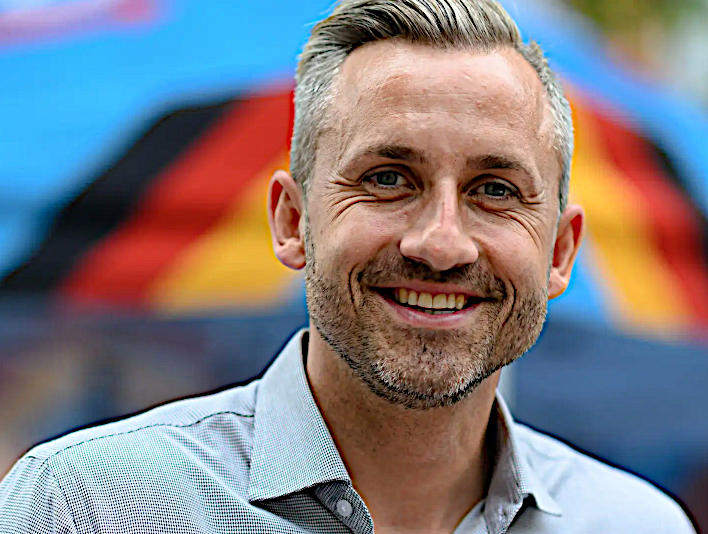
Ulrich Siegmund
In contrast, his AfD opponent is easy on the eye, relatively young, is well-turned out, is able to smile without resembling a shark, is comfortable in the presence of the citizenry, rides an Ossie motorbike, talks well without a script and above all he sounds and seems sincere.
The mad lefty who edits Der Spiegel put his double-digit IQ on show by putting a mugshot-style photo of Siegmund on the front cover of his magazine, readership 637'985 copies, titled 'the most dangerous man in Germany'. It is no surprise that within around 30 years the readership of Spiegel has almost halved. Siegmund handed out signed copies of the magazine.
Yes, let's try him, the voters say.
6— For the record:
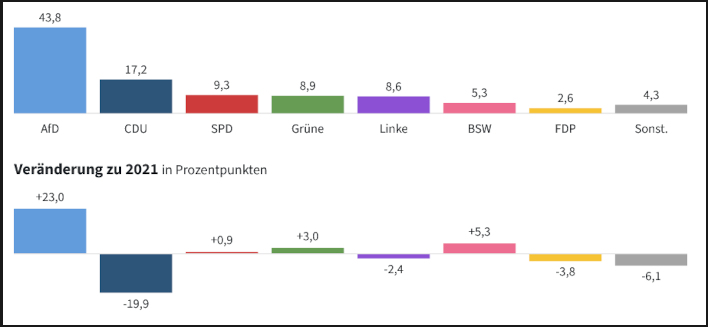
Provisional results 07.09.2026, 03:27.
0 Comments
Server date and time:
Browser date and time:
Input rules for comments: No HTML, no images. Comments can be nested to a depth of eight. Surround a long quotation with curly braces: {blockquote}. Well-formed URLs will be rendered as links automatically. Do not click on links unless you are confident that they are safe. You have been warned!