
Between the millstones of history
Richard Law, UTC 2026-11-22 13:45
Nearly nine years ago on this website I took a dive into the Marxist concept of Basis und Überbau, 'Base and the Superstructure'. This concept – arguably one of the most profound, subtle and useful ideas that Marx came up with – has been largely ignored by his followers, who, it seems, have been more interested in fomenting unrest and revolution than doing a bit of deep thinking.
The ignorance and stupidity of the GenZ kids currently demonstrating in support of their demands took me back those nine years.
Marx's insight can be stated very simply. The means of production form the base on which the culture of a society rests. Loosely rephrased in modern, non-Marxist terminology: the technologies available in our society determine our culture (in the very broadest sense of that word, including the way we think and the way we speak).
A simple example would be the Industrial Revolution, which changed the material base of society dramatically; the production of goods moved from small scale handwork in scattered cottage industries to factories requiring sizeable populations of workers; rail and road networks developed; the shift from country to town initially caused widespread social upheaval and poverty, a phase the German historians call, rather coldly, Pauperismus. No one – no individual or collective or government or group of nations – decreed this huge upheaval: once energy was harnessed, once machines for the automation of production were invented, once transport systems were built, the changes occurred as they had to.
Just to put a bit of flesh on the skeleton thesis, here are some illustrations from Käthe Kollwitz's (1867-1945) best known and magnificent cycle, Ein Weberaufstand (1893-97), 'A weavers' uprising'. The original Weavers' Uprising took place in 1844. Kollwitz was inspired by a famine among the weavers of Prussian Silesia in 1891/92 to produce this remarkable series of illustrations, five of which I reproduce here.
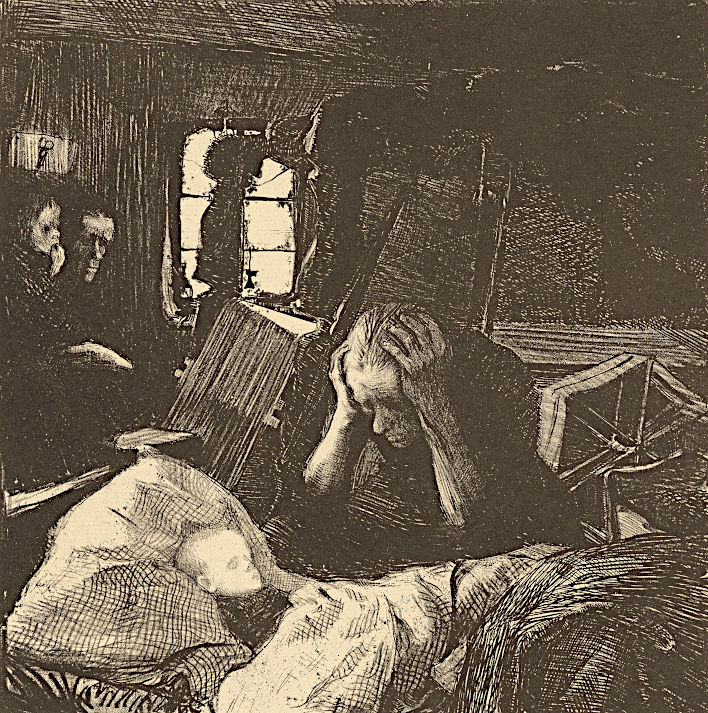
Käthe Kollwitz, Not, 'Desperation', sheet 1 of Ein Weberaufstand, 'A weaver uprising' 1893–97. Image: Kn 33 A III a, Kollwitz Museum Köln, Inv. Nr. 70300/84005. [NB: large, downloadable images are available on the museum's website, Kollwitz Museum Köln, Neumarkt 18—24, 50667 Köln, museum@kollwitz.de]
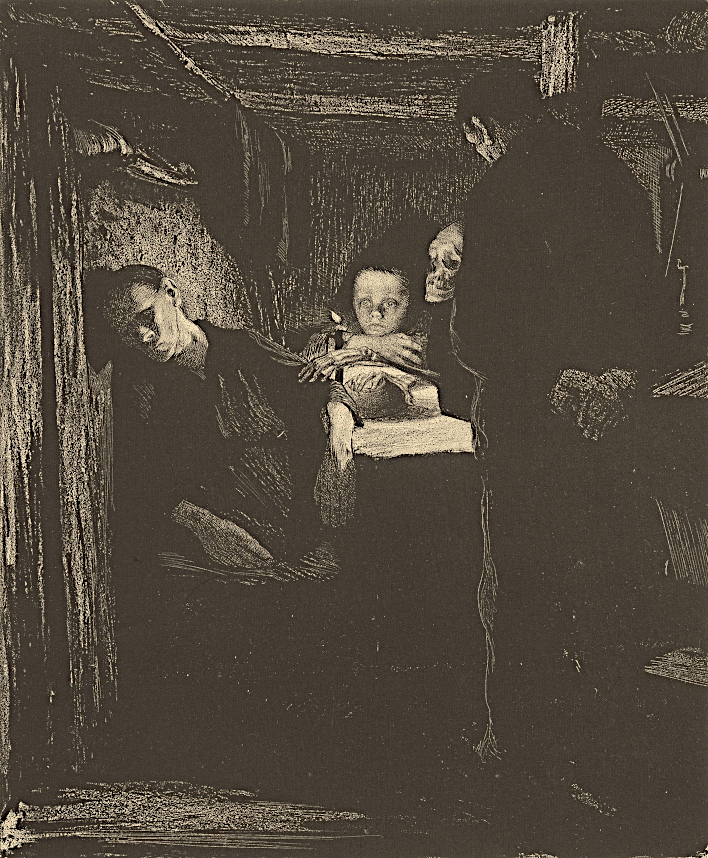
Tod, 'Death', sheet 2. Image: op cit. Kn 34 A b, Kollwitz Museum Köln, Inv. Nr. 70300/90043.
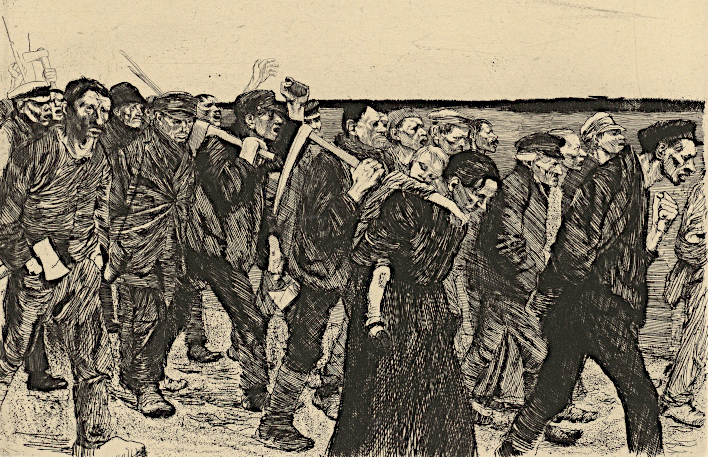
Weberzug, 'March of the weavers', sheet 4. Image: op cit. Kn 36 II a, Kollwitz Museum Köln, Inv. Nr. 70300/84002.
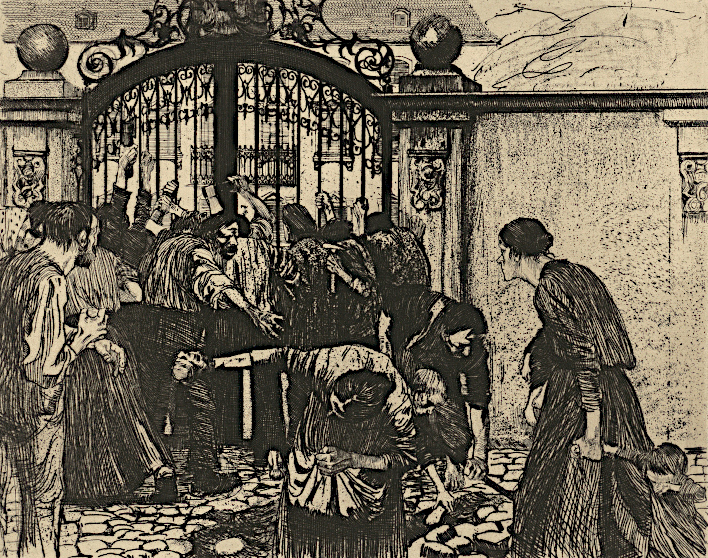
Sturm, 'Attack', sheet 5. The weavers at the gate of the house of the factory owner. They blame him for their misery, but he is just an agent of the technological Zeitgeist sweeping across Europe. Image: op cit. Kn 37 II a, Kollwitz Museum Köln, Inv. Nr. 70300/84003.
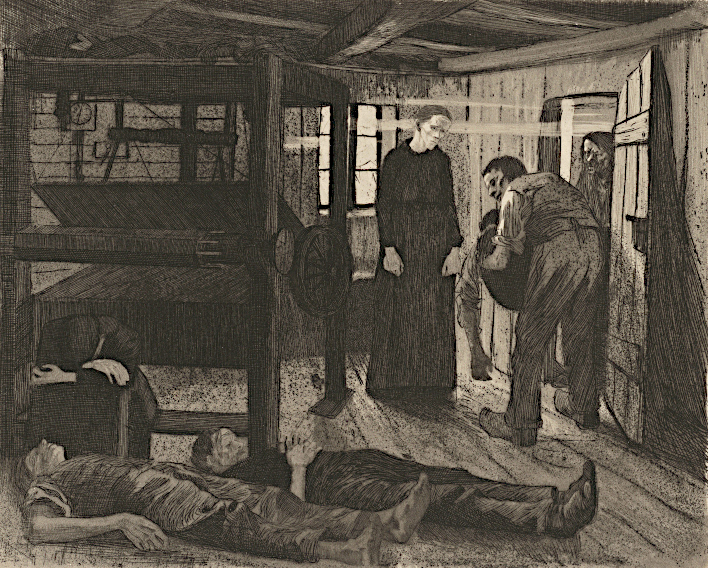
Ende, 'End', sheet 6. The uprising was put down with deadly force by the Prussian forces. In this illustration the dead are being returned to their cottages and laid out alongside their now useless looms, a dead technology. Image: op cit. Kn 38 II a, Kollwitz Museum Köln, Inv. Nr. 70300/84008.

Käthe Kollwitz, self-portrait, c1893. Image: Kollwitz Museum Köln.
Two hundred and fifty years later, neither the Solons who rule over us nor the kids who complain at us have learnt this lesson. Once the base contains an internet and smartphones and social media and AI, the superstructure contains all the associated cultural features, from conspiracy theories to swipe-right hookups to essays authored by bots. Those who think they can shape their culture by banning things are in for a disappointment.
So the GenZ kids of Europe can squawk out all the demands they want – it will have no effect, they get what the base gives them. The conspiracy theorists suspect some global coordination. If Marx is correct, no coordination is needed: the cultural events in the superstructure are determined by the changes to the base.
Whilst we are here, let us note that the global warming scam presents us with an interesting example of the base-superstructure theory in action. The changes in the base have to be useful or advantageous in some way in order to affect the cultural superstructure. The material junk of the scam – the windmills, the solar panels, the wackjob electricity grid that could/will fall over any moment, the attempt to move an entire transport system from fossil fuels to electricity – is clearly in the base. The consequences of all this should be far-reaching changes in the superstructure.
But these changes have scarcely come about, showing us that we are not dealing with Hegelian inevitability. Despite all the fanaticism, very many people resist the new culture and the new, inconvenient and expensive ways of doing things. The textile machines of the Industrial Revolution gave us cheap, affordable fabrics; no one wanted to go back to one-weaver looms in rural cottages. The global warming fanaticism only makes life less convenient, less comfortable and more expensive. It will not survive in the base much longer.
The GenZ kids should pick up their smartphones and embrace the brave new world that is upon them because, if they want to survive and flourish, unlike the Silesian weavers, they had better get with the programme.
0 Comments
Server date and time:
Browser date and time:
Input rules for comments: No HTML, no images. Comments can be nested to a depth of eight. Surround a long quotation with curly braces: {blockquote}. Well-formed URLs will be rendered as links automatically. Do not click on links unless you are confident that they are safe. You have been warned!