
The Valley of the Dead
Richard Law, UTC 2026-06-18 16:22 Updated on UTC 2026-06-22
The oral culture of the Swiss canton of Graubünden/Grisons was particularly rich in mythological tales of the spookier variety. The hang to spooky thinking and superstition was probably a legacy of the centuries of Catholic dominance in the region, but is also due in part to the researches of Dr Arnold Büchli (1885-1970), who spent most of his professional career collecting tales and sagas from the remote villages in the alpine valleys of Graubünden and so preserved these evanescent stories for posterity.
The case we are going to discuss today is taken from volume 3 of Büchli's blockbuster Mythologische Landeskunde von Graubünden (1990), 984 pages that weighs in at a wrist-wrecking 2 kg. This particular tale was communicated to Büchli by Dr Eugen Dedual-Naescher, 1899-1968, Staatsanwalt in Chur, who had family in the village of Burvagn, not far from the location of the tale.
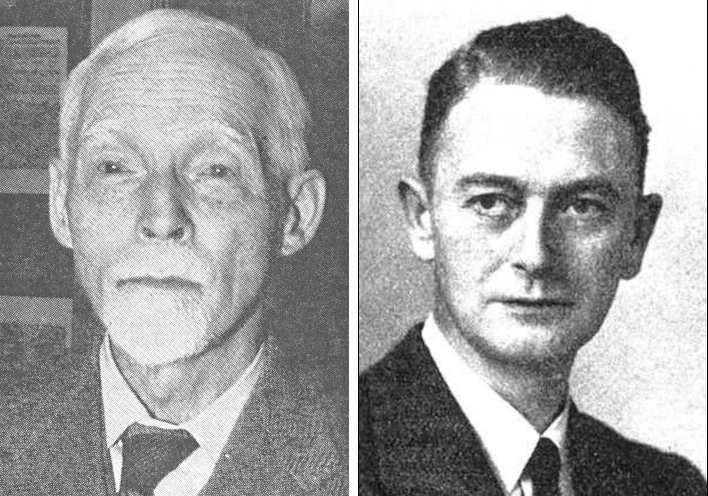
Left: Arnold Büchli (1885-1970), n.d.; Right: Eugen Dedual-Naescher (1899-1968), n.d. Image: Lenzburger Neujahrsblätter Band 43 (1972) / Bündner Jahrbuch, 1969.
Der Totenschimmel
Below Salaschigns, between the beck Adont and Salaschigns, there is a valley hidden to the side called the Valley of the Dead. During the second plague (1629), the dead from the Oberhalbstein and the nearby Albula valley were buried there. At that time the dead were tied onto a white horse, which knew the way on its own very well. The gravediggers came to the Valley of the Dead in order to bury the corpses. And then the white horse returned – without needing a guide.
When people saw the white horse, a shudder went down their spines. People saw the white horse in a moonlit night going clip, clop through the valley. The people were fearful of the plague.
I once went to that secluded, somewhat spooky valley with my sister. At every corner we thought we saw the white horse with its dead body approaching.
Unter Salaschigns, zwischen dem Adont-Bach und Salaschigns, liegt ein gebogenes Tälchen, Val da Morts geheißen, abseits. Darin wurden in der zweiten Pestzeit (1629) die Toten aus dem Oberhalbstein und dem nahen Albulatal begraben. Damals seie di Tote eme Schimmel ufbunde worde, wo de Weg ganz elei gwüßt hei. Und in der Val da Morts sei dann der Totengräber gekommen, um die Leichen zu bestatten. Und denn isch de Schimmel wider zrugg – ohne Führung.
Wenn d Lüt de gsehe hend, de Schimmel, isch ne de Gruse über de Rügge-n-abe gloffe. Me het das wîß Roß – in ere Mondnacht tripp, trapp! – gseh deher cho durs Tal. De hend d Lüt Angscht gha vor der Pescht.
Ich bin einmal mit meiner Schwester nach dem einsamen, etwas unheimlichen Tal gegangen. Um jeden Eggen ume hemmer gmeint, mer gsehe de Schimmel mit eme Tote deher cho.
[NB: Speakers of German-German will no doubt enjoy the way Dr Dedual-Naescher weaves in and out between the high tongue and Swiss dialect.]
Arnold Büchli, ed. Ursula Brunold-Bigler, Mythologische Landeskunde von Graubünden: Ein Bergvolk erzählt, © 1990, Desertina Verlag, 7180 Disentis, ISBN 3 85637188 5, Volume 3, p. 370.
Let's find out first where we are in this tale.
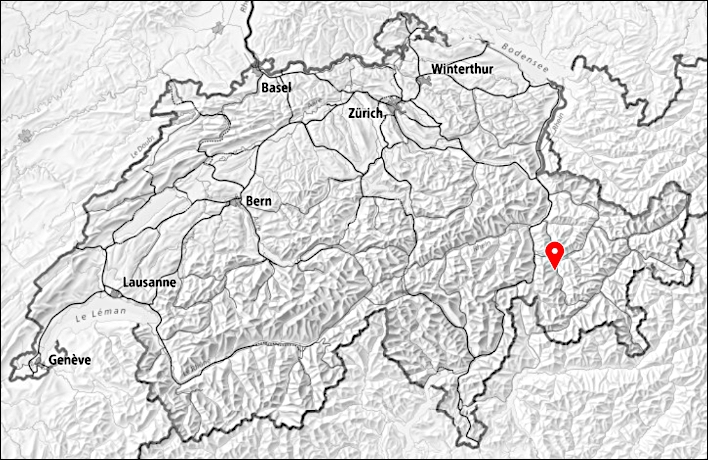
Location of the Val da Morts in Switzerland. Image: ©Swisstopo.
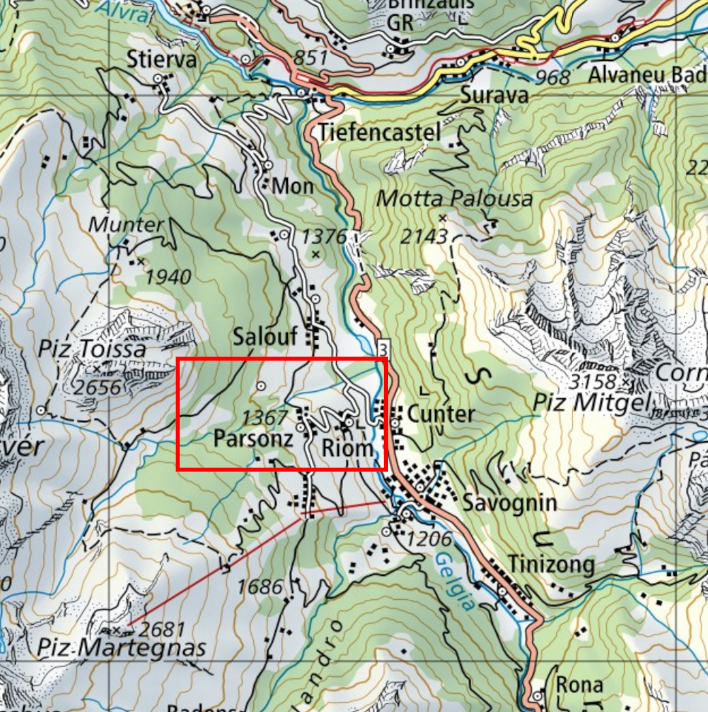
Locality of the Val da Morts Image: ©Swisstopo.
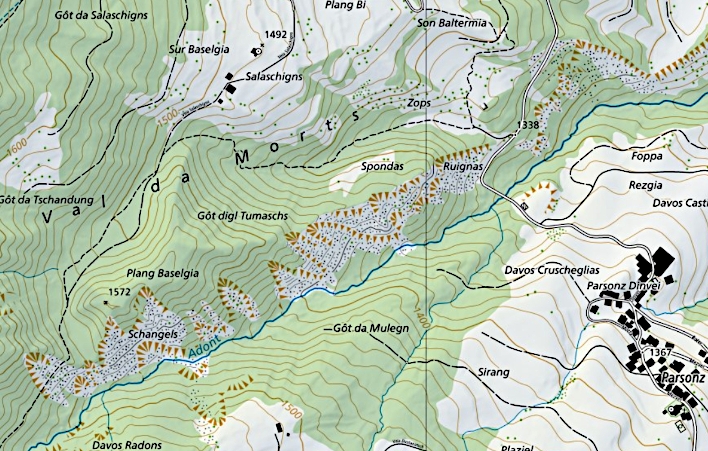
Val da Morts, Salaschigns, the village of Parsonz and the valley of the beck Adont. Image: ©Swisstopo.
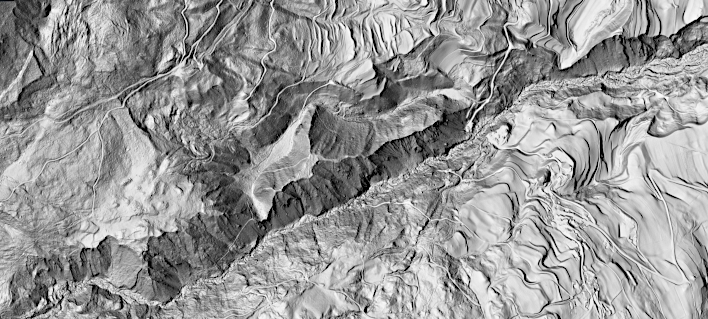
The Adont rises near Ziteil, at the foot of the Piz Toissa. It has cut a slash through the soft deposits and moraines left here after the retreat of the ice sheet. It flows into the Lake of Burvagn and thence into the river Gelgia/Julier. A recent 'micro-hydropower' project now captures most of its water and sends it down a pressure pipe down to a turbine in Burvagn, leaving behind a dribbling nonentity. Image: ©Swisstopo.
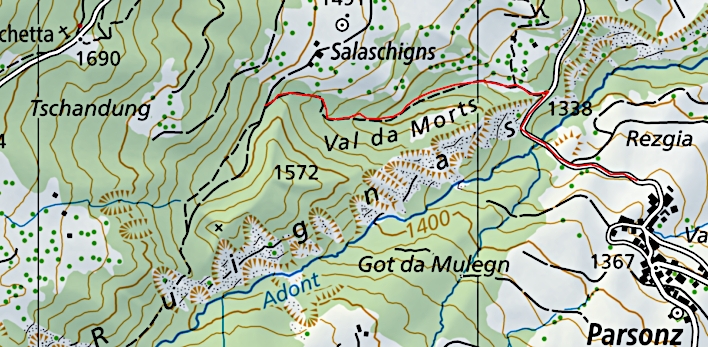
The present day path from Parsonz through the Val da Morts is marked in red. The distance from the outskirts of Parsonz to the top of the valley is a little over 1 km with a 40 metre ascent. The walk takes about half an hour. Image: ©Swisstopo.
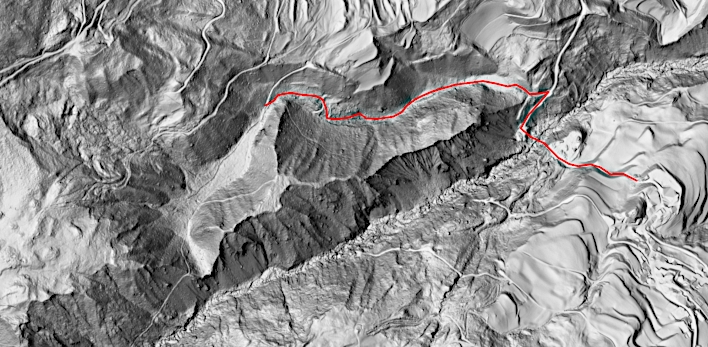
The relief map gives some idea of the drama of the Val da Morts. Image: ©Swisstopo.
Here are some photos of the path through the Val da Morts that I took in 2021. Some remarks are in the tooltip on each photo. Let's take a walk on the wild side:
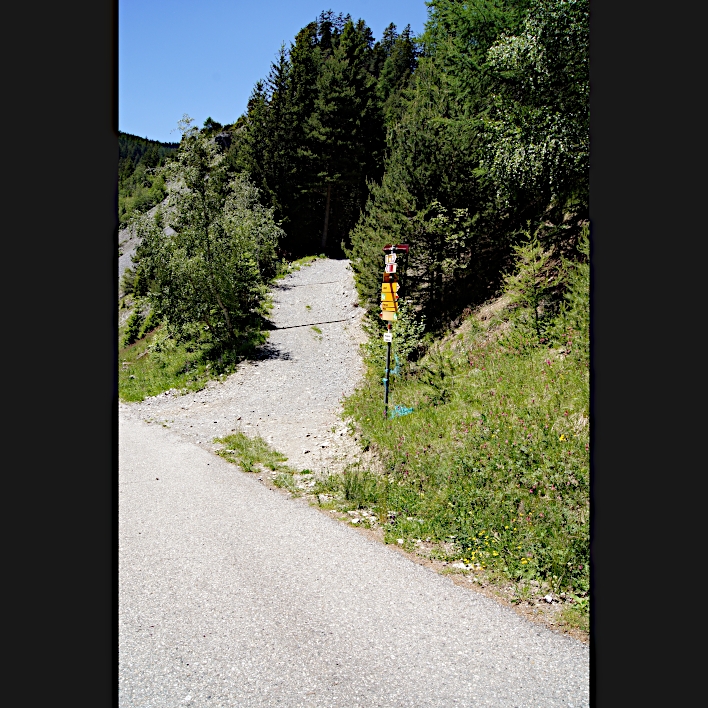


If we now return to Dr Dedual-Naescher's tale we run up against the fundamental problem with such spooky tales: hardly anything makes sense once we engage our brains. Let's review the problems one by one.
Hearsay
The first problem is that Dr Dedual-Naescher (b. 1899) is describing an event that took place according to him in 1629, that is, 270 years before he was born. If we take 25 years as the timespan of a single human generation, we are at a distance of 11 generations from the event. This is not only retailing something someone else told him, it is a game of chinese whispers. I don't know what kind of a lawyer Dr Dedual-Naescher was, but were he to think about it with his lawyer's cap on, he ought to come to the conclusion that his hearsay times eleven was worthless.
But as Dr Büchli would tell us, such tales have their ethnographical value as 'tales of the tribe' [©Ezra Pound]. We still stick at the question: 'How much of it is true?'
Plague notes
It was not until the start of the 20th century that medical science began to understand the cause of this terrible affliction. One highly infectious bacterium is responsible: Yersinia pestis. Depending largely on its mode of transmission, it manifests itself in different forms: pneumonic plague, bubonic plague and the 'black death'.
Pneumonic plague is caused by breathing in airborne droplets containing the bacteria. Winter is a good time for that version, with the sniffeling peasants huddling together for warmth in their cramped hovels.
Fleas are the other main vector, who move on from sucking the blood of infected rats and infect their human hosts. Rats are the usual suspects, but Yersinia pestis is not too fussy about its host victims – dogs, cats, pigs etc. The R&D department of the Maker of the Earth and Sea did some of its best work in designing the sophisticated transmission paths for this bacterium.
Contact with the bodily fluids of infected persons also spreads the infection. The bacterium assembles in the lymph nodes, causing some to swell into the lumps termed 'buboes', hence bubonic plague; sometimes the bacterium spreads into the flesh, causing necrosis of the tissues, hence the term 'black death'. Infectiousness is extremely high, survival rates are extremely low and the disease needs only a few days to kill its victims.
As long as the medical causes of the plague were unknown – that is, throughout human history until the start of the 20th century – the disease was a mysterious curse, some sort of divine punishment. Recall the expression 'a biblical plague'.
The plague of 1629
Dr Dedual-Naescher (presumably) inserted some extra information into his tale: in der zweiten Pestzeit (1629), 'during the second plague (1629)'. By 'the second plague' he seems to be referring to the Second Plague Pandemic, a mighty and disastrous pandemic which eventually affected most of northwestern and central Europe and all in all lasted around four centuries, having begun with the outbreak of the Black Death in 1348.
Of particular interest to us at the moment are the seven outbreaks in Switzerland, each lasting about five years with a fallow period of a handful of years in between: 1563-68, 1574-77, 1582-88, 1592-96, 1609-16, 1628-31, 1634-40 and 1667-69. [ECKERT passim]
Very few places were isolated enough to avoid the plague altogether – one way or another, fleas, coughs or sex, Yersinia pestis would get you in the end. The region of the Oberhalbstein, which encompasses Parsonz and the Val da Morts , is a corridor of busy transit routes over the Julier and Septimer passes between Switzerland and Italy. So it is no surprise that while the Swiss were dying of plague around 1629, the Italian plague of 1629-1631, known as the Great Plague of Milan, was killing Italians at the other end of the pass. Many Swiss men left the poverty of their alpine existence to fight as mercenaries across Europe, at this time particularly in the Thirty Years' War (1618-1648). Returning to their homeland, a few brought their diseases with them.
So we can note that the tale of the Val da Morts contains at least some element of historical reality. That said, we have to take it on trust that the relevant plague is that of 1692.
Collecting the dead
'[T]he dead from the Oberhalbstein and the nearby Albula valley were buried [in the Val da Morts]'. With this assertion, though, our eyebrows shoot up in surprise. I don't have the figures for the plague dead in the Oberhalbstein and Albula regions, but the figures generally correspond to the population of the areas. The death tolls vary from the hundreds to the thousands. It was not unusual to have to bury dozens of dead from a single town in a single day.
Life in the affected towns and villages came to a standstill. Hardly anyone was left to tend animals and crops; no one would be there to even bury the dead. There are tales told of healthy people arriving in almost deserted villages who were then infected from the fleas they encountered there. Given the immense numbers of plague victims, it is simply incredible that they were transported in such numbers from the Oberhalbstein and the Albula to this tiny valley above Parsonz.
Burial
The tale tells us that the corpses of the dead were 'buried there', that is, in the Val da Morts itself. On this matter we cannot suspend disbelief. Of all the places to bury bodies, this narrow, steep-sided, rocky, tree-covered valley is about as unsuitable as you can find: the middle section is particularly steep and rocky and all of it is dense and steep woodland on either side of the path. The valley was formed by the downhill drift of loose glacial deposits, which opened up to create a lateral gorge; there is no stream at the bottom of the valley. Having been through the Val da Morts a few times I can state without fear of contradiction that, although you might somewhere find a nook or cranny to dispose of a body, your gravediggers will surely down tools when the second corpse arrives.
A horse and cart could enter the first 50 metres or so of the Val da Morts as it now is, but beyond that point, the passage of a waggon would be impossible. A single horse or donkey could pass through the valley, a small herd of cows, too, so a placid horse with one or two bodies bound on to it is not unrealistic.
The white horse
The poor beast of burden that has to transport the corpses becomes rather special in this tale – in fact, it is the protagonist. It is exceptional because it is a Schimmel, a white or whitish horse. The word has been in German since the 15th century, possibly derived from the white mould which is its original meaning. Romansh Sursilvan has no special word for a white horse – it is simply a cavagl alv, but the term Schimmel was widely adopted from Swiss-German for noticeably white things; I have heard it used as the nickname for a blonde girl in an otherwise dark-haired family (but the Schweizerisches Idiotikon asserts that the term is only used for blonde-haired boys).
Thinking traditionally, we might expect black to be the appropriate colour for a funerary horse, but in our tale, the white horse is the bearer of the deep, Jungian symbolism of the race. For the profoundly Catholic population, who may have thought in the plague years that the Last Judgement was at hand, it is surely a memory of the 'pale horse' of the Biblical Apocalypse:
7 And when he had opened the fourth seal, I heard the voice of the fourth beast say, Come and see.
8 And I looked, and behold a pale horse: and his name that sat on him was Death, and Hell followed with him. And power was given unto them over the fourth part of the earth, to kill with sword, and with hunger, and with death, and with the beasts of the earth.
'Pale' is the traditional translation. Modern translations sometimes go for 'pale green', hinting at the colour of decay and corruption, but no one in 1629 would have known this. The Bible, King James Version, The Revelation of St John, 6:7-8.
Strictly speaking, the white horse of Revelation 6:2 is the horse of the warrior:
And I saw, and behold a white horse: and he that sat on him had a bow; and a crown was given unto him: and he went forth conquering, and to conquer.
Ibid. 6:2
But the 'pale horse' of Death is the vision that lingers in the memory.
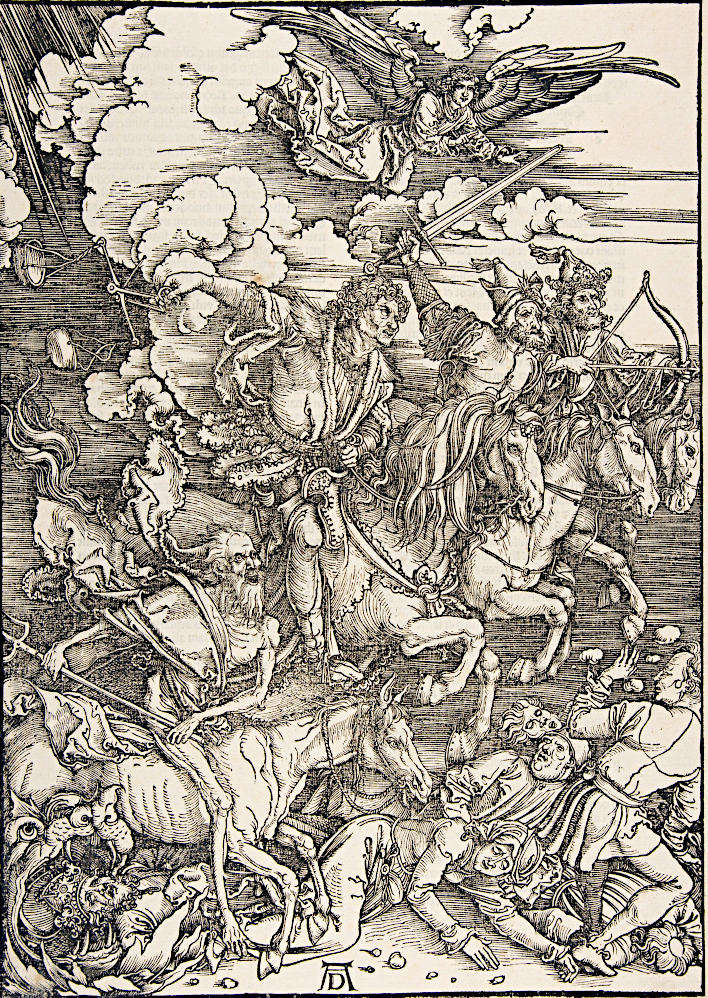
Albrecht Dürer, The Four Horsemen, c1511. Image: Metmuseum.
The restless dead
An attraction of such nonsensical tales as these for the mythically inclined is the fact that they can be decorated with further superstitions according to taste. For example, I heard a short broadcast talk in the Surmiran language some years ago, which proffered a confused fantasy that the Val da Morts was a place haunted by the restless spirits of the plague dead who had been buried there, presumably awaiting their transfer to Heaven. In this telling we hear of a horse (colour unspecified) which knew the way between the town of Savognin (about 2 km from Parsonz) all by itself and brought the bodies from thence in a cart to the Val da Morts, where they were buried:
… The bodies had to be buried as quickly as possible. Load the cart and off you go! The horse knew the route along the Chirgela road to Riom and then up to below Salaschigns. The Valley of the Dead. The grave for all the tormented, unquiet souls.
… Las baras òn da neir sutaradas schi spert scu pussebel. Cargedas segl tgar e dai! Igl tgaval catta tot sulet la veia sur Chirgelas vers Riom vease anfignen sot Salaschigns. La val da morts. La fossa per tot igls tribulos, ormas malquietas.
«Val da morts» da Zegna Pittet-Dosch, Impuls dals 13-12-2020.
This nonsense was delivered on the public broadcaster for Rumantsch, RTR Radiotelevisiun Svizra Rumantscha. There once was a man called Voltaire…
The idea of the restless, unshrivened dead is a particularly Catholic decoration to the story. It arises from the need to perform the Last Rites on the dying to smooth their passage to Heaven. The procedure is a job creation scheme for Catholic priests. It consists of three steps: firstly, an act of penance involving the confession of sins and a state of genuine remorse; secondly, an annointing by the priest; thirdly the so-called Viaticum, the act of Holy Communion. Taking the dying person through these three steps (absolved, anointed and aneled) does not guarantee an immediate entry into Heaven, but the duration of Purgatory may be shortened if the soul is received in a condition of some state of grace.
Whether Purgatory exists – Protestants are sceptical on this point – and if so, where it is, are matters of refined debate among theologians; among the laiety is a very different matter. Simple Catholics have visions of the spirits of the unaneled dead having to hang around awaiting their passage to Heaven. There are numerous places in Graubünden where the superstitious encounter their spooks: the Totentäli, the 'Valley of the Dead' in Alvaneu, the Toten töbeli, the 'Gorge of the Dead' in Grüsch, the Plan dils Morts, the 'Field of the Dead' in Wergenstein and on and on.
We can imagine that, in the plague times, the rather lengthy procedures of the Last Rites were only rarely performed, particularly by a priesthood who were also dying off like flies as an occupational hazard. Enter the Val da Morts, now infested with the souls waiting, perhaps for centuries, for their passage to Heaven. This may or may not apply to the white horse who transported their corpses, who was still spooking around in Dedual-Naescher's head eleven generations later.
The Val da Morts: a path, not a place
What does Eugen Dedual-Naescher's tale of the Valley of the Dead tell us? Nothing – unless it is one more reminder of the bottomless credulity of humans, even – or especially – high-ranking lawyers.
It suggests to us that for a large number of people – and not just the lower orders – the Enlightenment and the Scientific Revolution never happened. They are and were people indoctrinated from their earliest childhood into religious mindsets, what Nietzsche, that fearless rationalist, called by the right name: 'superstition'. It takes a very long time, once superstition and credulity has infected the mind, to purge the nonsense and straighten up and fly right.
Get out, you old Wight! | Vanish in the sunlight!
Shrivel like the cold mist, | like the winds go wailing,
Out into the barren lands | far beyond the mountains!
Come never here again! | Leave your barrow empty!
Lost and forgotten be, | darker than the darkness,
Where gates stand for ever shut, | till the world is mended.
J.R.R. Tolkien (1892-1973), The Lord of the Rings (1954), 'The Fellowship of the Ring', p.153-4. Discussed here.
There are, however, some interesting things that we can rescue from the present example of superstition.
We can begin by recognizing that, however it acquired its spooky name, the Valley of the Dead is not a simple location but a normal path – a route that has been trodden by countless feet down the centuries. The key property of a path is that it goes from somewhere to somewhere else and back. Once we abandon the white horse fairy tale, we are free to look at this path for what it is – a link between two places. Parsonz is at the lower end of the path, but what is at the other end? Where were the countless people whose footsteps beat this path going to and coming from? Salaschigns.
Salaschigns II
An easy five-minute stroll from the top of the Val da Morts will bring you to the chapel of Salaschigns (correctly, the chapel of Saints Bartholomäus and Mauritius). The building is no gothic complexity: it is a very simple, quite squat, white plastered church with a low bell tower with its axis north-east to south-west. The setting, at an altitude of 1'500 m above sea level, is quite spectacular and you will not be surprised that it is frequently used for weddings. A marriage contracted in this paradisical place can only go downhill – everything that comes after can only be a disappointment.
For such an isolated church its interior is suprisingly rich. Here is an assembly of some photos I have taken from time to time.
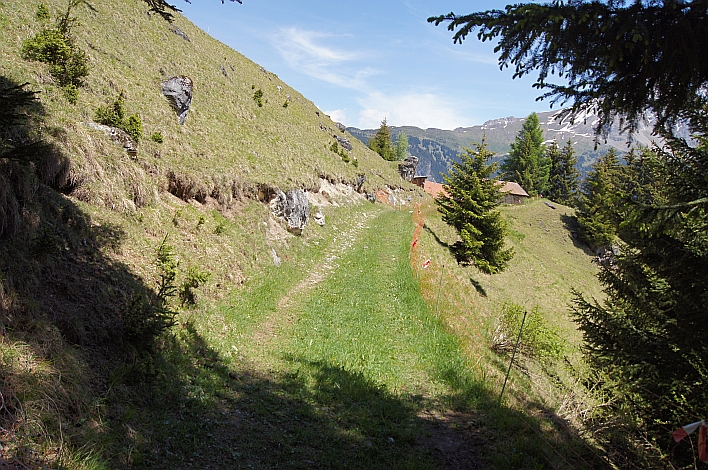


A partial restoration of the chapel was carried out in 2002, the main purpose being to seal the walls against damp:
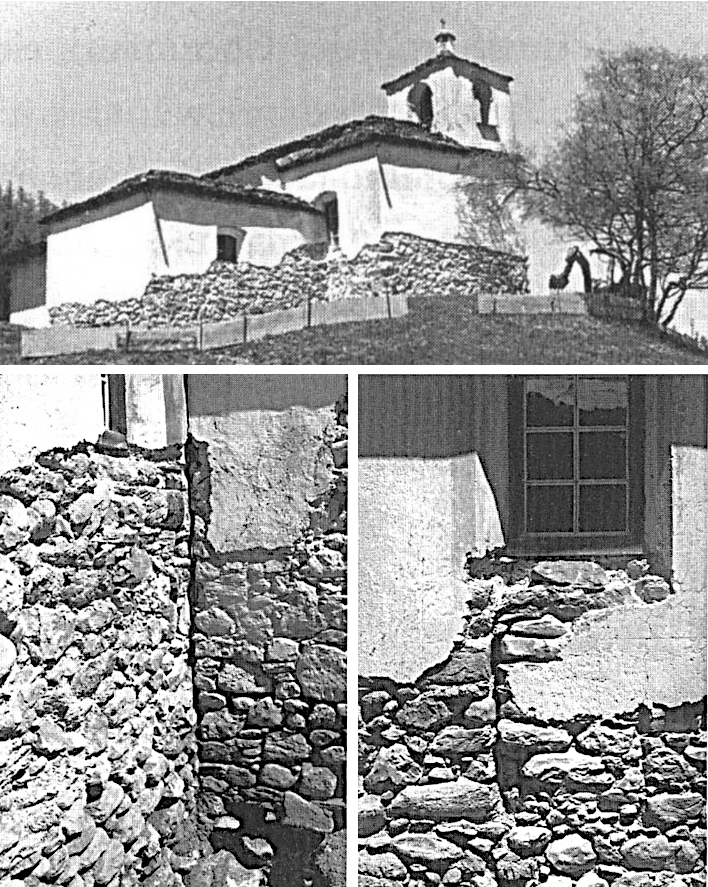
Images of the partial renovation of the Chapel of St. Bartholomäus in 2002. The chapel was built in 1595 and restored in 1662 (33 years thereafter). Image: Jahresbericht des Archäologischen Dienstes Graubünden und der Denkmalpflege Graubünden, Jahr 2002, Author: Jürg Rageth.
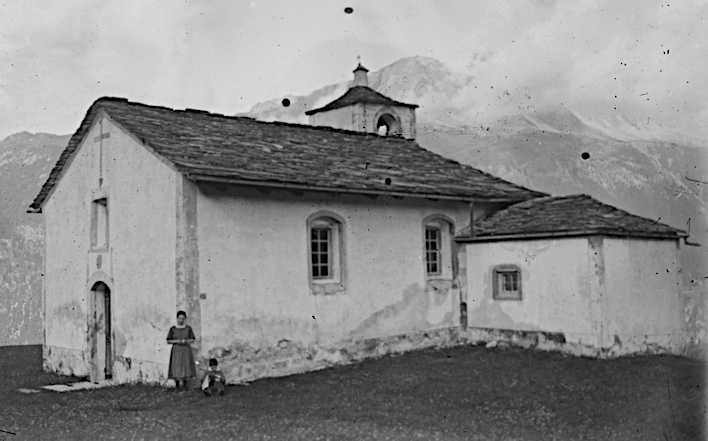
A photo of a woman and and a boy in front of Salaschigns II taken sometime between 1911 and 1950. The traces of the depradations of damp are easily visible on the walls of the chapel. Image: Good, Oskar (1880-1950), FN_XXV-820, StAGR, Staatsarchiv Graubünden.
Let us call this chapel Salaschigns II. It was constructed in 1595 (35 years before the plague year of 1629) and restored in 1662 (33 years thereafter). It was dedicated to Saints Bartholomäus and Mauritius. A recent renovation exposed what lies behind the white plaster: a wonderful example of rough stone masonry resting on foundations that extend up to a depth of 1.10 m to 1.30 m below the present ground level.
The skill with which the relatively small stones are laid together is impressive. From the look of them, the stones were not quarried but retrieved from the glacial debris the Adont had brought down into its bed, one look at them shows that. If that is the case, then there are plenty of reasons to trudge up and down the Val da Morts with paniers of rocks on the beasts of burden.
The rocks from the glacial sediments in this area are principally varieties of limestone. There are several remains in the area of lime kilns for the production of quicklime for mortar, most notably one very intact example close to Burvagn, just a few kilometres away. Since we are on the general subject of disposing of the victims of plague, quicklime is an old school, tried and tested way of rotting corpses. It was very popular in cities as a means to stop the dead polluting the water supply.
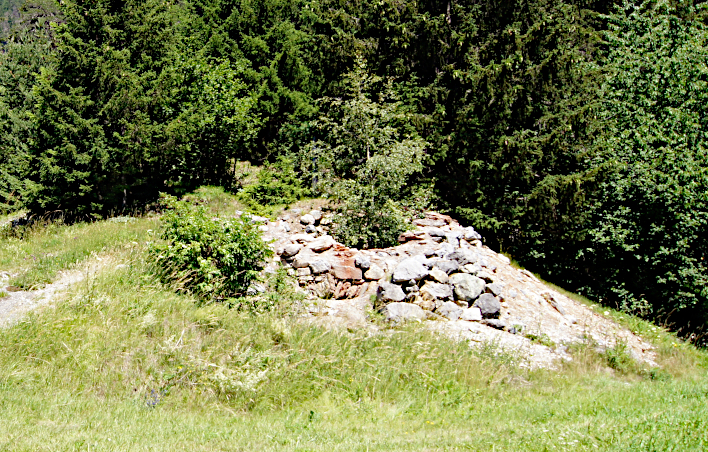
Remains of an almost intact lime kiln at Burvagn, near Salouf GR. Image: FoS
Nowadays, Salaschigns II is open to the world with a mountain road, but that is a relatively recent feature. Before 1886, if you wanted to go to Salaschigns II you would leave the road at its junction with the path through the Val da Morts and walk or ride your horse up the valley. In sum, the path through the Val da Morts was the only easy route to Salaschigns II. The path between Salouf and the pilgrim church at Ziteil went close to Salaschigns II.
Salaschigns I
If there is a Salaschigns II there must have been a Salaschigns I, the alert reader thinks. Indeed there was. The documentary evidence is that the Salaschigns I chapel was consecrated to Saints Bartholomäus and Mauritius in 1508, which was probably also around the year of its construction. It was therefore built nearly a century before Salaschigns II. However Erwin Poeschel [POESCHEL 256], the authority in such matters, notes that the larger of the two bells which hang in Salaschigns II is dated 1487. If this bell was not obtained from somewhere else and passed from Salaschigns I to Salaschigns II it means that Salaschigns I already existed twenty years before it was first mentioned. That is:
- 1487: Construction of Salaschigns I? (bell date).
- 1508?: First mention of a chapel of Salaschigns I? on the Plang Baselgia.
- 1561: Legal adjudication concerning upkeep: um den Unterhalt und Versehung der Kirche St. Georg in Salux [=Salouf] und der Kapellen St. Nikolaus und Bartholomäus in Persons (Salaschigns) (25.06.1561), [StAGR, AI/03b Nr. 144]. St Nikolaus became the parish church in Parsonz.
- 1595?: Construction of Salaschigns II (consecration date). Salaschigns I abandoned and demolished.
- 1662-1665: Renovation and bell tower extended.
Salaschigns I was erected on a small, level plain next to the highest point of the cliffs created by the tumbling Adont. From there it was easily visible from Parsonz and all the countryside around. After a while it became clear that the Adont was gnawing away at the soft cliffs and it would only be a matter of time before the chapel ended up in the stream itself. That small area became known as the Plang Baselgia, the 'Church Plain'. Its position may have been prominent, but it was not so easy to reach as its successor was, which seems to have been located with its proximity to the top end of the Val da Morts in mind.
Salaschigns I seems to have been cleared of its valuables and left to crumble. The replacement, Salaschigns II, was built on a more secure location not far away. It would be surprising if the builders of Salaschigns II did not cannibalise Salaschigns I, a source of stone much nearer than the foaming Adont.
In the meantime, Salaschigns I has vanished without trace. The archeologist Jürg Rageth looked for remains of the site in 2002, but found only a depression where the building might have been [RAGETH 134]. On our historical review of the maps of the site, the final clearing on the Plagn Baselgia has disappeared completely by 2010.
No burial ground is associated with Salaschigns II. It would be a surprise if a chapel such as Salaschigns I had a cemetery, but if it did, this might validate the transport of plague victims on a pack horse through the Val da Morts. However, if we believe the tale that the plague in question was that of 1628-31, Salaschigns II was already built by then and had no facilities for the burial of plague victims, but this assertion has no more evidential basis than the rest of the claptrap in the story. If we choose one of the earlier plague periods, 1563-68, 1574-77 or 1582-88, then the construction of Salaschigns I in 1487/1508, assuming it could process the plague dead in some way, could possibly be a destination at the top end of the Val da Morts. Who knows?
The path worn deep by five and a half centuries of human traffic between Parsonz and Salaschigns could more fittingly be renamed from the 'Valley of the Dead' to the 'Path of the Faithful', thus acknowledging those who have trodden this path in the cause of their faith as surely as any pilgrim to Compostela.
A recent history of the Val da Morts and Salaschigns in maps
The following sequence illustrates the development of the site through its mapped characteristics.
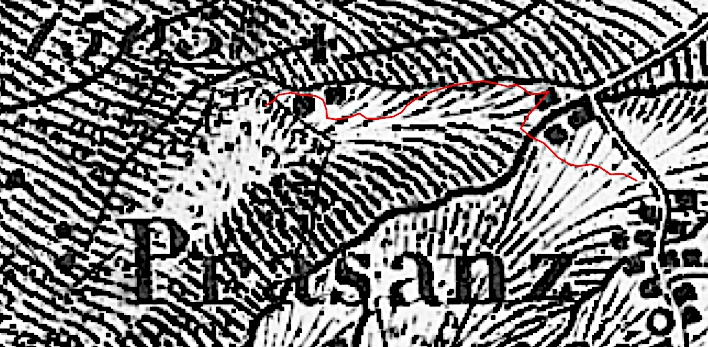


- The 1880 map is the very earliest useful representation of the site, though the limits of cartographic technology are noticeable in the vague positioning of Salaschigns II (the cross symbol), the anciliary buildings and above all the position of the Val da Morts. The course of the present day Val da Morts is given by the red line.
- The 1890 map is much more accurate and informative. The Val da Morts is indicated by name; just to the left of centre we see an intriguing rectangle, presumably a clearing, on the spot now designated as the Plagn Baselgia, this will be a permanent feature until 1970; at this time the 'road' between Salouf and Parsonz meets the Val da Morts just before the bridge over the Adont. This situation will remain the same for the next 80 years, until the extensive roadbuilding works in the 1970s that were part of the general 'amelioration' of the alps.
- The 1970 map is technically more advanced than its predecessors. At the centre left, the mysterious rectangular clearing that lasted 80 years has become an elongated oval clearing; a path that connects it with the main path is now shown, which exists for the next ten years or so and then disappears in 1990, along with the clearing. Salaschigns II and its outbuildings are rendered much more clearly, although the path that connects it with the top of the Val da Morts is not shown; the path through the Val da Morts still begins next to the bridge over the Adont.
- The 1980 map shows the new road connection that resulted from the ameliorations. The situation is now as we know it today, with the junction between the Val da Morts path and the road now some way above the bridge over the Adont.
- The 2000 map clearly shows a new, dramatic collapse in the summit area of the Plagn Baselgia.
- By 2010 the clearing on the Plagn Baselgia has disappeared completely and the rock collapse has consolidated.
Coda
Since we have today been pondering the Vergänglichkeit, transience, of humans and their buildings, let's finish poetically:
In my beginning is my end. In succession
Houses rise and fall, crumble, are extended,
Are removed, destroyed, restored, or in their place
Is an open field, or a factory, or a by-pass.
Old stone to new building, old timber to new fires,
Old fires to ashes, and ashes to the earth
Which is already flesh, fur and faeces,
Bone of man and beast, cornstalk and leaf.
Houses live and die: there is a time for building
And a time for living and for generation
And a time for the wind to break the loosened pane
And to shake the wainscot where the field-mouse trots
And to shake the tattered arras woven with a silent motto.
T.S. Eliot (1888-1965), 'East Coker', from Four Quartets, 1940.
References
- ECKERT: Edward A. Eckert, 'Spatial and temporal distribution of plague in a region of Switzerland in the years 1628 and 1629', Bulletin of the History of Medicine, Vol. 56, No. 2 (Summer 1982), pp. 175-194, The Johns Hopkins University.
- POESCHEL: Erwin Poeschel, Die Kunstdenkmäler des Kantons Graubünden, Band III, 1940,1975.
- RAGETH: Jürg Rageth, Jahresberichte des Archäologischen Dienstes Graubünden und der Denkmalpflege Graubünden, Band (Jahr): 2002.
Update 22.06.2026
A few small corrections for clarity and accuracy. Added photos of Büchli and Dedual-Naescher. Added a full citation to the RTR broadcast «Val da morts» da Zegna Pittet-Dosch. Added the early photo of Salaschigns II showing the problem with damp. Added citation to StAGR, AI/03b Nr. 144 re Salaschigns I.
0 Comments
Server date and time:
Browser date and time:
Input rules for comments: No HTML, no images. Comments can be nested to a depth of eight. Surround a long quotation with curly braces: {blockquote}. Well-formed URLs will be rendered as links automatically. Do not click on links unless you are confident that they are safe. You have been warned!