
A storm in a coffee cup
Richard Law, UTC 2026-10-10 12:14
'Five poems to read with your morning coffee' was the Telegraph headline to an article by Lucy Thynne, the paper's Deputy Literary Editor.

Lucy Thynne, poet and the Deputy Literary Editor of the Telegraph. Image: Telegraph.
The subhead told us that:
Every Monday, we publish a new poem that you can enjoy – and be challenged by – in a couple of minutes.
That was on Monday 5 October 2026. Since then eleven Mondays have been and gone and, despite the timetable present tense of the announcement, so far readers have been 'challenged' by a total of only five poems. Must try harder, Lucy.
At the time of writing this, 479 readers have commented on this project. The vast majority of them did not 'enjoy' the poems in Lucy's selection, nor did they feel 'challenged' by them – they disliked them with a vengeance. I have to agree.
Lucy's first choice was 'Adlestrop' by Edward Thomas, inconsequential emoting without metre but with an odd rhyme scheme.
After that lowpoint, her remaining four choices just went down the skill scale, being just woke, soppy prose with meaningless line-breaks – with one exception, Henri Coulette's rhymed but ramblingly incoherent poem 'Intaglio'. For her five choices she deserved all the criticism she got.
Perhaps, wounded by the reactions of the insensitive knuckle-draggers who read her article, she has given up on the task of arriving in her office every Monday morning and choosing a skinny latte poem from nearly a thousand years of English versification that her readers would enjoy.
Commenter Leigh Stewart reproduced 'Mid-Term Break' by Seamus Heaney, showing that no-scan, mainly no-rhyme can just about work in the right hands:
…
He lay in the four-foot box as in his cot.
No gaudy scars, the bumper knocked him clear.
A four-foot box, a foot for every year.
Just about.
Ezra Pound, master metricist, †01.11.1972
In the search for poets who 'challenge' us, we now arrive, 'by commodius vicus of recirculation' (©James Joyce, Finnegans Wake, my copy bought in 1965, 61 years ago, just before that 'summer of love'), at the first day of this coming November, All Saints' Day, which will be the 54th anniversary of the death of Ezra Pound, 87 years old, in Venice in 1972. If you survived that sentence, you are now ready for what is to come.
Pound's masterwork is his Cantos. Inspired by Browning's great unread (and nowadays unreadable) 'Sordello', Pound wanted to write a long poem. Well, he managed that: beginning in 1917 and scribbling for forty-five years his Cantos filled just over 800 pages – your Monday morning coffee would be very cold by the time you got through that.
Lucy could find plenty of things to fill her Monday morning spot in Pound's earlier, shorter works and there would be plenty of challenging going on with them. She herself probably finds Ezra's mid-life adoration of Benito Mussolini 'challenging'. If she could get past that little problem, the monstrous Cantos also offer many quotable nuggets that could be ripped out of their contexts.
But today, as we approach the anniversary of his death on All Saints' Day, let's ignore Lucy's coffee-time limitation and take a very high altitude look at the Odyssean theme in the Cantos, a work that puts all Lucy's scribblers in the shade. We shall also answer the question, raised by the Telegraph's commentators, whether unrhymed and metrically irregular text can still be poetry.
You will be delighted to hear that I am not going to present a tour through 800 pages of sometimes annoyingly obscure poetry, but I'll just select a few short passages concerning one of the main organizing themes of the Cantos to lay before you as examples of what great poets can do when they hit their stride.
As already noted, in Lucy's article, the chorus from the commentary box was that the poems in her selection, with the exception of Edward Thomas' and Henri Coulette's weak efforts, neither scan nor rhyme. Therefore they are not poems. They just look like poems because of their line-breaks.
Setting the bar
The problem goes much deeper than the printed form with the pointless line-breaks: the ideas behind the poems are also pedestrian or parochial. In contrast, almost nothing in Ezra's great Cantos is rhymed or follows a fixed metrical scheme, but he is operating at a level that only the greatest poets in English attain in handling issues that are important, difficult and indeed 'challenging'.
We don't have to search long for the Odyssean theme to surface in the Cantos. Here are the first seven lines of Canto I:
And then went down to the ship,
Set keel to breakers, forth on the godly sea, and
We set up mast and sail on that swart ship,
Bore sheep aboard her, and our bodies also
Heavy with weeping, and winds from sternward
Bore us out onward with bellying canvas,
Circe’s this craft[1], the trim-coifed goddess.
At first glance; no rhyming and no metrical structure – until, that is, you read it properly:
And then went down to the ship,
set keel to breakers,
forth on the godly sea,
and we set up mast and sail on that swart ship,
Bore sheep aboard her,
and our bodies also
Heavy with weeping,
and winds from sternward
Bore us out onward with bellying canvas,
Circe’s this craft,
the trim-coifed goddess.
Pound has given us the famed 'surge and thunder' of the Homeric original, the rush and withdrawal of the sea on the shores of the Peloponnese and the Ionian Islands. I don't need to mark up the metre for you – it will come completely naturally to you, which quality being the mark of a great poet.
It was brave of him to begin his long poem with 'and', but it was metrical genius to use 'and' as the marker of the start of each incoming wave. Note how, as the ship takes to the water, the wave rhythm changes to something much slower – the long tow of the surface wave.
Here, at the beginning of his labour of forty-five years on his masterpiece, he was still quite traditional in his arrangement of text on the page; as he progressed, however, he became much more aware of what modern literary scholars call the 'iconicity' of his text – the arrangement of text elements on the page in order to reinforce or communicate meaning. You will see what I mean when we go on a bit further. Ezra got to iconicity long before the literary scholars did.
Odysseus is at the starting point of the work, here invoking the aid of the ghost of the sage Tiresias to tell him his route back to Ithaca, his home country. Its Homeric source is the beginning of Book Eleven of the Odyssey.
As instructed by the witch Circe, Odysseus and his crew sail to Oceanus, the edge of the world and the location of Hades. They dig a pit and sacrifice the sheep, so that the blood flows into the pit and calls up the ghosts dwelling in Hell. Note that the Greek Hell is not a place of punishment, its occupants are merely powerless wraiths. Odysseus moves among the ghosts until he finds Tiresias, who tells him of the journey he must now take to get back to his home.
Ezra himself said that this scene shouts out the antiquity of the tale; it is a scene from the foretime of the Classical world: blood smeared ditches, wraiths and incantations.
In the bed of the witch
We now jump forward a little over 230 pages to our next exhibit of poetic magnificence: the opening of Canto XLVII. By now, Ezra has hit his stride in his monster poem. The surge and thunder of the sea coast is not required, but the text is a remarkable poetic compression of this key moment in the Odyssey:
Who even dead, yet hath his mind entire!
This sound came in the dark
First must thou go the road
to hell
And to the bower of Ceres’ daughter Proserpine,
Through overhanging dark, to see Tiresias,
Eyeless that was, a shade, that is in hell
So full of knowing that the beefy men know less than he,
Ere thou come to thy road’s end.
Knowledge the shade of a shade,
Yet must thou sail after knowledge
Knowing less than drugged beasts. phtheggometha
thasson
φθεγγώμεθα θãασσον
Ezra is being quite unhelpful here. The passage would be much easier for the normal reader to decode had he put quotation marks around line 1 and then between 'First must though go…' and '…drugged beasts'.
In the Odyssey this scene takes place in Book Ten, before the scene of the ship launching right at the beginning of Canto I that comes from Book Eleven. The narrative of the Odyssey itself, remarkably so for being the first great narrative of European literature, is also non-linear.
Odysseus' crew, as a result of a stupid lack of caution, have been turned into pigs by the witch Circe. 'phtheggometha thasson' / φθεγγώμεθα θãασσον[2], 'let us call out to her', is what they said when they heard the singing of Circe and went rushing to meet her. Pound's use of the Greek here, in transcription and original, is not showing off. He is forging links to the origins of the story he is adapting.
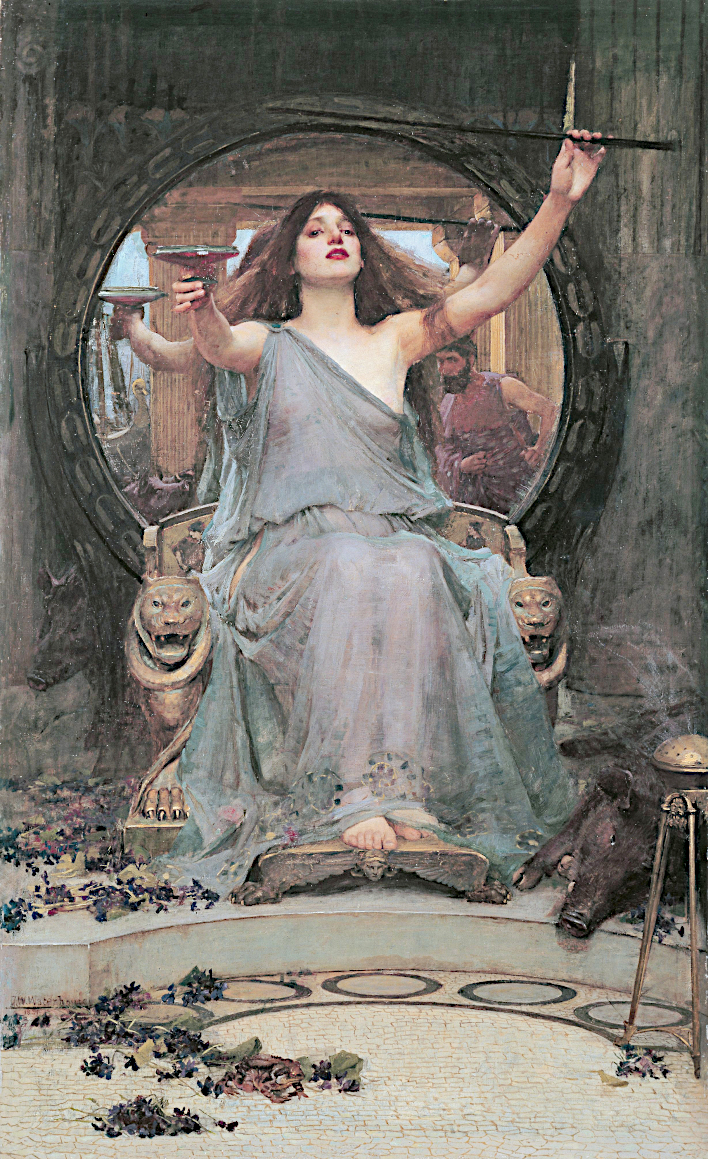
John William Waterhouse (1849-1917), 'Circe Offering the Cup to Odysseus', 1891. The witch imagined as a Pre-Raphaelite chick. Image: Gallery Oldham UK.
Odysseus, favoured by the goddess Athena, was forewarned by Hermes, who gathered the herb Molü for him, the antidote to her poison. Every Homeric hero, no matter how smart, needs a divinity on his side. Odysseus overpowers the witch, forces her to free his men and to swear an oath not to harm them further. In accordance with Hermes' instructions, he ends up in bed with her, a habit which he, stout yoeman, keeps up for a year. After a year of wining and dining and whatever, chez Circe, the crew's desire finally to be on their way home forces Odysseus to act. This is the point at which this episode begins.
Asked by Odysseus to help him and his men to get home she tells him [go and ask Tiresias,] 'who even dead, yet hath his mind entire!'. Ezra, always keen on condensing language to its incomprehensible minimum – and beyond, where possible – leaves the reader to work all this out alone. But once you have worked it out, it is a magical incantation that will stay with you forever. That being the point of poetry, not simply a couple of minutes' distraction while you drink a coffee.
In 'This sound came in the dark' the narrator signals the bedroom scene, after which Circe's instructions continue. The 'drugged beasts' is, of course, a reference to Odysseus' crew, the foolish gang who drank her potion.
I hope you noticed the way the phrase 'to hell' dangles free on the page. This is a very good example of Pound's experiments with iconicity. Odysseus has asked Circe to tell him the way home: 'First must thou go the road…', so far so good, then, after a visual break, '…to hell', which is certainly not what Odysseus or we were expecting. In fact, it is terrible news. Robert Fitzgerald translated the moment well:
At this I felt a weight like stone within me, and, moaning, pressed my length against the bed, with no desire to see the daylight more.
You can imagine how his crew reacted when he told them where they were sailing to next. So when you read this passage in the Cantos put your trust in Ezra and put in a slight pause after 'road'.
The attentive reader will also be struck by Pound's utterly brilliant condensation of the attributes of Tiresias: 'Eyeless that was, a shade, that is in hell / So full of knowing that the beefy(!) men know less than he'. Perfection! Changing one word would ruin it.
Moth flies over mountain
The rest of the Canto is a magnificent erotic comparison of male and female sexuality. If you were wondering how Odysseus managed to end up in bed with the beautiful witch, the present section will give you an answer. The Odyssey has Hermes insisting that Odysseus must perform the act of darkness with Circe as one of the conditions of his immunity from her magical powers, but we chaps suspect that he didn't need telling twice.
It is too long to explore here, but it is relatively easy reading and contains a torrent of wonderful expressions. The metrical surge and thunder has been replaced by an impressively subtle metrical flow, underscored by the iconicity of the text.
It all presents a profound philosophical disquisition in a wonderfully flexible metre that is one of the highlights of modern English literature: Paradise Lost for the twentieth century. Here is just a taste of what I mean (not something for the sisterhood, though, and probably NSFW, either):
Two span, two span to a woman,[3]
Beyond that she believes not. Nothing is of any importance.
To that is she bent, her intention
To that art thou called ever turning intention,
Whether by night the owl-call, whether by sap in shoot.
Never idle, by no means by no wiles intermittent
Moth is called over mountain
The bull runs blind on the sword, naturans
To the cave art thou called, Odysseus,
By Molü hast thou respite for a little,By Molü art thou freed from the one bed
that thou may'st return to another
The stars are not in her counting,
To her they are but wandering holes.
No rhymes, but metrically quite brilliant. I suspect that if thoroughly modern Lucy read this, quite a bit of her morning macchiato would end up on her monitor screen. Hey ho.
There is another major meeting with Odysseus in the Cantos which is based on the shipwreck Odysseus suffers at the hand of his enemy Poseidon. Pound cited that moment in the Odyssey as an example of the 'high water mark' of the adventure story genre.
I looked at this shipwreck theme in great detail in The shipwreck on the winedark sea, so I won't repeat all that here. The main part of the tale is recounted at the end of the last Rock-Drill Canto, C95:647, but, much like a real shipwreck, Ezra spreads fragments of it like flotsam in the surrounding texts.
That's enough. I shall spare you a long essay on the Dantescan theme in the Cantos. I hope, though, that I have achieved my goal of exploring the characteristics of good, unrhymed verse from the pen of a master of the task. I hope too, that among those you remember on All Saints' / All Souls' Days next month you will give a thought to Ezra, whose reputation is still adrift generations after his own great shipwreck.
References
-
^
Some guidance over the word 'craft' might help readers. The first few times I read this passage, overcome with the maritime scene, I took 'craft' to mean 'boat, ship', which admittedly sounds strange on its face – why would Circe need an ocean-going longship?
I thought that Pound's translation might be in error here: the ship is not Circe's but rather she sends the wind to speed the crew's ship on its way. Most misunderstandings can be made worse by a bit of scholarship; in this case, Pound's source for this text was a Latin translation from the Greek by Andreas Divus (1538), which Pound translates into English in his book Make it New, pp. 137-146. Divus' Latin version is correct (ventum imisit pandentem bonum amicum Circe) 'Circe sent a favorable wind', which lead me to conclude that Pound had mistranslated Divus' text in Make it New, an error that was then carried over into the version in Canto I.
Pound was indeed an inspired, though sometimes unreliable translator, but, mea culpa, he is blameless here. Not only blameless, but he shows us once again that his is a master of his 'craft'. Searching for the strong word, le mot juste, to express Circe's raising of a favourable wind for Odysseus he lit upon 'craft' not in the sense of 'ship', but in the powerful combination of meanings the word has acquired down the centuries: ‘strength, might, power’ (an obsolete legacy from Old English) plus 'skill, ability, art, magic'. In these senses Pound's choice of Circe's 'craft' is indeed the mot juste that renders Divus' Latin and the original Greek as the 'conjuring up of a favourable wind'. To rub my nose in my shame, the OED finds 'craft' in the sense of 'ship' to be a johnny-come-lately word with unknown origins. -
^
For those who fret over such things, the source is Odyssey 10:228:
τοῖσι δὲ μύθων ἦρχε Πολίτης ὄρχαμος ἀνδρῶν,
ὅς μοι κήδιστος ἑτάρων ἦν κεδνότατός τε:
‘ὦ φίλοι, ἔνδον γάρ τις ἐποιχομένη μέγαν ἱστὸν
καλὸν ἀοιδιάει, δάπεδον δ᾽ ἅπαν ἀμφιμέμυκεν,
ἢ θεὸς ἠὲ γυνή: ἀλλὰ φθεγγώμεθα θᾶσσον.’
Then among them spoke Polites, a leader of men, dearest to me of my comrades, and trustiest: ‘Friends, within someone goes to and fro before a great web, singing sweetly, so that all the floor echoes; some goddess it is, or some woman. Come, let us quickly call to her.’
Translation: A.T. Murray, 1919. - ^ Pound scholars are a quite prudish lot: I have yet to read a sensible interpretation of this passage. At a Pound Conference fifty years ago, during a discussion of Canto 47, a very eminent German professor of English stood up and explained to us in numerical detail what was meant by 'Two span, two span to a woman'. No one had the courage to interrupt and tell him that this was a meaning that was already perfectly clear to everyone else in the room – although no one would admit to it in case the sisterhood heard.
0 Comments
Server date and time:
Browser date and time:
Input rules for comments: No HTML, no images. Comments can be nested to a depth of eight. Surround a long quotation with curly braces: {blockquote}. Well-formed URLs will be rendered as links automatically. Do not click on links unless you are confident that they are safe. You have been warned!