
White horses
Richard Law, UTC 2026-10-13 08:04
A few months ago on this website I spent some time deconstructing one of Arnold Büchli's legends from the Swiss canton of Graubünden in 'The Valley of the Dead'. In the legend a Schimmel, a 'white horse', was said to bear the bodies of plague victims strapped on its back along (or to) the Val da Morts, the 'Valley of the Dead' near Parsonz.
In order to fulfill its sombre duty the horse could have been any colour – the colour of the horse did not need to be specified. If it were to be specified, a black horse would have been an understandable choice; any other horsy colour would have not been worth mentioning. But the legend as we have it tells us explicitly that the horse was white.
Deconstructing the legend was the task in hand and so I moved on from a discussion of the symbolism of the white horse, save for a gesture to the 'pale horse of death' in the Book of Revelations. After publishing the piece, the Schimmel, 'white horse' of the tale, returned to haunt me, its key question unanswered: 'why a white horse?'
What a pointless question that is! The legend is worthless nonsense from beginning to end; we don't know when it arose, whether near simultaneously with the plague event thirteen generations ago, or just a generation or two before Dedual-Naescher heard it, or perhaps even composed by him out of fragments he had heard. We have no idea whether the white horse existed, whether it was part of the tale from its conception or whether it was an embellishment that arose along the way. Well, that may all be true, but the question remains: 'why explicitly a white horse?'.
What is a white horse?
Two factors combine to produce the coat colour of a horse: the colour of the hairs of the coat and the colour of the underlying skin. Truly (spectacularly) white horses have a white coat and a white, pinkish skin. Such horses are prone to become sunburnt in places where the coat is thin, such as around the muzzle, and often acquire a melanoma in their middle-age.
Other 'white' horses can have darker skin and a white coat. The degree of whiteness is highly variable and often modified by 'spotting' or large patches of coloured coat. Grey horses can be sufficiently pale to be mistaken for white horses, as can cream-coloured horses.
Our definition is much simpler, bypassing genetic precision: if a horse is white enough to attract attention, it's a white horse. This helps us to understand the meaning of Schimmel, which can include a number of whitish colours. Here too, the main point is, the horse is white enough to be noticed.
Despite the coming of the internal combustion engine, horses are still important in horse racing, sporting events and leisure activities. These popular activities have driven the application of modern genetic science to the breeding of horses. Modern breeders want to know which horses to mate and what the result will be, so the literature on horse genetics, particularly coat colour, is very extensive.
What produces a white horse?
We know now that a particular set of genes – the 'dominant white' gene group – is responsible for producing some sort of white horse. One of these genes, if present, can produce a white foal from two dark coloured parents if one carries the correct gene, but also white/colour patterns are possible from other types of dominant white gene. A pure white horse is relatively rare.
Although there are still genetic mysteries left to unravel, breeders nowadays generally have a good idea what the foals of two specific parents will look like. The mystery has gone. However, if we think back to the days before modern genetics, the emergence of a white foal from two dark-coloured parents would certainly be a cause for wonder.
Something special
This surprise, combined with the natural rarity of white horses, in turn seems to have led to the status of the white horse as being something special.
In the superstitious minds of the ancients, all things had a cause – since no rational, scientific explanation was available, the birth of a white foal was either a divine or a diabolical event, according to whatever superstition erupted into the mind of the primitive at the moment of birth.
Chance, odds or probability were as unknown as genetics. A simple concept of probability first emerged in the 16th century; some elements of its development by mathematicians in the subsequent centuries gradually seeped down into the common mind: 'stuff happens', we say.
In a parallel development, governments, with their newfound statistical understanding, realised that lotteries were an excellent way of taking money from the poor without needing to trouble them with tax collectors; the poor had their superstitious hopes and dreams – and paid for them accordingly.
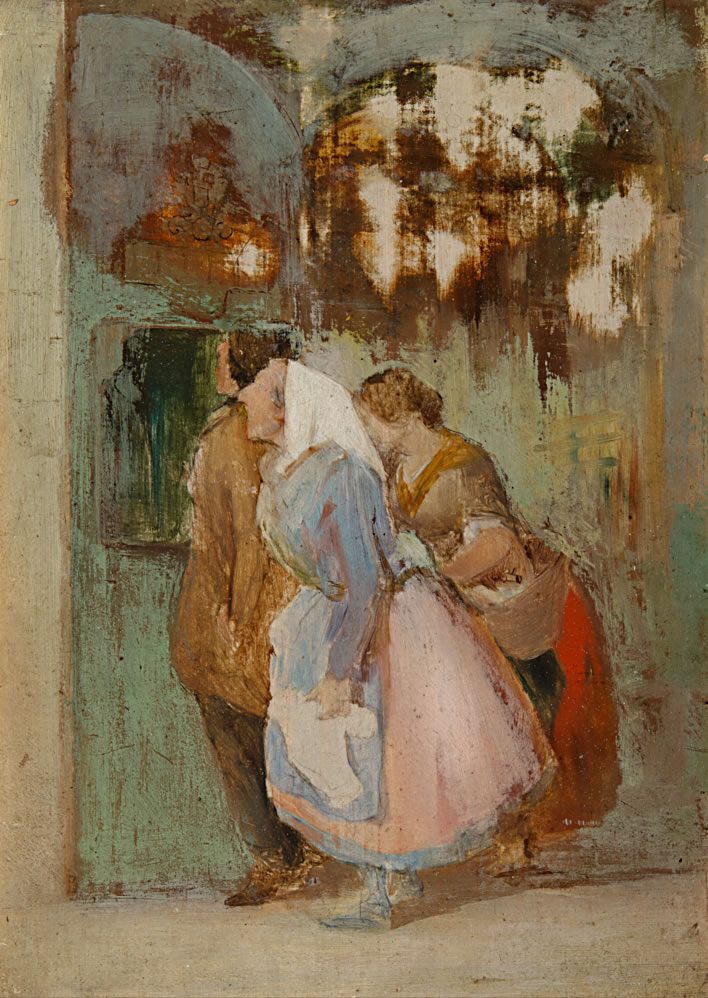
Josef Navratil, Outside the Lottery, 1850s.
Very little of the statistical understanding of events seeps down to the common people, otherwise no one would buy lottery tickets; they would keep their pence for themselves and become less poor because of that. But, more than three centuries after the Enlightenment and the Scientific Revolution, superstition still rules.
Even now, when good or bad things happen, many people assume divine or satanic intervention, or that the winners and losers of such an event somehow 'deserved it', now receiving their 'just desserts', perhaps in accordance with the nonsensical doctrine of karma.
At least the exceptionalism behind the emergence of a white foal has evaporated – perhaps – certainly among horse breeders, but the relative rarity of the white horse has secured its place as the mark of the exceptional. No one would change the name of 'White Horse' Scotch Whisky to 'Black Horse' or even 'Grey Horse'.
The ruler on a white horse
Napoleon's favourite horse was an Arabian stallion he called Marengo, referring to his victory at that battle. Marengo was not a pure white, but not far off.
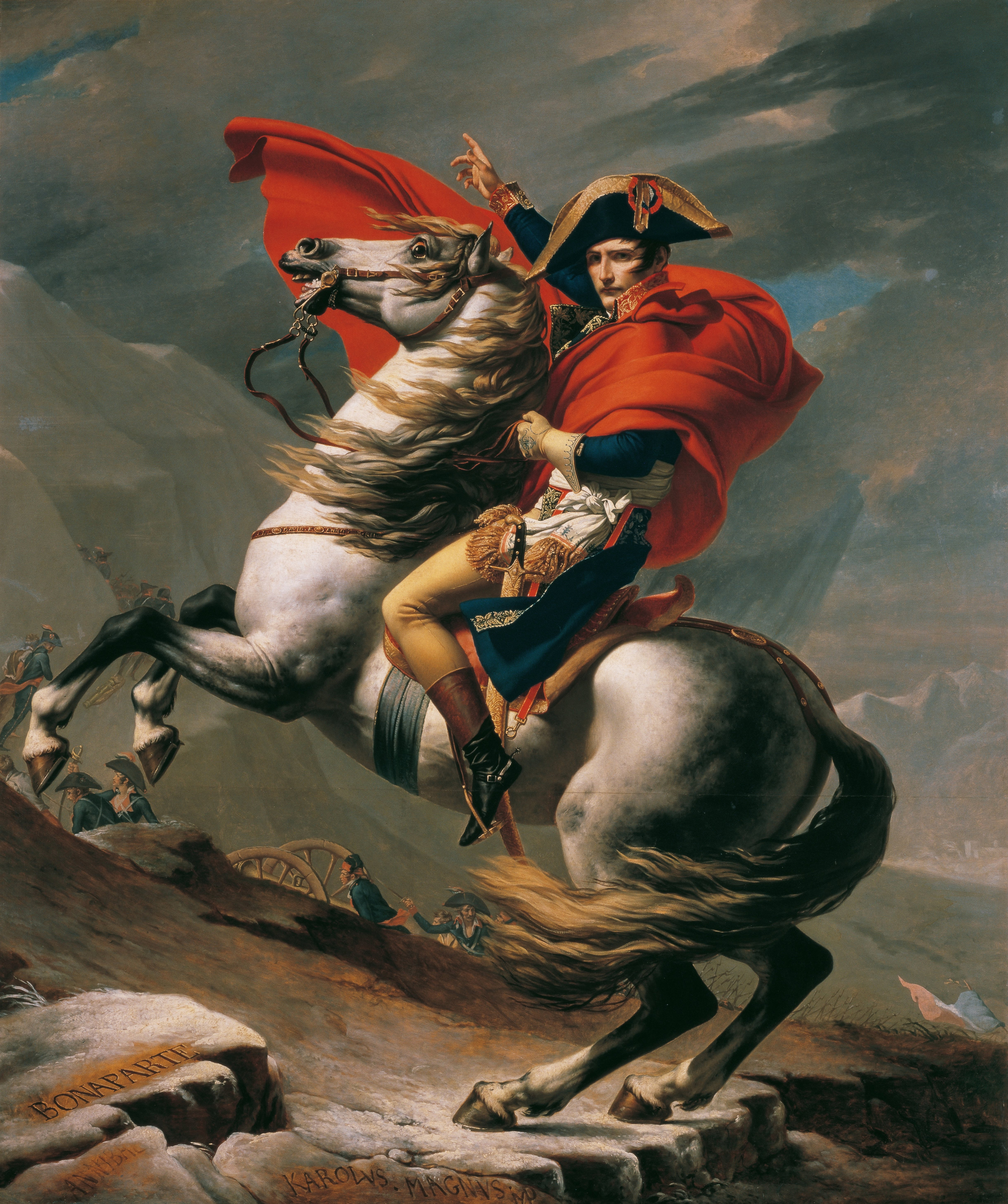
Jacques-Louis David (1748-1825), 'Napoleon and Marengo crossing the Alps over the Great St. Bernhard Pass', 1801-1803. NB: there are four other versions of this painting, one of which shows Marengo as a bay (dark brown). [Click to open a larger image in a new browser tab] Image: Österreichische Galerie / Belvedere
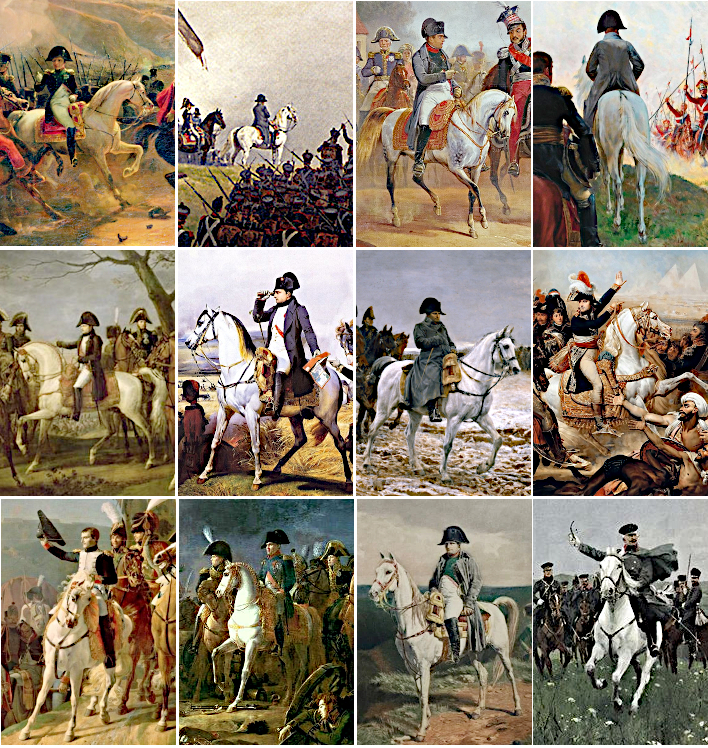
The Emperor on his white horse at (top-left…bottom-right) Smolensk, Ligny, Leipzig, Hanau, Austerlitz, Wagram, Soissons, Pyramids, Ulm, Austerlitz, Wagram. The very last painting is not of Napoleon, but of Generalfeldmarschall Gebhard Leberecht von Blücher, who led the Prussian army at the Battle of Waterloo, also on his white horse.
Returning to Revelations, we noted then that the truly white horse was the mount of the ruler of men, the figure representing earthly power. Many rulers have chosen to cut a fine figure mounted on a white horse for ceremonial parades; on the battlefield, however, such exceptionalism just marks the rider as a valuable target for the enemy's fusiliers. Napoleon wisely kept himself out of the thick of it; Blücher led from the front and for his bravery got a bullet in the head which eventually killed him.
The white horse in German mythology
If the sagas of the Germanic north are to your taste you will find numerous white horses associated with gods and heroes. I am not saying that these had a bearing on the existence of the Schimmel in Dedual-Naescher's tale. The Germanic sagas were barely known – if at all – in the profoundly Catholic canton of Graubünden.
Up to about 500 BC the dominant tribes in Switzerland were the Celtic Helvetii and, in what is now Graubünden, the non-Celtic Raetii. Other Germanic tribes frequently invaded, but after about 50 BC the Romans took over, imposed their own culture and their own pantheon, sometimes muddling dieties up a bit. The Romans were insanely superstitious and not too fussy about where their beliefs came from.
All things decay and the Romans lasted about 400 years until the German tribe the Allemanii pushed them out of Switzerland and ultimately, with other barbarians, brought the Roman Empire in the West to its end. Thereafter the population was rapidly Christianised, leaving behind in Graubünden a mongrel culture with elements of all of the above. The Catholic Church in particular was energetic in its war on the old cultures, but, as we noted in Büchli's collection of legends, much of the primitive mind and the ancient superstitions survived until recent times.
The demonic white horse
[I have added some atmospheric images from the 1984 DDR/Polish film of Der Schimmelreiter to cheer up a gloomy tale a bit. The plot of the film diverges at some points from Storm's book.]
When things happen that are unexpected, the primitive mind gets to thinking. Where no rational explanation is available, the irrational has to step in. Whether the emergence of a white foal is interpreted as a good thing or a bad thing probably depends on the mood of the moment: a happy person will instinctively view this unexpected event as a blessing; an unhappy person, beset by woes, will expect no good to come of it and look upon it as more of a curse than a blessing.
An example of the latter cast of mind is to be found in Theodor Storm's 1888 novella Der Schimmelreiter, 'The rider on the white horse', set in the dykes of the North Frisian coastline of the Baltic Sea.
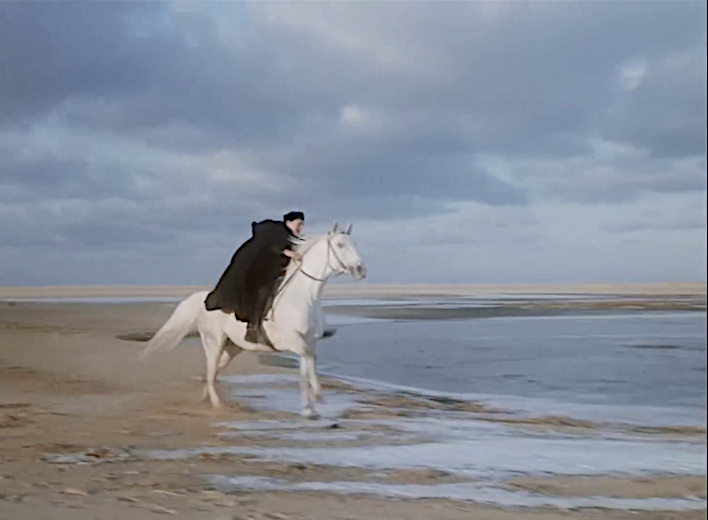
Hauke on the white horse on the Frisian sands Image: Still from the film Der Schimmelreiter (1984), Producer/Director Klaus Gendries, co-production DDR, Poland, 96 mins.
Storm's novella is very well known in Germany: its overloaded plot, overwrought structure and many ambiguities have given German literary types something to think about and write about for more than a century. It is widely held to be an important work and so teachers find it a useful tool to torture their little ones with.
A very condensed plot summary for the busy people who come to this website runs as follows:
The protagonist of the tale is a man called Hauke Haien (for those who haven't brushed up their Frisian German for a while, 'Hauke' is the equivalent of 'Hugo'). Since his youth, Hauke has been obsessed with the design and the construction of a new dyke that would reclaim valuable agricultural land from the sea. Through various twists and turns in the plot he becomes the 'dyke master' for his village and is given the chance to implement his plans.
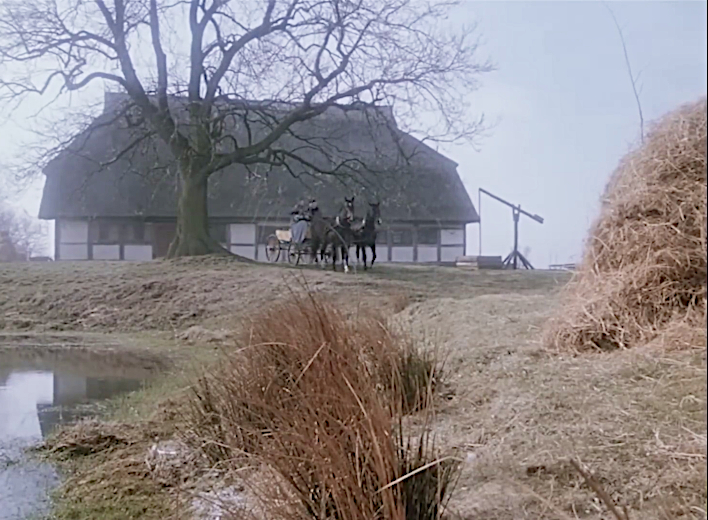
Hauke and Elke's house in this evocative landscape. Image: ibid.
In the village he comes across an itinerant from whom he buys a white horse. The itinerant is a shady character with a claw-like handshake (spooky, geddit?). The horse is a bag of bones, but Hauke stables it and cares for it personally. People notice its 'fiery eyes'. Within a few months the horse recovers. However, the horse will only allow Hauke to ride it. Hauke's own exceptionalism as the innovative dyke builder is now complemented by the exceptionalism of his steed.
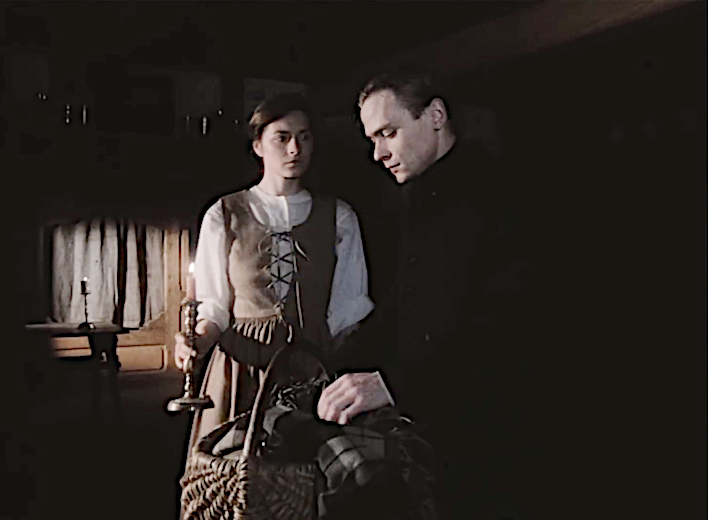
Elke and Hauke Image: ibid.
The superstitious locals remember that the skeleton of a horse was embedded in the sands by a nearby dyke. When Hauke acquired his white horse, these bones disappeared. He marries Elke, the daughter of the previous dyke master; they have a child, Wienke, who turns out to be schwachsinnig, retarded. Is this yet another demonic intervention? As a young child she is struck by an illness which seems fatal. Hauke prays, 'take me, not her'. The child recovers, but the spooked readers suspect that a divine bargain has been struck.
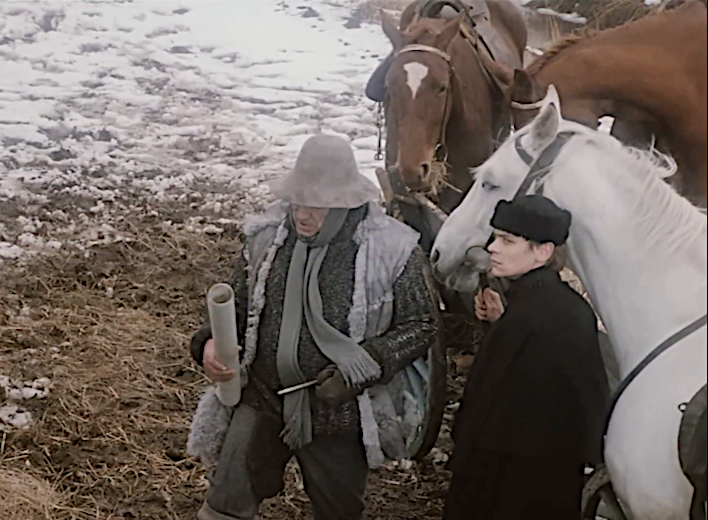
Hauke, the white horse and the Oberdeichgrafen, Hauke's nominal boss. Image: ibid.
During the construction of Hauke's new dyke the locals are about to bury a dog alive in it – local tradition holds that a living thing has to be buried alive in the dyke to ensure success; in earlier times the sacrificial victims were humans, but since then a degree of enlightenment has come to Frisland and living animals are now acceptable. Hauke, confident in his own calculations for the design of the dyke, rescues the dog. The labourers on the dyke are clear that no good will come of the violation of this ancient ritual.
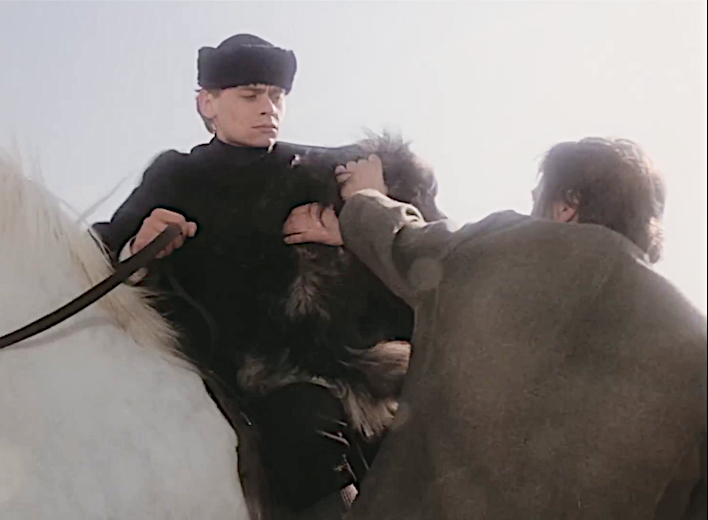
Hauke rescues the sacrificial dog. Image: ibid.
The spring and autumn weather on the Frisian coast can be stormy, but occasionally, dependent on wind and tide, exceptionally fierce storms with mountainous waves can arrive. The locals breach Hauke's new dyke in order to protect the two old dykes on either side of it. [The logic of this escapes me: it is not as though a bit of seawater running inland will appreciably lower the Baltic sea and its storm waves.]
The storm not only breaks through Hauke's weakened dyke, it washes away wife and child driving in a trap from his house. Hauke, riding on his white horse at the height of the storm, sees this and shouts Herr Gott, nimm mich; verschon die andern!, 'Lord God, take me, spare the others'. The horse and rider spring from the dyke into the swirling storm waves, never to be seen again. The skeleton in the sand reappears.
Since that time, locals and travellers have frequent encounters with a ghostly rider on a white horse, Der Schimmelreiter, riding along the dykes.
Very little in Storm's garbled plot makes much sense. The characters are not very clearly delineated, particularly Hauke, who is at times an aggressive tyrant, at other times a quite enlightened chap. The villagers are portrayed as superstitious, barely educated morons; most of the womenfolk have been captured by a weird cult. About the only person in the story with any sense is Elke, Hauke's wife.
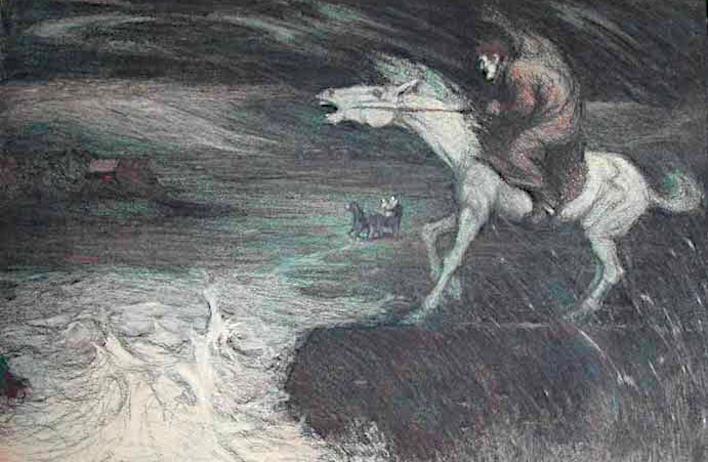
Franz Karl Basler-Kopp (1879-1937), Der Schimmelreiter, c. 1924.
The purpose of this long detour into Frisian literature is to show that the exceptionalism of the white horse can be taken by simple minds to be an aspect of the demonic. Dedual-Naescher's plague Schimmel is capable of transporting human corpses on its own, itself an unnatural ability, particularly if the souls of the dead are on their way to Purgatory. The divine mind operates through the intermediary of angels; only the devil would have a white horse for his work.
0 Comments
Server date and time:
Browser date and time:
Input rules for comments: No HTML, no images. Comments can be nested to a depth of eight. Surround a long quotation with curly braces: {blockquote}. Well-formed URLs will be rendered as links automatically. Do not click on links unless you are confident that they are safe. You have been warned!