
Talking with the animals
Richard Law, UTC 2026-03-10 11:14
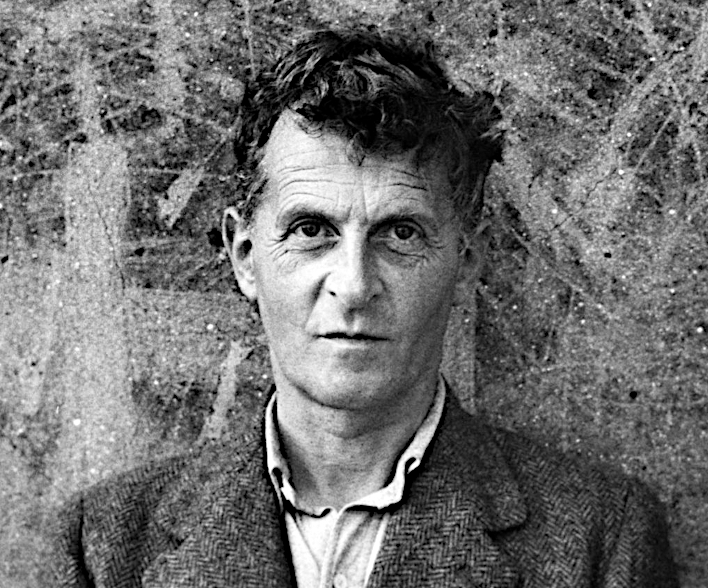
Ludwig Wittgenstein, ND.
The following remark by Ludwig Wittgenstein (1889-1951) seems to be quoted quite frequently these days:
If a lion could talk, we could not understand him.
Ludwig Wittgenstein, Philosophical Investigations (1953, 1958), Basil Blackwell Ltd., Oxford, p. 225. The translation is by G. E(lizabeth) M. Anscombe, the analytical philosopher who became the default translator for his works. From 1929 onwards until his death in 1951, Wittgenstein hacked about at producing what became the Philosophical Investigations. Along the way there were many 'drafts', 'early drafts', 'intermediate drafts', as well as manuscripts consisting of cut and pasted scraps from previous drafts. Some of this is in English, some in German. The quotation here comes from Part II of the work, the typescript of which – as if we didn't have enough problems with this work – was subsequently lost, so I cannot offer you the German 'original' text.
I suspect that most people reading this will think they know what Wittgenstein's sentence means, until, that is, they think a little harder about its meaning. It is just one short sentence in language that is completely plain and everyday, but the deeper you go into it, the more incomprehensible it becomes.
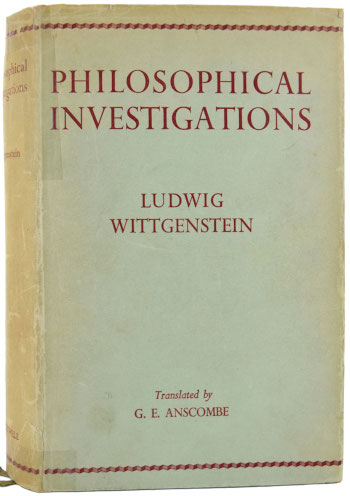
Caution: We should never forget that Wittgenstein did not write this sentence. We do not have the German original. The sentence we have before us comes from the pen of G.E.M. Anscombe, the translator. She was a usually reliable translator of Wittgenstein, though her style is often tainted with 'Wardour Street English'.
The sentence is not a 'philosophical' statement in the manner of Wittgenstein's infamous first main proposition of his Tractatus Logico-Philosophicus of 1922 (German edition 1921 as Logisch-Philosophische Abhandlung 1921): 'The world is everything that is the case' – also one short sentence consisting of apparently simple words which taken together is quite incomprehensible to the non-specialist.
A few adventurous souls offer explanations of Wittgenstein's voluble lion, but in my opinion the explanations are no clearer than the sentence being explained. The modern feminist might suggest that Ludwig should try talking to the female lions, who are much better at discussing their feelings.
Caveat: the Madhouse of Philosophy
Before we get up close and personal with a chatty lion, we have to draw the attention of readers to the Figures of Speech First Law of Philosophical Futility: No philosopher has ever produced any thought of universal and permanent validity. Those unfortunates taking Philosophy courses are doomed to spending years in the comparative study of errors, filling their heads with ideas, none of which is true.
In the case of Ludwig Wittgenstein, there are people who have wasted their best years breaking their brains on the incomprehensibility of his Tractatus, only to find out – too late, too late – that not long after finishing the work he himself realised that it was a crock. Now we hear that there are study groups dedicated to grinding their way through his later Philosophical Investigations, widely regarded as 'Tractatus 2.0'.
The history of philosophical enquiry is a sort of perpetual Brownian motion across the surface of the intellectual world: One thinker sets off in one direction, is contradicted by one or more successors, who in turn are contradicted and so on – the whole random walk of propositions getting humanity precisely nowhere. Scientists and engineers have brought innumerable benefits to Mankind; philosophers, nothing – apart from the occasional psychopath who believed their scribblings and got his myrmidons to attempt to put them into practice.
The situation is made worse when philosophers retreat into isolation, the better to think undisturbed. If we believe Plato, Socrates' philosophising was done over a convivial dinner with friends, wine, women, boys and song and was the better for it – his ideas are nonsense, but at least relateable nonsense. We have no extant texts of his, which may suggest that he did not waste valuable drinking time scribbling in solitary confinement.
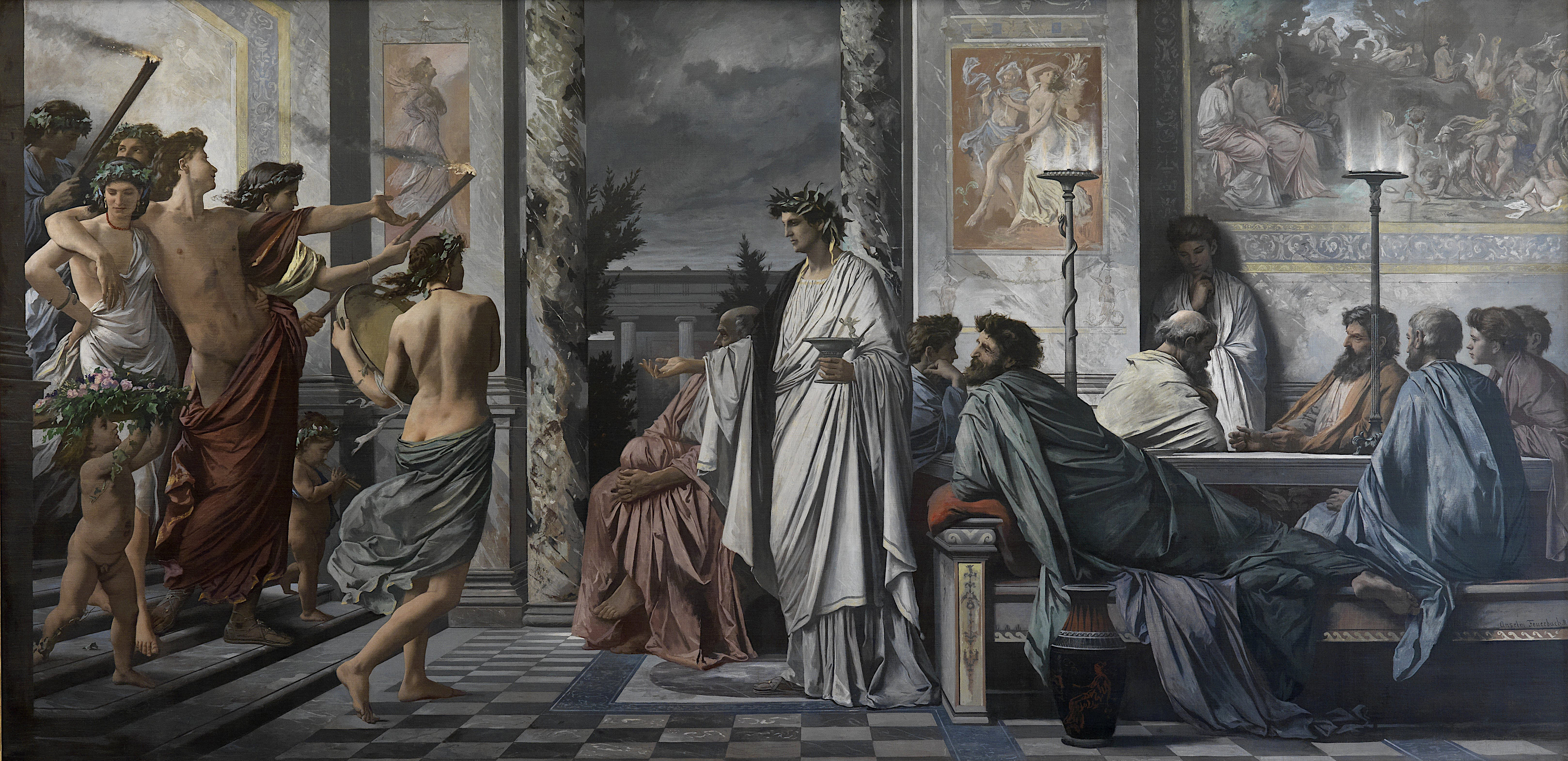
Anselm Feuerbach (1829-1880), Das Gastmahl (version 1), 1869.
A scene alluding to Plato, Symposium, XIV. The fifth Interlude: 212 C-215 A.
Applause followed. Then suddenly, when Aristophanes was on the point of making an observation, a loud knocking was heard at the door. Presently Alcibiades, leaning on a flute-girl, appeared. 'I am come to crown Agathon,' he cried, 'if you will admit a drunken reveller.' Being heartily welcomed, he took the seat next Agathon, where Socrates had made room for him. And as soon as he perceived Socrates, he began playfully to abuse him. Then, taking some of the ribands with which he had bedecked Agathon, he crowned 'the marvellous head of Socrates, the invincible in words.'
Image: Staatliche Kunsthalle Karlsruhe [Click the image to display a larger version in a new tab.]
Feuerbach painted a later version of this work. Here it is:
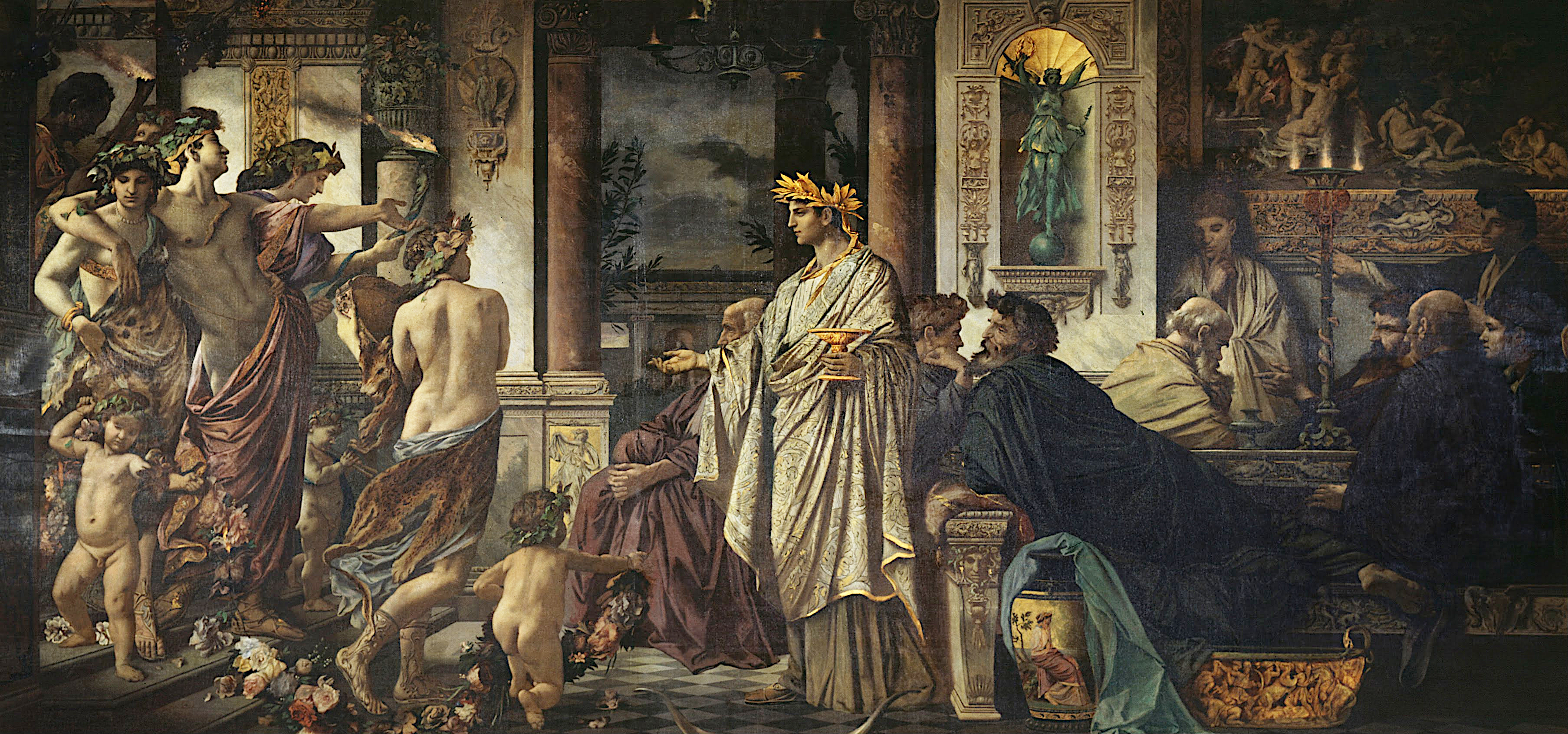
Anselm Feuerbach (1829-1880), Das Gastmahl (version 2), 1874. Image: Alte Nationalgalerie Berlin [Click the image to display a larger version in a new tab.]
Symposia of the Bacchic type are no more productive, but much more fun:
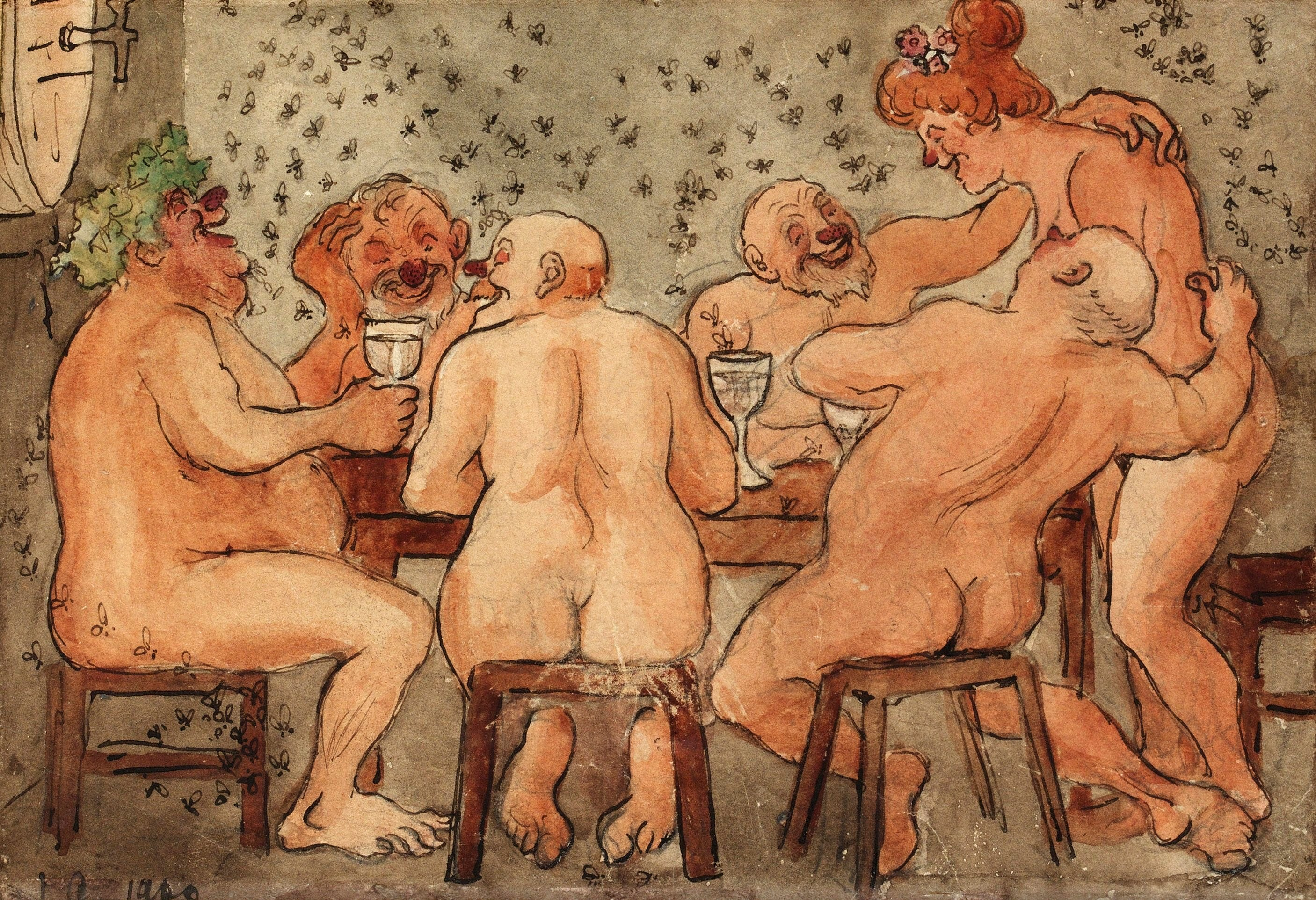
Ivar Arosenius (1878-1909), Backusfest, 1900. Image: (Private collection) Aroseniusarkivet. [Click the image to display a larger version in a new tab.]
In contrast, Wittgenstein seems to have spent much of his thinking time in solitary pondering in remote cottages in Ireland or in his house half-way up a fjord in Norway.
If you want the solitary life, the best thing you can do is hang a 'do not disturb' sign on the door and leave the telephone off the hook. His history of drafting, re-drafting text and shuffling scraps of paper around leads us to adapt the great insight of C. Northcote Parkinson: 'Scribbling expands so as to fill the time available for its completion'.
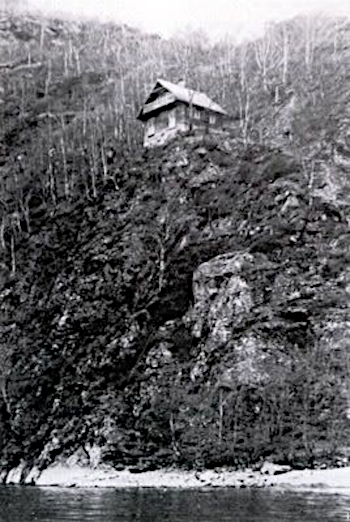
Ludwig Wittgenstein's small wooden house perched above Eidsvatnet , not far from the village of Skjolden, Norway. He stayed in the village between October 1913 and June 1914. He commissioned a house to be built to his own design in the forest beyond the village. It was finished in his absence in autumn 1914. It was seven years (including war service) before he was finally able to visit his house in August to early September 1921. Another ten years went by before he returned in for three weeks in the summer of 1931. Six years later he returned from August 1936 to December 1937. His last visit was from October to November 1950, shortly before his death.

Seven years after Wittgenstein's death, in 1958, the house was dismantled and re-erected in the village of Skjolden. The only thing left of the house were the foundations.

The reputation of 'the Austrian' grew after his death. By 2017 the community realised what a tourist magnet they had and the house was rebuilt and restored and returned to its original position over the lake. For further information see the website of the Wittgenstein Foundation in Skjolden.
The context of the sentence
The source of the sentence under discussion, the Philosophical Investigations, was scribbled and typed and crossed out and retyped and cut and pasted and re-ordered and re-written over a period of twenty years and left in great disarray at the time of his death. Almost wherever he had hung his hat during that time, one or more boxes turned up with manuscripts and assorted scribblings.
In Philosophical Investigations the sentence 'If a lion could talk, we could not understand him' is separated from what precedes it and what follows it by some generous space, suggesting that the author was quite taken with his aphorism. Are there any clues in the context that would help us to interpret the sentence in question more surely? Here is the paragraph that precedes it:
We also say of some people that they are transparent to us. It is, however, important as regards this observation that one human being can be a complete enigma to another. We learn this when we come into a strange country with entirely strange traditions; and, what is more, even given a mastery of the country's language. We do not understand the people. (And not because of not knowing what they are saying to themselves.) We cannot find our feet with them. "I cannot know what is going on in him" is above all a picture. It is the convincing expression of a conviction. It does not give the reasons for the conviction. They are not readily accessible.
Ludwig Wittgenstein, Philosophical Investigations (1958), Basil Blackwell Ltd., Oxford, p. 225.
This is a case where we need the original German, for Anscombe's rendering in English is bonkers. It may be an excellent translation, since the original is quite probably also bonkers. Having read this paragraph attentively several times it seems disappointingly trite and full of oddities: 'We cannot find our feet with them' [bei ihnen Fuss fassen ≈ 'integrate with them'?]; 'the convincing expression of a conviction'. The syntax and punctuation in the paragraph is erratic and no help at all to understanding. Some phrases seem to echo German phrases, but the whole thing is such a shambles, so full of imprecise waffle, that it is not worth the effort of decoding it. As such it gives us no help in understanding 'If a lion could talk, we could not understand him'.
Analytical Philosophy
The dominant philosophical movement during Wittgenstein's life was Analytical Philosophy – not a very helpful title; it might be better to call it Language Philosophy. It challenged the movement that had dominated philosophy for the previous two centuries or so, Idealism (don't ask). As usual, there were many movements and subdivisions within Analytical Philosophy, but the general principle was constant: that many philosophical problems were only problems because of the shifting sands of language on which they were formulated.
I remember as a young man reading a paper (author and title long forgotten) which teased out seventeen (I think) distinct meanings in the natural language use of the oft-discussed expression 'free will'. Without such analytical clarity, discussion and debate just sank into a fruitless activity.
In this respect, the Oxford philosopher C.E.M. Joad (1891-1953) made a name for himself on the post-war BBC radio discussion programme The Brains Trust with his frequent opening phrase 'Well, it depends what you mean by…', which became a popular catchphrase at the time. Joad, though a generally disgusting crypto-communist, serial womaniser and amoral thief detested by many of his philosopher colleagues, became a celebrity with his easy-going manner and fund of anecdotes.
Joad's catchphrase is a good way to start our examination of Wittgenstein's remark about talking lions.
The talking lion
Taking the statement a word at a time, there is not much we need to say about 'if', 'lion' (although for some reason Wittgenstein quite often uses lions in his examples), or 'could'.
The analyis suddenly becomes more interesting when we get to 'talk' and even more so when we reach 'understand'. We could argue that lions and all the other animals that are capable of making controlled noises already 'speak'. They may not be uttering long streams of language, but in their growls and roars and purring they are making some sort of statement, which is being externalised for some reason or other. The Wikipedia entry for 'Lion' has a section dealing quite extensively with lion communication.
Varying from species to species many animals also seem to be able to communicate with each other within the constraints of their physiology. But 'talk' implies more than just 'speak'. It takes the act a step further and means to converse or communicate with another person or party by means of speech. Whereas 'speak' involves simply generating sounds (whether anyone is listening or not), 'talk' implies engaging in a conversation, which in turn requires shared 'understanding'. In his German text, did Wittgenstein write sprechen, reden or even sich unterhalten? Unfortunately, we do not know and so we shall have to be content with Anscombe's 'talk'.
Humans have developed organs and brain functions that facilitate the generation of speech and are thus 'world-open' communicators. At the other end of the spectrum, bees, for example, can communicate the location of food sources to their fellows in the hive using a 'dance' pattern. They have no capability or need to share much more. It may be limited, but it is still communication.
Most people would not accept dancing figure-of-eight directions to be 'speech', but the animal kingdom supplies us with plenty of examples of non-verbal communication.
If a bee could talk it would have a bit to tell us about flowers, nectar, pollen, pollen gathering and the life of the hive. None of this is part of our own experience, but it is something that we could easily imagine, which is why I apply the term 'world-openness' to this ability.
If 'talk' implies the use of a human language, something more than one-dimensional roars, grunts and growls, the lion is going to need a lot of reconstructive surgery and dentistry.
I can't abide The Lion King (1994/2019). Disney's Jungle Book (1967) is a cultural highlight of the 20th century, so you will have to pretend that the tiger Shere Khan (voiced by the wonderful George Sanders) is a lion. This is how animals speak when no humans are around. Three minutes of perfection; three minutes in which you have time to ponder how far Western culture declined in just thirty years. Video: Walt Disney Productions, 1967.
In a human, the vocal cords, the soft and hard palates, the relatively short tongue, the teeth and the small mouth and lips (which allow the formation of a variably resonant cavity) all work together to produce the complex sounds of human speech (in any language). The brain has also evolved in order to be able to direct these highly complex motor functions.
Not only is the lion physically incapable of generating a human language (mouth, tongue etc.), it ipso facto does not have or need the brain functions that are needed to control these physical elements.
And finally, consider that even if the lion did have the physiology and brain circuits to generate language, the human child needs at least four or five years of socialisation with total immersion in a mother-tongue just to get started with 'talking', let alone master the subtleties of modal and conditional verbs.
The hypothetical 'if' is extremely hypothetical in the case of the talking lion. The lion might see Prof. Wittgenstein and think: 'Defenceless meaty creature ready to be caught and eaten'. It will probably not think: 'I am hungry. If I eat that defenceless meaty creature my hunger will subside for some time.' Such hypotheticals are not much use to the apex predator of the veldt.
Wittgenstein appears to be going beyond that situation. Let us assume he is imagining a lion which can 'speak' in whatever manner in which it can 'speak' – which is the current situation of growls and roars etc. Assuming that we humans can categorise whatever noises the lion makes into elements of meaning – a very big assumption, since lion language does not necessarily contain any of the usual analytical components of human speech such as consonants, vowels, words (nouns, verbs etc.), syntax and grammar.
We may not be able to parse the lion's utterances in the way that we do with human languages, but from the study of many examples and the context in which they occur we might have a decent chance of extracting some meaning. We humans are, after all, the ones with highly developed powers of ratiocination – it is the lion that will have the problem of understanding humans.
—'Grok, please tell me what that lion just said.'
—'He said "What does 'the world is everything that is the case' mean?".'
—'I've no idea, Grok. What do you think?'
—'I'm sorry, but I have no idea either. We may not be able to talk to this lion'.
If the lion's brain contains some sort of speech processor, it will be a primitive one that is quite incapable of 'understanding' our language. The conversation, therefore, would never rise above the lion level.
Man's best friends
Having staggered out of the swamp of 'talk', we Analytical Philosophers on a mission are now sucked into that slough of despond, 'understand'.
Pet owners are convinced that they 'understand' the noises their pets make as well as the expressions and body language that they can exhibit according to species. The task of becoming a pet requires an animal to learn to react appropriately to the cues (speech or behaviour) expressed by its owner; the good owner has to guide the animal in decoding these cues and also to learn the cues the animal is capable of expressing.
This video is here not just to show you a Berner Sennenhund enjoying its grooming ritual, but to let you decode the two woofs at the beginning and the frequent 'tongue-tipping' that takes place under certain circumstances. Video: X/Puppies @Puppieslover
Dogs are particular masters of this learning task, which is why they have become 'Man's best friend' over the millennia. Pets learn to respond to human speech in appropriate ways, so that most dog-owners, for example, have to avoid the casual or accidental use of the word 'walk' outside the context of taking a dog for a walk. So, on this very superficial behavioural level, humans and their pets can clearly communicate with each other in the context of some shared themes such as food, exercise and so on.
But few of us would say that such simple interactions qualified as 'talk'. Many pet owners may assert that they and their pets 'speak' to each other; it would be surprising, though, if any pet owner thought their little darling could 'talk' – even in the special case of parrots, who, as every pirate knows, are just mimicking sounds without understanding. Once we accept noise making and certain behaviour patterns as communication, most pet owners would say that they understand their pets and their pets understand them.
That said, it is certainly true that, compared to their pets, humans exist in a vastly extended cognitive world. Our world does not just rely on speech, it is also dependent on writing, which makes ideas, feelings and memories to some degree transmissable and which also makes written history possible. Humans live in a vast cloud of 'culture' – names, events, music, social conventions and so on. Animals live in a present and have memories and behavioural patterns to a degree we humans do not fully understand. Someone probably has already written a 400 page thesis on tail wagging in dogs.
The singer of the Odyssey, a great dramatist who knew how to get and keep his listener's attention, gave them a homecoming scene in which Odysseus' agèd dog Argos, loyally still waiting after his owner's long absence, recognizes him despite his master's disguise. The singer cannot resist adding that the dog then dies contentedly, which projects human thinking into the dog's mind.
It is also true that animals live in a much richer world of sound and smell than humans – hence Argos' detection of Odysseus despite his disguise. Does Argos have a sound and smell category 'owner' in his brain?
We humans can barely imagine what it is like for a dog, say, to enter a crowded room or walk down a busy street. None of these capabilities can be shared; most of human life is inaccessible and incomprehensible to animals, most of the lives of animals are likewise inaccessible and incomprehensible that is, 'outside the experience of' humans.
One could argue that the nuances of hearing and smell which the animal experiences are so far outside the boundaries of human experience that it would be almost impossible for an animal who had the power of speech to describe them in ways a human could understand them.
At the base of human language is some way of identifying, naming and categorising language objects – which means 'things' in its broadest sense: physical objects, feelings, mental states and so on and their interrelationships and relationships with other humans. Most importantly, these relationships are species specific. For a dog a lamp-post or a fire hydrant is merely an object bearing doggy fragrances; for a human these objects are filled with meaning. A pet might notice that its owner is holding something up to one ear and making uninteresting and incomprehensible noises into thin air; the human is talking to another human on a mobile telephone.
Perhaps that was Wittgenstein's reason for considering conversing with an extreme case such as lions – wild, undomesticated, dangerous creatures – rather than a nice, friendly pet such as a golden retriever, say, that he could have talked to in the long, dark, cold, candlelit nights in his Norwegian hermitage. Our samoyed, Yeti, was always ready to share the time of day with anyone – sometimes whether they wanted to or not.
Empathy and imagined understanding
Some humans have a talent for formulating their private experiences in a way that others can 'understand' them, despite never having experienced them directly.
For example, it is not necessary for those whose most dangerous feat is standing up from the sofa to have had the experience of being almost frozen to death to 'share', 'understand' or 'have empathy for' the climber Walter Bonatti's (1930-2011) experience when he and his companion on the 1954 Italian expedition to K2 survived a terrible night in an open bivouac (neither tent nor sleeping bag). They were strapped to the second highest mountain in the world about 500 metres below the summit at an altitude of over 8'000 metres. They survived a night without shelter in temperatures of around -50°C. But even with that wonderful human talent of 'imagination' it is impossible for any but a very select few who have experienced similar trials to fully 'understand' Bonatti's experience. Perhaps we should speak of the difference between 'empathy' and 'understanding'.
And with that thought we arrive at the crux of the problem, a conundrum that has been the key philosophical problem for several centuries.
Shall two know the same in their knowing?
We can call such sharing of language and experience one of the key problems in our understanding of human existence. The Idealists in their various ways not only saw the impossibility of directly knowing what another person was perceiving or thinking, but even the impossibility of proving that the other person had an existence outside the observer's own thoughts. This problem has still to be properly resolved (probably never) and led philosophy into an intellectual cul-de-sac that lasted for two centuries, one which is still with us.
The American modernist poet Ezra Pound formulated the problem elegantly and concisely – which, after all, is what we expect poets to do:
'Oh you, as Dante says
'in the dinghy astern there'
There must be incognita
and in sea-caves
un lume pien’ di spiriti
and of memories,
Shall two know the same in their knowing?
[C93:631]
Ezra Pound (1885-1972), The Cantos, 'Canto 93', p.631. FoS commentary on this passage.
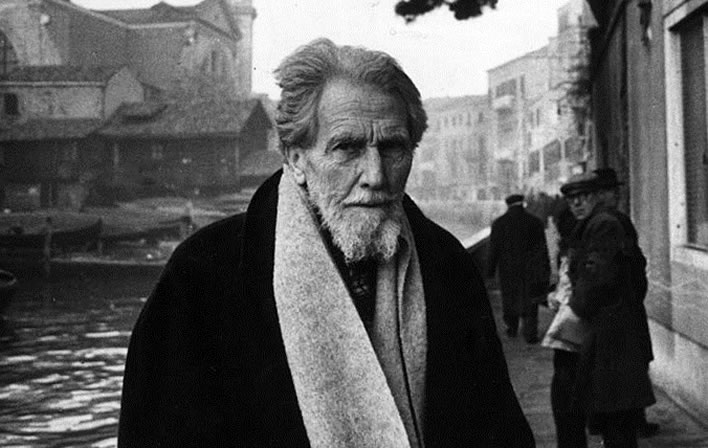
Ezra Pound in Venice in 1963.
'Shall two know the same in their knowing?' Pound was struggling to communicate his fragmentary vision of a divine world which frequently broke through into his everyday existence. In trying to explain these parallel worlds he stumbled into the great unresolved question: how does anyone know what is going on in someone else's mind? and can knowledge, perceptions and understanding ever be shared?
His 'Pisan Cantos' are full of memories of his life so far, of ghosts and divine manifestations, all things that are unknowable to anyone else: 'and of memories'. The subsequent cantos become ever more arcane as this other world intrudes.
In Pound's case the great irony is that most of his masterpiece The Cantos is written in a way which presumes that the reader can see into Pound's labyrinthine mind. In Canto 100, towards the very end of the work, we think the arcane scales may have fallen from Pound's eyes when he tells us:
'A pity that poets have used symbol and metaphor
and no man learned anything from them
for their speaking in figures.'
Ibid, C100:799
At least we may think so, until our joy immediately dissipates when we look closer and observe that the passage is enclosed in single quotation marks. As far as I know, no Pound scholar has any idea from whence this quotation comes. Quod erat demonstrandum: 'Shall two know the same in their knowing?'. Certainly not if you have anything to do with it, Ezra!
Alone
We have no secure idea of what is going on in another person's head – it is perfectly possible that we can empathise more about what's going on in a lion's brain, than what is going on in a human's brain. Wittgenstein/Anscombe glibly write 'understand' (verstehen, begreifen, fassen). Our sophisticated language allows us to make-believe that we do; we have empathy, we can imagine feelings and emotions in the same way that we can imagine Bonatti's sufferings, if we put our minds to it. We have the feeling that we share our lives and experiences, we speak of a 'meeting of minds'. Yeats wrote:
…and it seemed that our two natures blent
Into a sphere from youthful sympathy,
Or else, to alter Plato's parable,
Into the yolk and white of the one shell.
W.B. Yeats (1865-1939), 'Among School Children', from The Tower, 1928, p. 56.
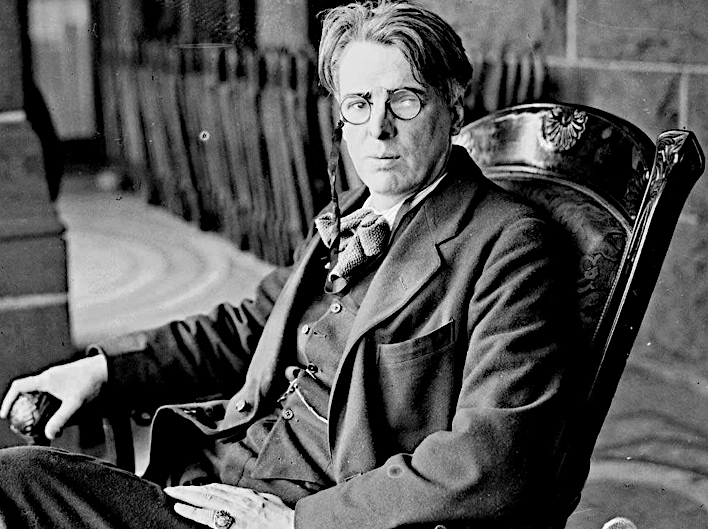
W.B. Yeats, ND.
This is just a comforting fairy tale. Consider situations where we are confronted by the other worlds of the mentally ill, for example, or the minds of the monsters of history, or those of today's monsters: the young man who stabs little girls to death in a dance class, or the youngster who shoots up his school class. The terms we apply to these people – deluded, insane, crazed – show the limits of our understanding of our fellow human's thought processes.
'Why?' we ask, 'whatever possessed him or her' to do that, the suspicion of possession by something other-worldly being a long-standing rationalisation for the dark depths of another person's psyche. As soon as this extends beyond the everyday, the social norm, we realise that not only are such people beyond our understanding, all people are beyond our understanding – their mental life is fundamentally unknowable, inexplicable, but within certain social conventions it is imaginable. We only notice it when the social conventions that bind us break down. Writing of the possibility of 'understanding' lions is brave, when we don't even 'understand' each other.
Even in everyday life the limits of our shared world only become visible when we, the generally sane, are confronted with situations beyond those limits, from babies screaming for no apparent reason, refractory children with irrational tantrums, substance abusers lacking all self-control, addictive personalities destroying themselves… and all the other opaque minds we meet. Fifty years ago the Western world had a few fidgety children; now there are millions (approaching 15% of the juvenile population of the US) of sufferers from an affliction labelled ADHD that we do not understand and cannot cure.
The hierarchy of the incomprehensible extends up to mass murderers, whose motivation is usually completely baffling. It seems common that the family of the teen who one day decides to take a gun and kill his classmates and then himself are as surprised as everyone else at this event.
Back to lions
As already noted, the lion is physically and mentally incapable of expressing itself using noises from human phonetics with the vocabulary, grammar and syntax of some human language or other. Let's call this the 'Jungle Book' option and rule it out straight away.
Some commentators on Wittgenstein's aphorism have suggested that the lion's life is so far detached from that of the modern human, that we could not 'understand' what the lion is saying to us.
Perhaps, but we former hunter gatherers and lions have still quite a lot in common, if only we could express it. Lions may not be able to grasp and use the high-level cognitive understanding that evolution has given us, we have come a long way since lions, but we still share many emotions and 'ideas' with them.
Just like humans, lions copulate, give birth, nurture their cubs, and give them a three-year survival course that teaches them the skills needed to be lions. The human survival course is much longer, but there is much more to learn.
It is ironic that Wittgenstein should have chosen the lion as his conversational partner, since lions are remarkably social animals. They form 'prides' (containing an average of 15 lions – males, females and cubs) and, most interestingly for the present discussion, have a very extensive and structured range of vocalisations, much more extensive than the odd roar. There is also a wide range of social interactions such as grooming and head rubbing.
It would be interesting to ask lions about some of their deep-seated instinctual behaviours. A particular example would be feeding strategies. The head of the pride gets to dine on prey first (and the select pieces), then, going down the ranks, the others take their turn until the old lions and the cubs pick the bones and munch the offal.
I have observed exactly the same behaviour in social birds such as crows, jays and alpine choughs: even when there is plenty of food available, the top bird will keep interrupting its own feeding in order to drive away all competition, which then usually has to make do with quick pecks at the outer parts. Even then the top bird may attack any bird that approaches the food. When the ranking birds leave, the lower orders can get to what is left.
Almost as though a switch is thrown, in the presence of food the members of the pride or the flock change from cooperation to intense rivalry. Although I have never managed to talk to my bird visitors about this behaviour, I suspect that it results from that most primal of imperatives, hunger. There are times – perhaps all the time – when animals experience some level of hunger, in the face of which all social courtesy behaviours are smothered under this elemental drive for survival. I am quite sure that the trait that animals are least likely to possess is altruism. The development of altruism may, in fact, be one of the great leaps in the the evolution of man.
For this reason, owners of several dogs will instinctually give them their own feeding bowls. However good-natured the dogs are in every other situation, having several of them at the single feeding bowl will always lead to a doggie punch-up.
0 Comments
Server date and time:
Browser date and time:
Input rules for comments: No HTML, no images. Comments can be nested to a depth of eight. Surround a long quotation with curly braces: {blockquote}. Well-formed URLs will be rendered as links automatically. Do not click on links unless you are confident that they are safe. You have been warned!