
1875-1900, childhood and education
Richard Law, UTC 2026-08-27 08:17
René, the replacement
Arguably the greatest disaster of Rilke's life had its origin two years before he was born, when his mother, Sophie – called 'Phia' in the family – gave birth to a daughter 'Zesa'. The little girl was premature and she died after one week. Phia grieved deeply for her lost daughter and after that moment took to dressing in black.
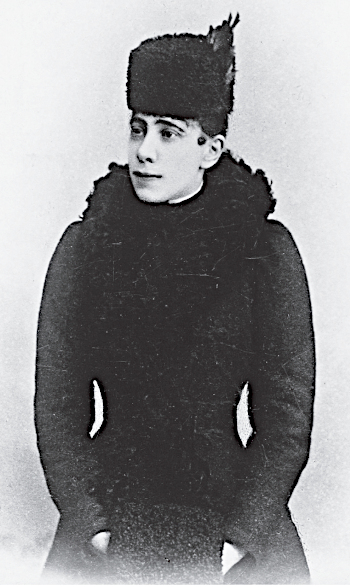
Sophie ('Phia') Rilke, ND. We can clearly see where René/Rainer got most of his facial features from, particularly his prognathous mouth and lips.
When Phia fell pregnant again she must have prayed that the child would be another girl. We should remind ourselves that in those days the sex of a baby only became known at the moment of delivery – for gender reveal parties the world would have to wait a while – so the shock that a boy emerged seems to have triggered a 'replacement child syndrome' in her already hysterical personality.
Worse still, young Master Rilke came into the world on 4 December 1875 two months ahead of schedule, reducing his chances of survival and triggering all Phia's fears for her new baby.
The replacement child was baptised René Karl Wilhelm Johann Josef Maria Rilke – thus in the context of what had gone before we must note the ambiguity of 'René' (signifying 'reborn' in French), which can be used for males and for females, often without the explicitly feminine form 'Renée'. In Catholic regions the otherwise female name 'Maria' is not infrequently placed in a subordinate position in male names as an act of Mariolatry. Young master Rilke got a double dose of feminisation.
In relation to this gender fluidity, much has been made of his mother's dressing him in girls' clothing. This can be overstated, since it was quite common at that time to dress boys in smocks or simple dresses until they reached a certain age.
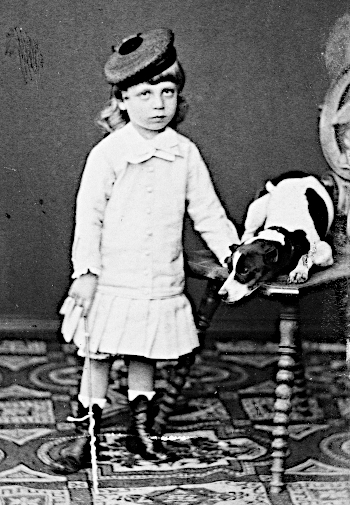
René Rilke, 1879, aged 3 years 8 months.
Image: Schweizerisches Rilke-Archiv
Readers can see an example of this in our piece from over ten years ago, The Bad Old Days, based on Otto Kubel's (1868-1951) illustrations for a German children's reader. One of the illustrations shows the youngest boy in the family, Heini (=Heinrich) being proudly kitted out with his first trousers, a great rite of passage for the time. Up to then we have usually seen Heini wearing a smock and some kind of apron.
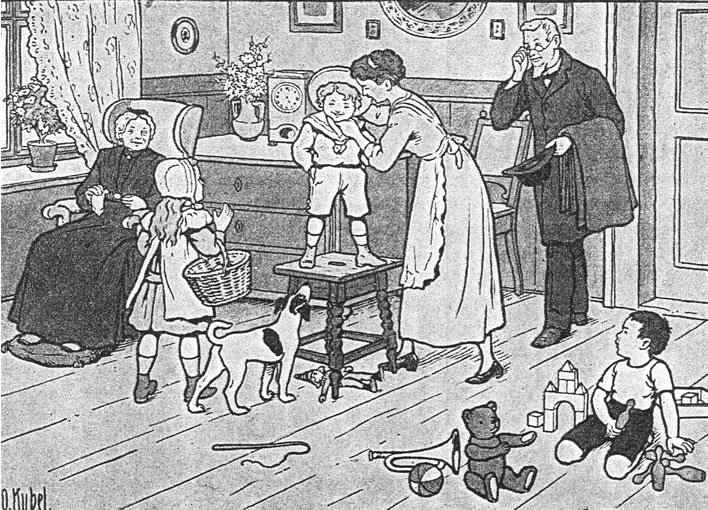
In the days before washing machines and dry cleaners a sturdy apron for messy children was indispensible to help keep their clothes clean. Here's another example:
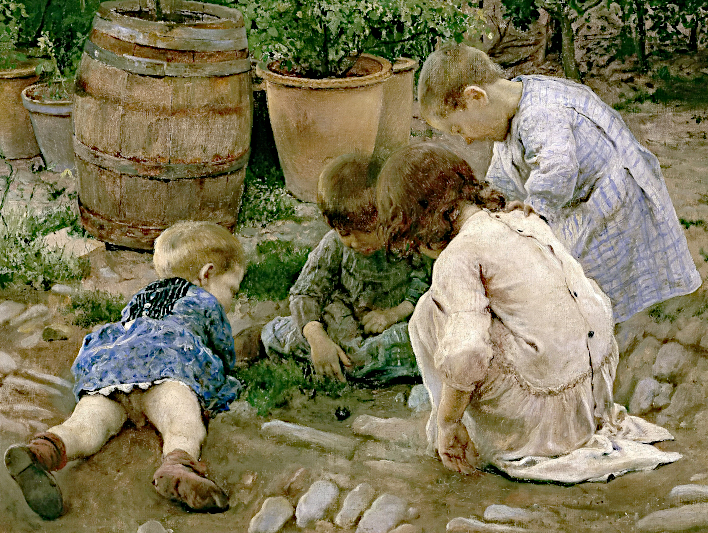
Three little boys and one little girl, all in dresses, 1893.
José Jiménez Aranda (1837-1903), Los pequeños naturalistas / The little naturalists, 1893
Image: Museo Nacional del Prado.
That said, Phia did take the feminisation of René to emotional extremes. Her dress sense for him borders on the psychotic. A proper biography would list Phia's many other manipulative character flaws that made her in many ways unfit to bring up a child, especially a delicate and sensitive one such as René. She had a narcissistic personality which René, a sensitive child, learned to manipulate by flattery.
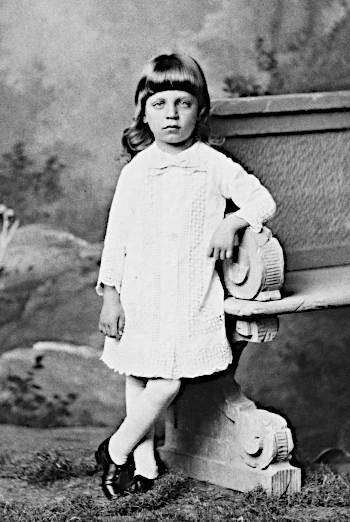
René Rilke, 1880, aged 4 years.
Image: Schweizerisches Rilke-Archiv
Phia's hysterical protection of her little René turned out to be more like imprisonment, as Rilke himself put it. In his first year of his life she managed to get through 24 nannies, trusting none of them. When he finally went to school he was never left to make his own way there.
Calling Dr Freud
The lawyer and editor Carl Sieber (1897-1945) married Rainer Maria Rilke's daughter Ruth (1901-1972) in 1922. The pair spent much of their lives organizing and publishing Rilke's writings. In 1932, Sieber published René Rilke. Die Jugend Rainer Maria Rilkes, in which he presented a remarkable anecdote, one which has often been reproduced in Rilke biographies:
In order to placate his mother over some misdeed, René, his hair braided in plaits and his sleeves rolled up, knocked on the door. At Phia's 'Come in' he entered and introduced himself as Ismene: 'Ismene stays with dear Mama, René is a good-for-nothing, I have sent him away. Girls are really much nicer.'
Um seine Mutter wegen einer Unart zu versöhnen, klopft René, das Haar in Zöpfe geflochten und die Ärmel aufgestreift, an der Zimmertür. Auf das Herein Phia Rilkes stellt sich René eintretend als Ismene vor: ‹Die Ismene bleibt bei der lieben Mama, der René ist ein Nichtsnutz, ich habe ihn fortgeschickt. Die Mädchen sind doch viel herziger.›
Carl Sieber, René Rilke. Die Jugend Rainer Maria Rilkes, Leipzig, 1932, p. 71
This anecdote is puzzling on several levels. Firstly, Rilke gives us a similar tale in his semi-autobiographical novel Die Aufzeichnungen des Malte Laurids Brigge, 'The Notebooks of Malte Laurids Brigge':
It occurred to us that there had been a time when Mama wished that I had been a small girl and not this boy that I was. I had guessed that somehow and I had the idea sometimes of knocking on Mama's door in the afternoon. When she asked who was there, I was happy to call out 'Sophie'. I made my little voice so delicate that is tickled my throat. And when I entered (in the tiny, girlish house dress that I wore anyway, with the sleeves rolled right up), so I was simply Sophie, Mama's little Sophie who was busy around the house and for whom Mama had to braid a pigtail, to avoid any confusion with the naughty Malte, when he returned. His return was not wanted at all; Mama and Sophie were both happy that he was absent and their conversation (which Sophie kept on in the same high-pitched voice) consisted usually of listing Malte's bad deeds and complaining about him. 'Oh, yes, that Malte' sighed Mama. And Sophie knew a lot about the badness of young boys in general, as though she knew a whole heap of them.
Es fiel uns ein, daß es eine Zeit gab, wo Maman wünschte, daß ich ein kleines Mädchen wäre und nicht dieser Junge, der ich nun einmal war. Ich hatte das irgendwie erraten, und ich war auf den Gedanken gekommen, manchmal nachmittags an Mamans Türe zu klopfen. Wenn sie dann fragte, wer da wäre, so war ich glücklich, draußen »Sophie« zu rufen, wobei ich meine kleine Stimme so zierlich machte, daß sie mich in der Kehle kitzelte. Und wenn ich dann eintrat (in dem kleinen, mädchenhaften Hauskleid, das ich ohnehin trug, mit ganz hinaufgerollten Ärmeln), so war ich einfach Sophie, Mamans kleine Sophie, die sich häuslich beschäftigte und der Maman einen Zopf flechten mußte, damit keine Verwechslung stattfinde mit dem bösen Malte, wenn er je wiederkäme. Erwünscht war dies durchaus nicht; es war sowohl Maman wie Sophie angenehm, daß er fort war, und ihre Unterhaltungen (die Sophie immerzu mit der gleichen, hohen Stimme fortsetzte) bestanden meistens darin, daß sie Maltes Unarten aufzählten und sich über ihn beklagten. »Ach ja, dieser Malte«, seufzte Maman. Und Sophie wußte eine Menge über die Schlechtigkeit der Jungen im allgemeinen, als kennte sie einen ganzen Haufen.
Rainer Maria Rilke, Die Aufzeichnungen des Malte Laurids Brigge, 1910, p. 89.
In Malte, the mother's name is not mentioned. Instead, the girl-form of the transvestite son takes the name 'Sophie', which, of course was the name of Rilke's mother. His boy-form name is that of the hero of the book, Malte.
In Sieber's anecdote, the girl-form of the transvestite son takes the name Ismene and his boy-form name is of course Rilke himself, René. But where on earth does Ismene come from? Is this really a name thought up by a six or seven year-old child? Firstly it is a very rare name; it seems very unlikely that the name Ismene belonged to any girl of Rilke's acquaintance (which may have been an attraction). I have never ever heard it used in English, German or other European language.
The name has come down to us via Classical Greek literature in the name of a daughter of Oedipus and Jocasta and a sister of Antigone, who appears in the plays of Aeschylus and Sophocles. Ismene here is the sister who offered to die alongside the condemned Antigone, even though she herself was completely innocent of the crime of which Antigone is accused.
After a moment's thought we realise how closely this situation picks up on the René/Ismene – Antigone/Ismene guilt model. But are we really to believe that the seven year-old René is supporting his innocence by using the name of a relatively obscure character from Greek drama? Perhaps René's tutors had given him a good grounding in the works of Aeschylus and Sophocles, but the grim, blood-soaked moral dramas would appear to be strange reading matter for a small child.
Unfortunately, Sieber offers no explanation for the use of the name Ismene. [I currently don't have access to a copy of Sieber's book, so I cannot say anything about the wider context of the anecdote.] So in sum, according to Sieber's anecdote, whenever René got into trouble with his hysterical mother, he assumed the identity of Ismene, the loving innocent, and transferred all blame to the wicked René. In itself this behaviour is borderline psychotic, suggesting a split personality disorder. Certainly, he seems to have intuitively created his own Doppelgänger, a figure of the type that was popularised at the beginning of the nineteenth century in the spooky tales of E.T.A. Hoffmann and which specifically existed, daß er [Malte] fort war, 'when he was away'. Rilke's Malte would fit very well into the Hoffmann canon.
If we follow the semi-autobiographical account in Malte, the transvestite approach to the mother is not undertaken to appease her for some particular misdeed, which is the motive given in Sieber's anecdote, but rather, when they are both alone and unobserved, it is a general strategy for obtaining approval and emotional intimacy from his mother.
If Ismene is really an allusion to the Oedipus/Antigone drama, we cannot pass without noting the crucial importance of the story for the early psychoanalysts, who defined the now-famous concept of the Oedipus complex. Lou Andreas-Salomé, the most important woman in Rilke's adult life, was an early adopter of psychoanalysis and a friend of Freud.
Can there be any doubt that in the conversations between Rilke and Salomé the Oedipean aspects of his relationship with his mother supplied much to talk about? The mother-figure in Malte is called Sophie, the real name of Rilke's mother; the mother figure in the anecdote is merely 'Mama', but the 'daughter' is Ismene.
My guess is, as usual without any evidence whatesoever, that the 'anecdote' is not contemporaneous with the mother-son relationship during Rilke's childhood, but the product of a later psychoanalytical process. Once the subject starts messing around in the murky depths of psychoanalysis, the subject's past is no longer a simple narrative, but subject to that shaping process that the psychoanalysts call analysis and interpretation. In psychoanalysis nothing is what it is. Something of the sort may have taken place, but the name Ismene suggests a later elaboration.
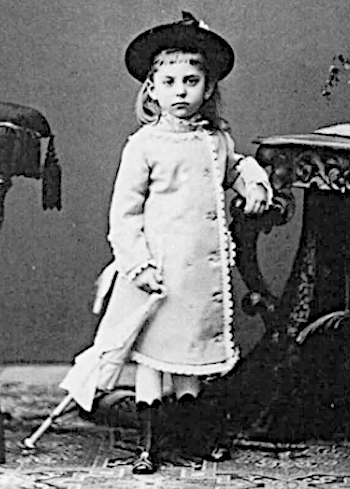
René Rilke. ND.
Sophie Entz and Josef Rilke
Phia, Sophie Entz (1851-1931), was the favoured daughter of rich industrialist and bank director Carl Entz. The Entz family may have been wealthy and respectable, but they were not nobility. In the still feudal Austro-Hungarian empire, nobility was everything.
There was a strange corruption of capitalism, in that it was quite normal, once a fortune had been accumulated, to buy a certificate of nobility from the Emperor, which could cost thousands of Gulden and which required a scandal-free reputation. The Entz family never did this, but certainly the female side obsessively clung to their longing to escape from the monied upper bourgoisie into the aristocracy and thus perpetuated their misery – what a sociologist would call their feeling of 'relative deprivation'.
Sophie married Josef Rilke (1839–1906) in 1873 in high hopes of eventually becoming ennobled. Josef had some genealogical descent fantasy that supposedly made him an aristocrat, but this line of descent did not stand examination. You can draw all the descent trees you want, but the only thing that matters is the Adelsdiplom, the 'Patent of Nobility'.
Sophie was then twenty-three and the connubial clock was ticking. Josef was at that time attempting a career in the Austro-Hungarian military, but as time went on he missed out on the promotions he thought were his due and finally left the military to become an employee of a railway company.
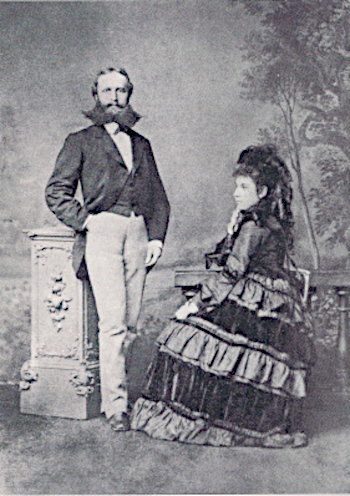
Josef and Sophie Rilke, ND.
The loss of status and the loss of hope of status distressed Sophie, who affected aristocratic airs at an almost psychotic intensity. The couple separated in 1884 after eleven years of marriage, but never divorced – not an easy step to take in a deeply Catholic society. She had married a military chap and ended up with a station-master – a disappointment all round.
For seven years Phia-Pygmalion sculpted her René into the form of the talented aristocratic artist she wished for him. There were lessons in German and French, painting, drawing and poetry. She wished to keep her little René away from the rough, uncultivated boys in schools, so that the already stretched family budget had to pay for private tutors.
In 1882, aged seven, René was sent to the private (and expensive) Catholic Piarist junior school in Prague. He attended that for the next four years and seemed to do quite well in his studies. He was intellectual and studious; his talent for flattery and telling people what they wanted to hear – the coping mechanism he used with his mother – may have helped.
René, the military man
His father and mother had separated in 1884 and something had to be done with René. If his mother had projected the dead daughter Zesa onto him, his father now projected onto him the military man he himself had failed to become. Josef seems to have been resentful about his lowly station in the Austro-Hungarian Empire, the Empire of Paperwork, as we have often called it on this website.
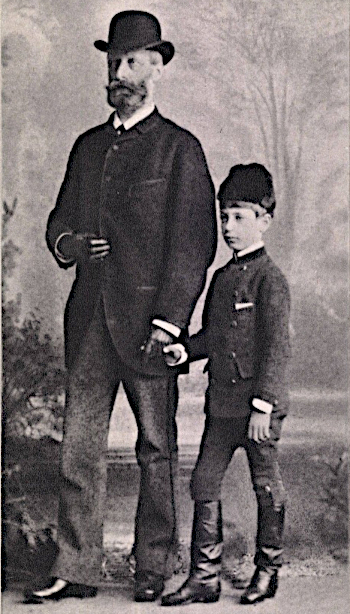
René and his father Josef, 1884?.
Curious readers who can read German and who want a taste of what this resentment must have been like should get hold of an example of one of the annual registers of the still largely feudal empire, each a kind of Who's Who, a pyramid ranging from the gilded, property-owning, landed nobility with an entry in the Almanach de Gotha occupying the apex down through the thousands of functionaries and sub-functionaries and sub-sub-functionaries to the people in charge of the stables – or railway stations. Each with an indispensible, carefully curated title that was in daily use.
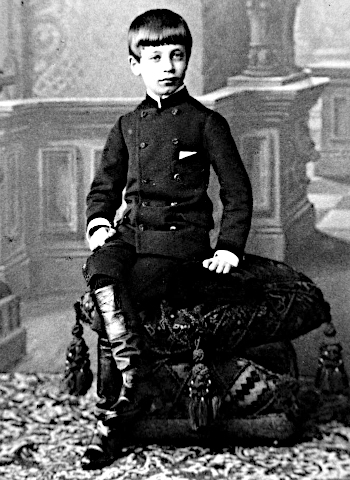
René Rilke in school uniform, ND.
Even after years of expensive education, it was ultimately family rank and connections that were the determinants of getting a job in the pyramid. It was also an advantage to live in Austria, close to the heart of the empire, should you have academic, political or literary pretensions. In the days when long-distance travel was tedious, uncomfortable and slow, for many talented people at the outer edges of the empire the goal was to relocate to the Austrian heartland, and Vienna itself if possible.
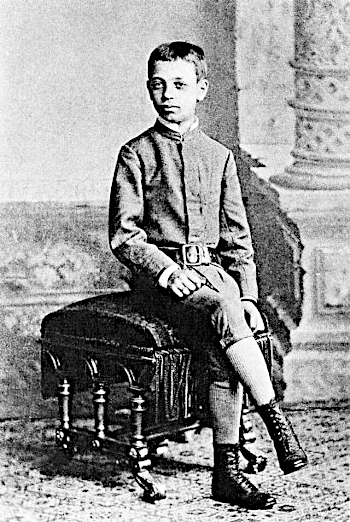
René Rilke in school uniform, ND.
A military career had the advantage that in most cases no lengthy studies were needed and the intellectual requirements were modest or minimal. In this connection, readers may recall the character of Josef Švejk, the hero of Jaroslav Hašek's (1883-1923) renowned satire The Good Soldier Švejk (1923), who was too stupid even for the Austro-Hungarian army and was discharged as an unusable dolt, only to be recruited again. Hašek, from the Czech colony in Prague, was a near contemporary of Rilke's, who came from the German-speaking colony.
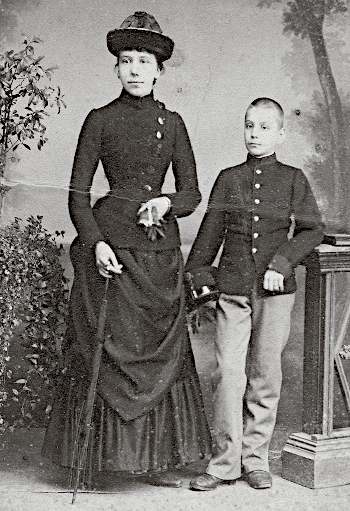
Phia, with René in uniform, c. 1887-1888.
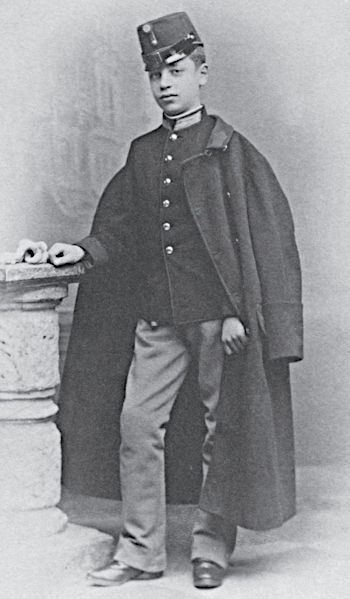
René in uniform c.1887.
Thus it was that father Rilke felt it his duty to try and obtain for the thoughtful, sensitive, feminized and introspective René a career in the military. In short, while his mother was emasculating and emotionally blackmailing him, his father was wanting little René, who was quite short, even for the standards of the time (1.65 m ~ 5'5" as an adult), slope-shouldered, slender and physically weak, but with a high intellect and a linguistic talent, to butch up for a soldier's life. In 1886 René was packed off, aged eleven, to the army boarding school in Sankt Pölten. Phia had his underwear decorated with frills and lacy edges, which, according to some of his biographers, made him an easy target for the school bullies.
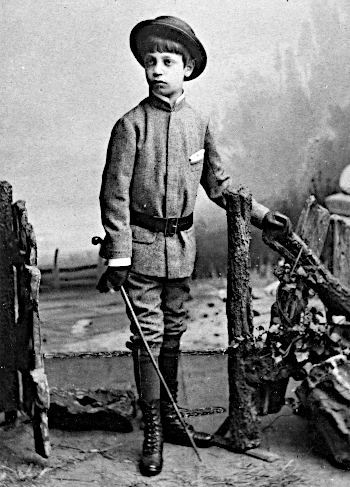
René Rilke, 1885, aged 10. [photo: Langhans Atelier, Prag]
Image: Schweizerisches Rilke-Archiv
After five years there he was transferred to the next step up, the army school in Weißkirchen, Moravia – a place with a character that was diametrically opposite to everything he had experienced so far. According to René it was a brutal, physically demanding, culturally void environment which almost destroyed him. His only defence was in frequent illness. He survived nearly a year of this torture until he was finally removed in 1891, sixteen years old, 'discharged at the request of a relative', on the grounds of 'continual illness'.
We read of no lasting friendships from those schooldays. The brilliant Austrian writer Robert Musil (1880-1942) also attended the army school in Weißkirchen from 1894 (three years after René had left) until 1897, later calling it the Arschloch des Teufels, the 'Arsehole of the Devil'. Musil's scathing novel about his experiences there, Die Verwirrungen des Zöglings Törleß, 'The Confusions of Pupil Törless' resonate with our understanding of what Rilke went through, particularly in respect of the homoerotic and sadomasochistic undercurrents in the treatment of the pupils. A reading of Musil's masterwork, Der Mann ohne Eigenschaften, 'The Man Without Qualities' is also instructive for the character of Rilke in its treatment of 'social otherness', der andere Zustand, the 'other condition' as Musil calls it – an analysis which will have to wait for a future increment of our potted biography… if I ever get to it.
That is the current standard view of Rilke's military upbringing. It seems very plausible, but that is a good reason to distrust it. Caution is always required, since writers are notorious for making things up – that is, after all, their speciality.
Rilke's experience of the Weißkirchen academy may have been grim, but it is possible to view his years in the Sankt Pölten school quite differently. He did, after all, manage five years there, unlike in Weißkirchen, where he did not survive one full year. Let's take a moment to play the advocatus diaboli for the Sankt Pölten school.
After eleven years in the care of his deranged mother and a string of childminders, the four years in Sankt Pölten seemed to do him a lot of good – he found himself among sane people for the first time in his young life.
The pen-pushers in the army of the Empire of Paperwork recorded with great exactitude that in his time there he grew 20 cm taller, gained 13 cm around the chest and added 17 kg in weight. Admittedly, a pubertal growth spurt, but we notice that on his entry into the school he was observed to be blutarm, anaemic, and schwächlich, weakly/puny – just look at the scrawny little stick-insect pictured above with his father, presumably around the time of his entry into the Sankt Pölten school; fours years later gesund, gekräftigt, healthy, stronger.
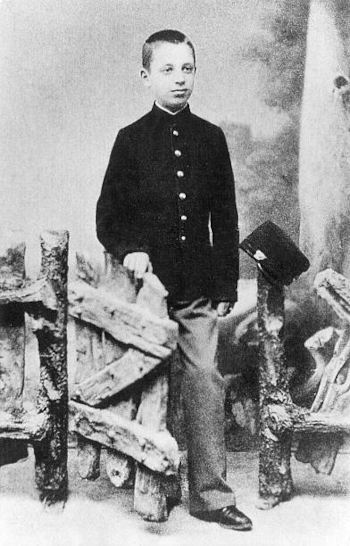
René Rilke in school uniform, ND.
Academically he made progress: as a pupil in his first year he obtained a 'good'; by the end of his time he was achieving excellent marks and his linguistic talent was recognised. His behaviour was praised, sehr artig, bescheiden, zuvorkommend, 'very well-behaved, modest, obliging' and his character recorded as still, gutmütig, sehr strebsam, 'quiet, good-natured, very industrious'. What a swot!
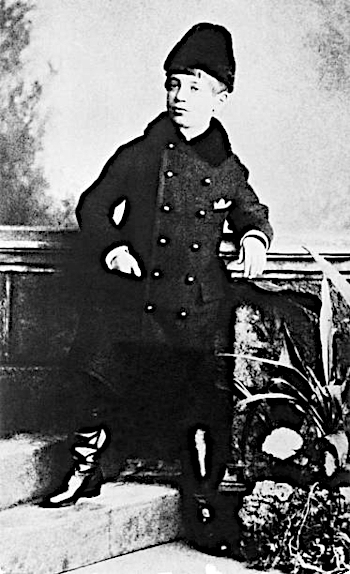
René Rilke in school uniform, ND. He seems to enjoy striking poses in his uniform for the photographer.
Some of the other pupils in Sankt Pölten have written their recollections of Rilke the schoolboy. Note that his school comrades were not lowlife thugs; many if not most of them would rise to elevated positions in later life (if they survived the impending war). The opinions are universally positive and balanced, some recognising the fine qualities of this strange child whilst noting that he was completely unsuitable for a military career.
Rilke was five years long, day and night, among us fifty pupils … he seemed like someone from another world, tender and slender, with small hands and feet, a childish complexion, very, very high voice and he appeared to us like a girl in uniform … clean, carefully groomed to the very tips of his fingers and extremely proper in his conduct.
Rilke war fünf Jahre hindurch Tag und Nacht unter uns 50 Zöglingen ... er war wie aus einer anderen Welt, zart und schmal, mit kleinen Händen und Füßen, kindlichem Teint, sehr, sehr hoher Stimme und schien uns ein Mädchen in Uniform... nett, gepflegt bis in die Fingerspitzen und äußerst korrekt in seinem Gehaben.
Summa summarum, he spent five years in the military junior school in Sankt Pölten without complaint or incident – a model pupil, though clearly not suited to the military life.
His mother had given him a taste for dressing up and he was happy to be seen in his uniform in Prague, even after the end of his Weißkirchen martyrdom. Even in 1908, when he had apparently left the martyrdom far behind him, he expressed his 'great respect and continued thankfulness' towards his former teachers in Sankt Pölten.
Furthermore, it was, after all, the Austrian army which in 1916, at the height of the First World War, kept him tucked away, safely pushing a pen in the War Archive while his contemporaries were being fed into the meatgrinder on the fronts. After four months he was discharged and was free to go on his self-obsessed, artistic way.
However, at some unspecified time after that, a Damascene conversion seems to have taken place, so that by 1920 he was damning everything within the St.-Pöltener Gefängnismauern, 'prison walls of Sankt Pölten'.
Well, that's writers for you – pinches of salt all round are always needed.
I suspect, as usual without any evidence whatsoever, that his intense relationship with the most important woman in his adult life, Lou Andreas-Salomé, eventually did for him. She was a passionate exponent of the psychoanalysis craze then in its infancy, a friend and disciple of Sigmund Freud, whom Rilke also got to know. The last thing the already mentally screwed up, self-obsessed Rilke needed was someone 'interpreting' his psyche and his subconscious for him. That would certainly have 'done his head in', to use the modern vernacular. He had been dreadfully mistreated in Sankt Pölten, he just hadn't realised it.
Escape
After leaving the military school in 1891 he started to study at the Business Academy in Linz. The idea of René Rilke, someone who was dogged by permanent cash-flow problems for the rest of his life, as a business trainee was absurd, but the studies and the environment were at least sane compared to what he had been through so far in his life.
His rich uncle Jaroslav, the successful Rilke, still hoping that René would manage to make himself employable, paid for his upkeep in Linz. It was Jaroslav who had got father Josef his job with the railway after his military career imploded – the entire Austro-Hungarian Empire ran on patronage and recommendation. René lasted about six months at the academy, until a childrens' nurse had a rather seedy fling with him, which resulted in his expulsion. More or less seedy flings would become one of Rilke's specialities.
Uncle Jaroslav, though annoyed at this turn of events, continued to support him financially in his studies, which allowed him in 1892 to return to Prague, where he stayed with an aunt (rather than his father) and where he undertook three years of intensive private study and tuition that culminated in the Matura in 1895, passed with distinction. There can be no doubting Rilke's intellectual capacity.
It was in this time (January 1893 to December 1895) that he acquired his first notable girlfriend, Valerie von David-Rhonfeld (1874-1947) – probably much to the distress of her aristocratic family when she brought her stray, spindly, rather odd-looking poet home. Her father was Emil Freiherr David von Rhonfeld (1837-1918), a much-decorated artillery General in the Austro-Hungarian Imperial Army. He was also Governor of the Kingdom of Dalmatia.
They were right to be worried, for she part-financed Rilke's first book of poems (Leben und Lieder, 1894) by putting up her pocket money and pawning pieces from her grandmother's lace collection.
As one of his biographers points out, the relationship with Valerie set a pattern that was the same for almost all of the subsequent relationships he would have with the many artistic young women who would fall for him: he bombarded her with hyperbolic love letters, sometimes handed over in person at their meetings, but when the moment came, as it always did, sooner rather than later in most cases, he would move on and leave the once-revered belovèd hanging in silence and get himself some peace and quiet to write and travel, as though she had never been.
Most of his girlfriends took the dumping in their stride; Valerie, who never married, took revenge: around thirty years after her dumping, a few months after his death, she sold his letters to a dealer, accompanying them with a blistering commentary on Rilke which listed all his defects. Hell hath no fury like a woman scorned:
René suffered badly from stomach upsets, his face was extremely disfigured by spots and pustulant pimples, his features were common and repellently ugly, his breath was unbearable.
René […] litt schwer an Magenverstimmungen, sein Gesicht war von Finnen und Eiterpusteln masslos entstellt, zumal seine Züge von abstoßender gemeiner Hässlichkeit waren, und sein Atem unerträglich war.
Koch p. 71. quoting VDR, 278 (Erinnerung von Valerie von David-Rhonfeld). RMR: ‹Sieh dir die Liebenden an›. Briefe an Valerie von David-Rhonfeld. Hg. v. R. Scharffenberg u. A. Stahl. Frankfurt/M.; Leipzig 2003
She put up with that and much more for almost two years, it seems.
In 1896 he immatriculated at the University of Prague, reading Philosophy, History of Art and German Literary History, Then, to keep his donor Uncle Jaroslav the lawyer happy, he enrolled in the summer of 1896 in the Law faculty. His father also supported him with a fixed sum every month which, according to his father, should have been sufficient for his daily needs with occasional extras. That support continued until the death of his father in March 1906, sixty-five years old. René had partially reconciled with him the year before. He attended his funeral, but Phia, the estranged wife, did not turn up, to the relief of René and probably the great relief of the shade of his father, too.
After a year in Prague he transferred to the University of Munich.
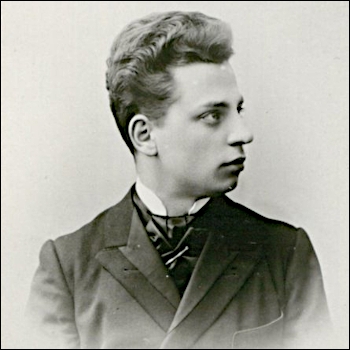
René Rilke, 1897.
Free at last
After about twenty years, the nightmare that had been his childhood finally passed. The moment of that transition is marked by a simple rite of passage and metamorphosis: the moment he changed his name from René to Rainer. That name change occurred during his first relationship with the most important woman in his life, Lou Andreas-Salomé (1861-1937).
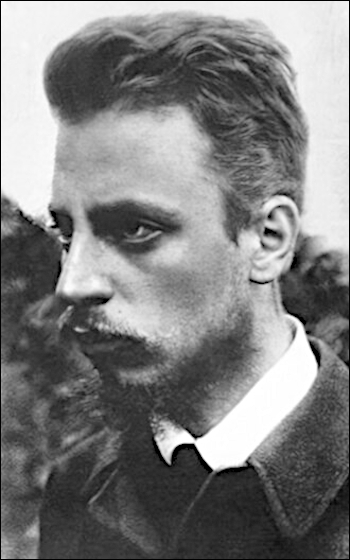
Rilke, now Rainer Maria, 18 September 1900.
Nowadays our expectation would be, that from such a psychologically perverted childhood only a drug-addled and/or alcoholic adult wreck could be expected to emerge. Although we could never call Rilke 'normal' – he had too many harmless and not so harmless oddities for that – his monomaniacal drive to write was the thread around which his mind and his existence was organized. This need had begun early; it kept him going throughout his childhood and became the central obsession of his adult life. When he was not writing his literary works, he was writing letters: well over a thousand to his mother alone, despite the discomfort he felt in her presence on the rare occasions they met face to face.
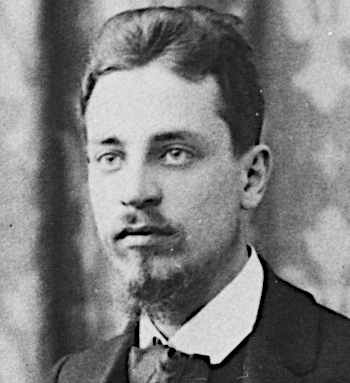
René Rilke, 1904.
0 Comments
Server date and time:
Browser date and time:
Input rules for comments: No HTML, no images. Comments can be nested to a depth of eight. Surround a long quotation with curly braces: {blockquote}. Well-formed URLs will be rendered as links automatically. Do not click on links unless you are confident that they are safe. You have been warned!