
1901-1926, life and literature
Richard Law, UTC 2026-08-27 08:17
The reader who has managed to get this far in our potted Rilke biography is now entering a period of manic projects and relocations, thirty years which cannot be covered in a paragraph or two. Our starting point is 1897, the year he met Lou Andreas-Salomé and changed his name from René to Rainer. Here are some broad-brush take-aways, for those in a hurry:
Executive summary
- Rilke the nomad: Once his education was behind him, Rilke travelled as though there were no tomorrow. Most of his stays were only a few months long – odd behaviour for someone whose goal was to be left in peace and quiet to write, but given Rilke's childhood 'imprisonment' at home and in boarding schools, his newfound freedoms were there to be enjoyed. The result is a biographical patchwork quilt that cannot be compressed into a couple of paragraphs. Your author's view of the reason for Rilke's nomadism is that it is simply the parasite jumping from host to host.
- Zipless sex: He was quite a chick magnet, although anything but a hunk: even his admirers commented on the defects of the bottom half of his head; the top half with his hypnotic eyes was the attraction. His feminine nature and sensitivity seem to have made him irresistable to a certain type of artistic young woman, usually visual artists or musicians. He had a fling with a writer (Lou Salomé was Oedipean mothering, no 'fling') but she was the exception to the rule; the late life fling with the writer Erika Mitterer might also be an exception, but you have a lot of reading to do before we get to that. These liasons were brief; though not completely zipless in Erica Jong's strict sense, the zips were very short. The end of a relationship was often signalled with a Rilkean health crisis, before he moved on, just wanting to be alone with his own thoughts and his pen. At some point the belovèd would get the message that the zipper had run off the end.
- Mendicant writer: He was usually short of money, despite having a supportive publisher who sent advances on demand and a circle of aristocratic supporters. He was a master of the oblique begging letter. He decided early on in his career that a great artist such as he should not waste his precious time writing for money. I have never read any account of financial support for his wife and more particularly his daughter Ruth, who seems to have been very dependent on the good offices of her grandparents.
- Parasite: He enjoyed the financial and emotional support of a series of rich, aristocratic women, who put him up or who gave him the use of their spare properties with servants and cook included, or even bought properties for him to occupy. He was a fussy, generally vegetarian eater and his sponsors sometimes had difficulty finding a cook who could meet his special requirements. As far as we know, the relationships he had with his supporters were platonic, but, given that this is Rilke, some level of Oedipus complex was probably never far away. Phia's deep-seated snobbery never left him: he lived in other people's grand houses and castles with servants at his bidding, or stayed at noble hotels at other people's expense. Occasionally he had to live in a bourgeois apartment, but with the rent paid by someone else.
- Ahistorical: He lived through a time of social upheaval, but never questioned the class structure on which he relied to sustain him. Revolutionaries such as Bertolt Brecht held him in contempt. For Rilke the class 'underling' was a given – he always preferred that his servants should be uneducated and incurious, thus avoiding the embarrassment of a minion asking him about his work or attempting a literary conversation with him. He was incapable of affecting the common touch.
- Obsessive letter-writer: Despite usually wanting to keep his distance from other people, he was a manic writer of letters, preferring, it seems, controlled literary interaction on paper to the social intensity of face-to-face contact.
- Going off the rails: His poetry also went on a long journey, from skilful craftsmanship, metrically impeccable, to incomprehensible, self-obsessed nonsense. As we noted in connection with Ludwig Wittgenstein's disastrous retreat into isolation so that he could think and write undisturbed, isolation and overthinking brings on the detachment from everyday reality that we usually call madness. It did that with Wittgenstein and it did that with Rilke.
- A suitable case for treatment: Rilke's mental state hovered between neurotic and psychotic, interspersed with patches of near normality. Most of his early poetry focussed on the description and interpretation of the objective world around him and much of it is very fine – well observed and beautifully written. Between about 1903 and 1911, arguably as a consequence of his involvement in psychoanalysis, he became more and more self-obsessed: The semi-autobiographical Die Aufzeichnungen des Malte Laurids Brigge (1910) and Ewald Tragy (1898) regurgitated his fractured childhood and youth, keeping old wounds unhealed and festering. In 1911 he started the Duineser Elegien (1912-1922) and was done for. We shall discuss the incomprehensibility of the Elegien and Die Sonette an Orpheus (1923) in another article. Let us just state for the moment that these late works present a mental world that no sane person can share or comprehend.
- Literary beatification: For some reason beyond your author's understanding, after his death Rilke ascended into the German literary heaven where he is seated on the righthand etc. etc. Insel Verlag, which kept Rilke above water financially from 1905 until his death, has had the milking machine connected to their cash cow ever since: Complete Works and not so Complete Works in various multi-volume formats, single volumes, paperbacks and so on. Wallstein Verlag is now playing catchup with, among other editions, a 26 volume 'historical critical' edition. The worshippers at the Rilke altar need many metres of sturdy bookshelves and very, very deep pockets to manifest their adoration.
Throughout this second part of our biographical overflight I have tried to supress my contempt for Rilke the man and Rilke the artist, but have often failed. I regret the lack of self-control, since it was no fault of his that his 'poor little, wandering, gentle soul' was placed into the care of such bizarre parents and emerged as a largely worthless, egocentric human being with hardly any redeeming features.
Acts of selflessness are few and far between. His wife was dumped, his daughter was dumped, his lovers were dumped, he was the cuckoo in Lou Salomé's marriage, his supporters were milked of cash and benefits.
His self-obsession was so great that the quarter century of turmoil in Europe through which he lived, the shifting of the great tectonic plates of history under his feet, passed largely unremarked by the poet's focus on small things and on himself. He has no original thoughts to contribute at all; his poetry and prose are intellectually empty. His mother and her family longed for nobility; it is no surprise, therefore, that René spent much of his adult life feeding like a tick off the refined blood of the aristocratic circles which adopted and sustained him. He had no interest whatsoever in the fate or the doings of the common people nor the wider world around him.
The Lou years, 1897-1900
1897 — Munich/Wolfratshausen, Berlin
After more than 20 years of mother-fixation under the demented Phia, Rilke encountered a strong-willed, intelligent and talented woman, one of the outstanding females of her generation, Lou Andreas-Salomé (1861-1937).
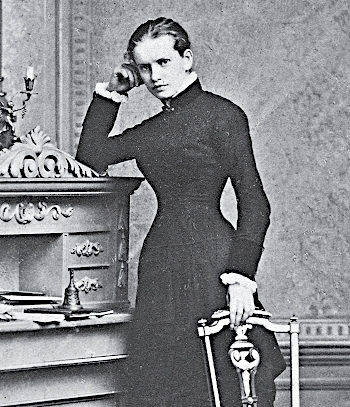
Lou Salomé, c.1880.
She had had the self confidence in 1882 to reject her suitors Friedrich Nietzsche (twice) and the philosopher Paul Rée. Nietzsche was angry but – ever the rationalist – got over it; Rée died in 1901, it is suspected by his own hand, seeking oblivion. In 1887 she married the orientalist Friedrich Carl Andreas, on the condition that the marriage was sexless. It eventually dawned on Andreas that the 'no sex clause' only applied to him, which led to some temper tantrums.
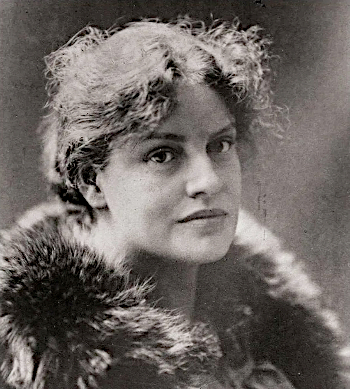
Lou Andreas-Salomé, 1897.
In 1897 Lou took the young Rilke under her wing as a lover and as a suitable case for psychoanalytic treatment. She was 15 years older than he was and thus was without doubt also something of a mother figure for the emotionally crippled young man. They met in Munich. It was she who suggested that he change his name from René to Rainer.
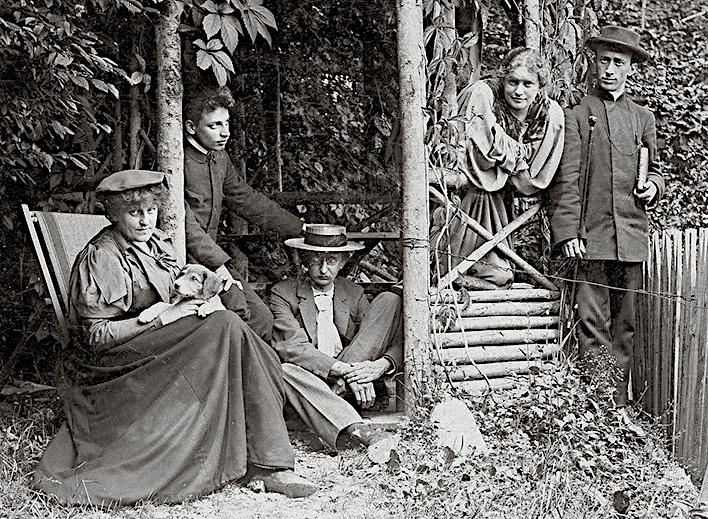
Frieda von Bülow, Rilke, August Endell, Lou Andreas-Salomé, Akim Wolynski in the arbour of the 'Lutzhäuschens' in Wolfratshausen 1897.
Scribblers United: Frieda von Bülow (1857-1909) was a German writer, a particular friend of Lou Andreas-Salomé (I regret to say that I do not know the name of the dog); August Endell (1871 in Berlin-1925) was a German Art Nouveau architect and art critic; Akim Wolynski (1863-1926) a Russian literary and art critic with a particular hang to Russian mysticism. Lurking in the shadows, Rilke has eyes for only one person there.
He followed her when she moved back to Berlin in the autumn of 1897, at first to a small apartment of his own, then, from the summer of 1898, he lived in a strange ménage à trois in the house of Salomé and husband. These weeks of normal domesticity and household chores in the service of a woman seem to have done the spoiled Rilke some good. [Works: Dir zur Feier, Advent]
1898 — Berlin, Florence, Viareggio.
Seemingly as part of the education of her adopted poet, but probably also to give herself a break from the scrambled psyche of this wearingly intense young man, Lou cut the mental umbilical cord with Rainer and packed him off to Italy on his own with a list of things to do and see. He arrived in April 1898 and stayed for about six weeks.
Lou made him keep a diary, in which he dutifully recorded his jejune thoughts on art, artists and God. Rilke's jottings are just vacuous introspection – thinking without ground beneath his feet. The reader becomes thoroughly bored with Rilke's pondering his 'complicated state of mind' (©W.S.Gilbert); we read almost nothing about interesting things such as his stay, the place itself or his interactions with others, just uninformed speculations without understanding.
On 11 May he travelled on to Viareggio, on the coast of the Ligurian Sea, returning to Berlin at the beginning of June. It appears that Lou wasn't very impressed with his diary, a feeling we can completely understand. [Works: Florenzer Tagebuch, Ewald Tragy]
1899 — Moscow und St. Petersburg, Berlin.
In April Lou (38), her husband Carl (53) and her poet toyboy Rainer (24) set off for a three month tour in Russia. Lou had been born in Russia; in anticipation of the visit, Rainer immersed himself in Russian language and literature and grew a straggly, Russian-style beard. He fell in love with the country before they had even set off.
Husband Carl frequently had difficulty repressing his jealousy, so that Lou and her young poet had to be discreet. Rilke fell in love with Russia and everything Russian; he was particularly moved by the mystic woo-woo of the Russian Orthodox Church that spoke to him more than the woo-woo of his Catholic upbringing. [Works: Stundenbuch (1/3); Cornets draft; Mir zur Feier]
1900 — 05-08 2nd Russian tour; Berlin, 08-10 Worpswede, Berlin.
Lou and Rilke made a second trip to Russia. Carl did not go with them this time, so the two lovebirds could be much more lovey-dovey – and Rilke even clingier. Rilke's romantic infatuation with Mother Russia deepened. By this time he was dressing like a Russian. Rilke always had a heightened dressing up sense, perhaps another aspect of his feminine side which reflected the current state of his soul: we recall little René in his girly dresses and little René in his school uniforms; many who met him in later years noted that he was always dressed punctiliously as a gentleman; now we find the lover of all things Russian dressed accordingly.
They met Tolstoy for a second time but were disappointed that he was now politically active in the cause of the peasants and not interested in supplying them with more Russian woo-woo. 'Artists are the antennae of the race' (©Ezra Pound). However, although Tolstoy clearly sensed that something was coming, neither Rilke nor Salomé's antennae registered what would become of their Russian delusion in a mere 17 years; for him, the Russian peasantry was merely a decorative feature within the mystical landscape of his mind.
Overwhelmed with thinking, in the last month of their Russian tour Rilke sank into a psychotic crisis with which even the in-house psychoanalyst Lou could not cope: in an act of self-preservation she abandoned him and fled to visit her family in Finland. He was saved by an invitation he had received to join the artist colony in the town of Worpswede (near Bremen), a crutch which would replace the one he lost with the departed Lou.
He arrived on 27 August in Worpswede, dressed like a pint-sized Rasputin. He began a serious relationship with the sculptor Clara Westhoff (22) and a flirty relationship with her friend, the painter Paula Becker (24) [Works: Stundenbuch (1/2); Die Weise von Liebe und Tod des Cornets Christoph Rilke draft; Mir zur Feier]
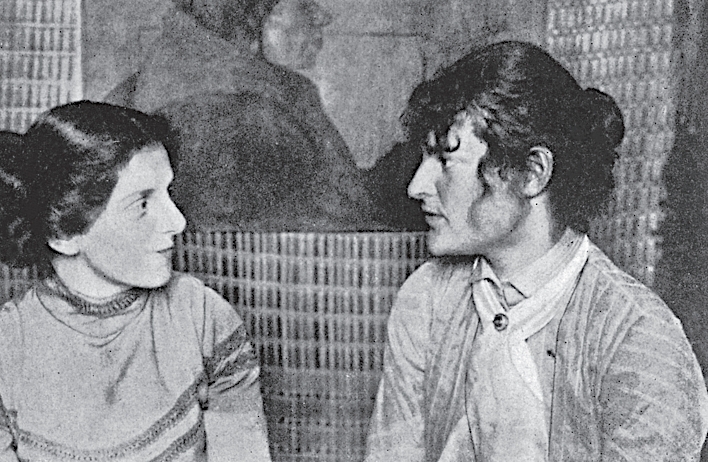
Paula Becker and Clara Westhoff (right) in conversation in Worpswede.
Rilke on tour 1901-1914
1901 — Worpswede/Westerwede, Dresden.
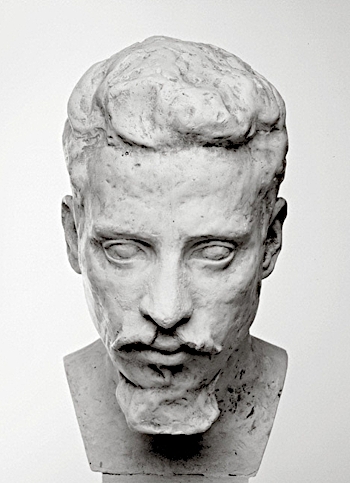
Clara Rilke-Westhoff: plaster bust of Rilke, 1901.
Lou Andreas-Salomé finally dumped Rilke in February. Rilke, possibly on the rebound, moved on and married Clara Westhoff in Worpswede/Westerwede in April, daughter Ruth was born in December. On every level the pairing of this odd couple, the dainty writer and the muscular sculptress, defies all reason; even more so their immediate production of a child. We have to file that under the mysteries of the human heart.
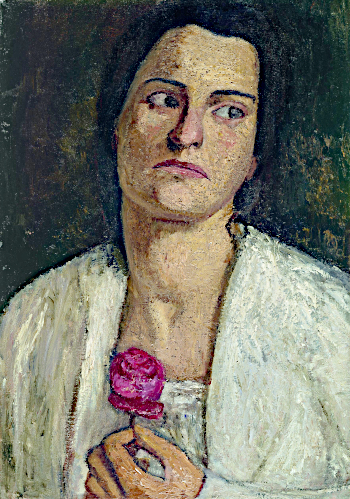
Paula Becker, Portrait of Clara Westhoff (1905). Image: © Hamburger Kunsthalle.
For the honeymoon they betook themselves and their various ailments, real and imagined, to a sanatorium in Dresden. [Works: Stundenbuch (2/3)]
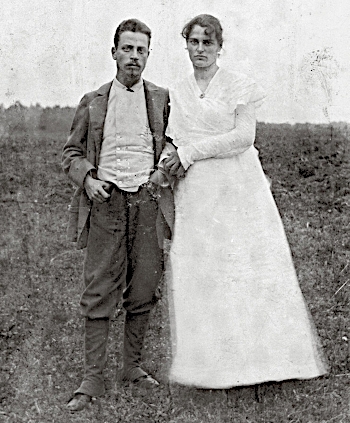
René Rilke (still in a Russian shirt) and Clara Westhoff on their wedding day.
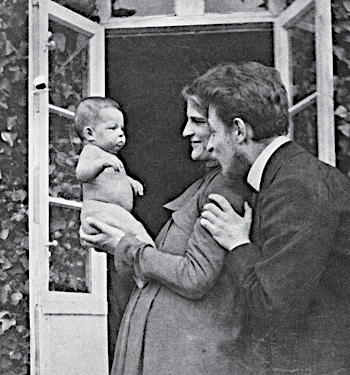
Clara Rilke-Westhoff with René and baby Ruth. Ruth's expression shows that her simple soul has not yet come to terms with the two strange people who have brought her into the world.
1902 — Dresden, Westerwede, Paris
The end of May they returned from the sanatorium to a small house in Westerwede. The disaster of the pairing of the odd couple was already becoming clear, mainly driven by Rilke's narcissistic, egocentric personality. In August Rilke and Clara went to Paris to meet and write about Rodin; Ruth stayed with Clara's grandparents.
1903 — Paris, Viareggio, Paris, Rome
In April Rilke had another psychotic crisis, which was followed by a reconciliation with Lou. In May Rilke returned to Paris, then in September went to Rome with Clara. The Rilkes' marriage was already on the rocks; Rilke had by now formed the opinion that marriage and great art were incompatible. From now on, whenever together, they would almost always live separately. [Works: Stundenbuch (3/3); Briefe an einen jungen Dichter; begins Neue Gedichte]
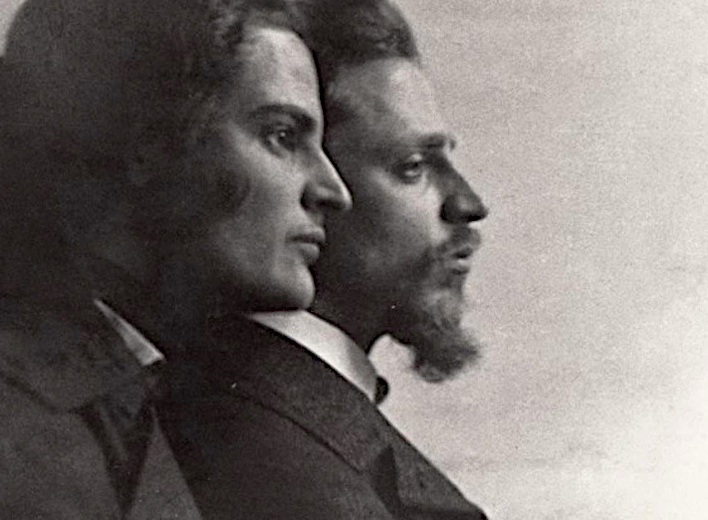
Clara Rilke-Westhoff and Rainer Rilke, c.1903
1904 — Italy, 06-12 Sweden/Denmark.
Rilke began a friendship with the Swedish writer Ellen Key (1849-1926), another mother figure: Key was 55, Rilke 29. As would be the case with all his other middle-aged female sponsors, she took him under her wing. She arranged accommodation for him in southern Sweden with the painter Ernst Norlind. Rilke and Clara met Key in person at the end of August. Clara returned to Germany at the beginning of October. Ellen Key found further free board and lodging for him in Furuborg. [Works: begins Malte].
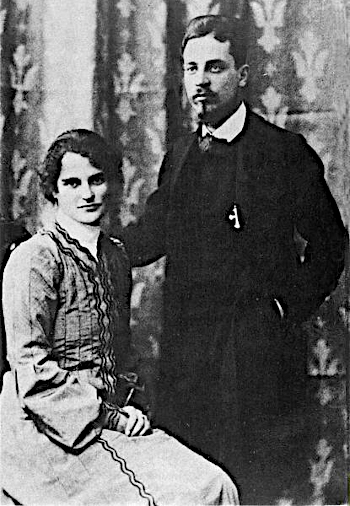
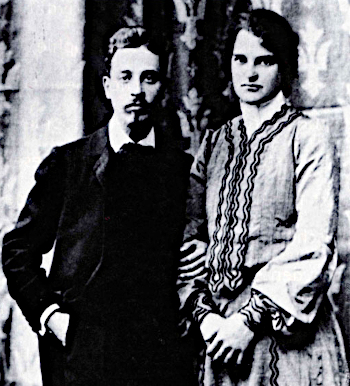
Rilke and wife Clara photographed in 1904.
1905 — Dresden, Berlin, 09 Paris, 10 Germany, Austria
Yet another sanatorium stay in Dresden (anaemia once more, the peril of an idiosyncratic vegetarian diet). Rilke decided he needed to study and enrolled at the University of Berlin. His studies lasted about a month, before he took up an invitation he had received when he was in the Dresden sanatorium from the fifty-two year old Countess Luise von Schwerin (1853–1920), that he could stay in Schloss Friedelhausen, Marburg, for several weeks. This brought him in contact with the rich and influential people within her elevated circle; it was the launchpad of the model of aristocratic funding that would be with him for the rest of his life. He stayed there for a total of six weeks.
In a further stroke of luck Rilke was taken up as an author by Anton und Katharina Kippenberg's Insel-Verlag in Berlin; they had some costs keeping their new poet afloat during his life, but after his death Rilke's work became one of the cash cows of their publishing house.
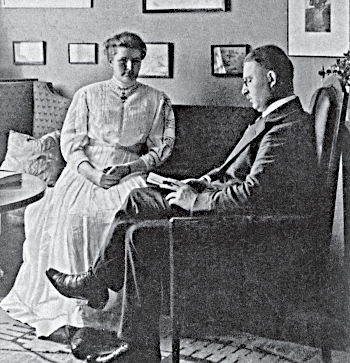
Katherina and Anton Kippenberg, the owners of the publishing house Insel Verlag.
In the course of the year Rilke replaced his Swedish/Danish support group with his new support group of German aristocrats – good timing, for he began to fall out with Ellen Key. She had taken her apostolic role in the glorification of Rilke seriously and began producing essays and articles and giving lectures about him, putting information into the public domain that Rilke preferred to keep away from strangers. In September 1905 Rilke went to Meudon/Paris to be Rodin's private secretary.
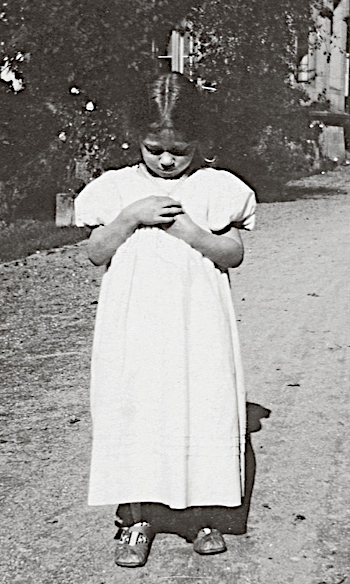
Ruth Rilke, 1905. Not really camera ready, unlike her father, who as little René always struck a pose and met the camera eye-to-eye.
1906 — Germany, Prague, Paris, Belgium, Capri
Josef Rilke died in March. Rilke undertook two lecture tours on the subject of Rodin; in May Rodin dismissed Rilke (for secretarial incompetence, unsurprisingly). In Paris Rilke encountered Ellen Key, distancing himself from her even further.
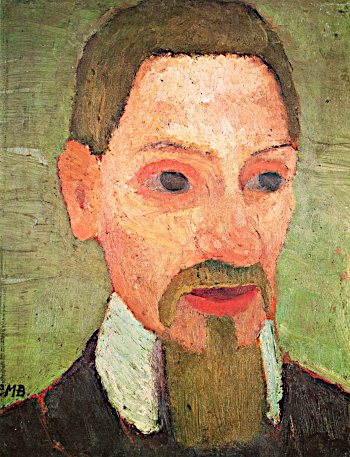
Paula Becker, Portrait of Rainer Maria Rilke, 1906.
Rilke travelled in Belgium with Clara and Ruth; he was invited by Alice Faehndrich to spend the winter in Capri at her Villa Discopol. Faehndrich was the widowed sister of Countess Luise von Schwerin. Rilke arrived at the beginning of December; he had his own pavillion in the grounds and stayed for five and a half months. [Works: Gedichte, Cornets (3rd version) ]
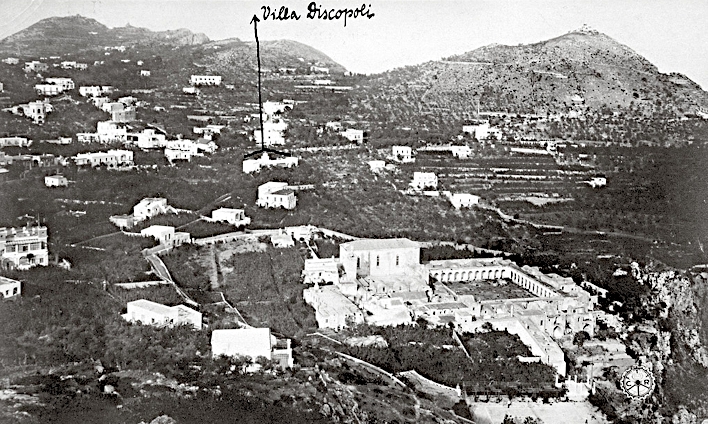
A postcard of Capri from Rilke to Clara Westhoff-Rilke, dated 09.12.1906, with the Villa Discopoli marked.
1907 — Capri, Paris, Venice
He met Ellen Key on Capri in March; returned to Paris at the end of May. In late autumn he went to Venice for ten days, where he acquired his next girlfriend, the beautiful and talented pianist Mimi Romanelli. [works: Neue Gedichte(1/2)]
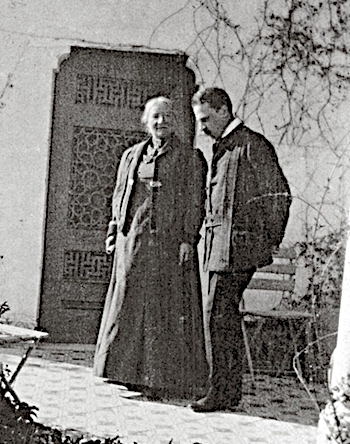
Ellen Key and Rilke, 03.1907?
1908 — Capri
A critical letter from Ellen Key in October 1908 ended their relationship. Key, who was passionate about the welfare of children, had become a de facto grandmother to his daughter Ruth (Clara seems to have been a rather disorganized and improvident mother). [works: Requiem für eine Freundin]
1909 — Provence, Bad Rippoldsau
In December Rilke obtained yet another 'noble adoption', this time by Princess Marie von Thurn und Taxis (1855-1934). She was 54, a culture-obsessed, art-collecting polyglot who heard of Rilke from some members of her Paris salon.
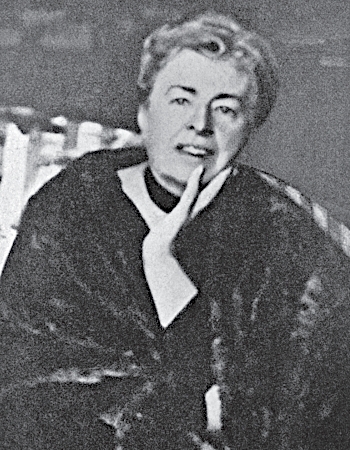
Princess Marie von Thurn und Taxis, ND.
1910 — Many locations
In this year Rilke attained peak nomad. Since we are not attempting a comprehensive biography a list of the many places he hung his hat in 1910 will have to do: Leipzig, Jena, Berlin, Leipzig, Weimar, Berlin, Rome, Duino (Princess Marie von Thurn und Taxis), Venice, Paris, Oberneuland, Franzensbad, Schloss Lautschin (guest of Princess Marie), Munich, Schloss Janowitz (guest of Baroness Sidonie Nádherný (1885-1950) pen friend 1906-1926), Riva (Lake Garda), Munich, Cologne, Paris, Marseille. [works: Final edit of Malte]
1911 — Egypt, Weimar, Leipzig, Munich, Duino.
More wanderings, then for about six months, from 22 October 1911 until 9 May 1912, he was the guest of Princess Marie von Thurn und Taxis in Schloss Duino, Trieste. (The castle was seriously damaged in February 1916 by bombardment during the First World War.)
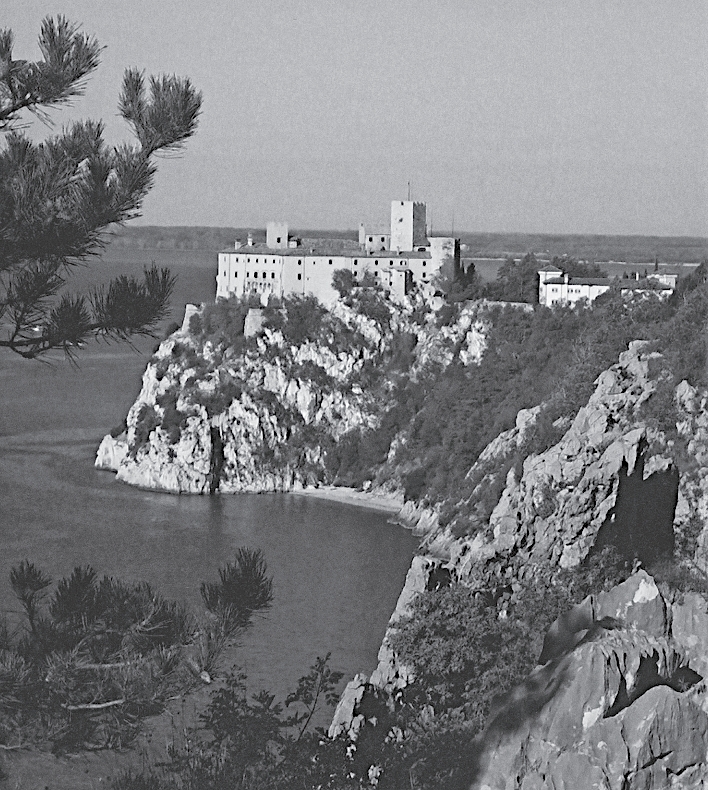
An archive photograph of the Castello di Duino near Trieste. This is the place that Rilke would know, before its being damaged in 1916.
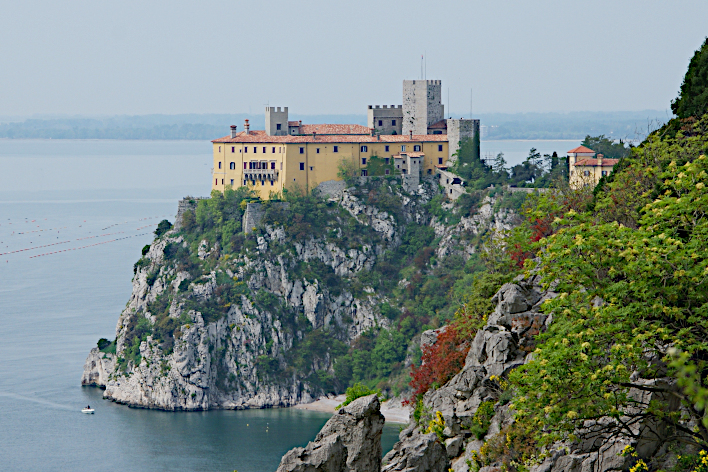
A modern photograph of the Castello di Duino.
1912 — Duino, Venice, Toledo, Ronda
Rilke stayed until 9 May in Duino, then from May until September he stayed in Venice, in an apartment owned by Princess Marie. In September he returned to Duino in the company of Marie's family for a month. Then, in his mind, the Spanish city of Toledo mystically called for him to come and visit. He was there from October, then he moved on to the more southerly and warmer city of Ronda in the south of Spain. [works: D-Elegies 1, 2]
1913 — Ronda, Paris, many locations in Germany
End of February 1913 he left Spain for Paris; from the beginning of June he was in Bad Rippoldsau for a spa treatment followed by manic tour of sanatoria: Heiligendamm (Ostsee), Kochel am See (Bavaria), Krummhübel/Karpacz (Poland); including an equally manic tour of German cities: Göttingen, Berlin, Hamburg, Leipzig, Weimar (accompanied by his publisher Anton Kippenberg), Munich (meeting with Sigmund Freud), Dresden. Mid-October back to Paris. [works: Gedichte an die Nacht, D-Elegy 3]
1914 — Paris, Berlin, Duino, Venice, Irschenhausen
At the end of January Rilke (39) received a fan letter from the pianist Magda von Hattingberg (1883-1959, 31) to which he replied with a barrage of increasingly hyperbolic declarations of eternal love. In our social media age, this behaviour would cause any sensible modern woman to run for cover or call the cops.
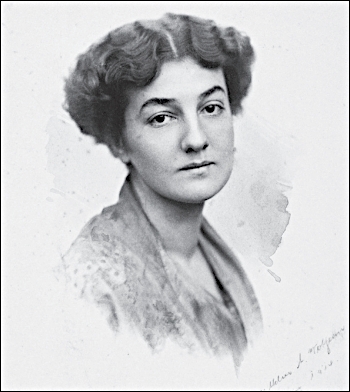
Magda von Hattingberg, ND.
On 25 February he travelled from Paris to Berlin to meet her; from 10 March Rilke accompanied her on a concert tour: Munich, Innsbruck, Zurich, Winterthur, Basel and then to Paris; after three weeks in Paris together they both travelled to Duino as the guests of Princess Marie from 20 April to the beginning of May. Rilke and Magda travelled to Venice, which was where, after four months, the eternal love finally evaporated and Magda was finally dumped unceremoniously; he returned to Paris alone.
In September he began a relationship with the painter and writer Lou Albert-Lasard (1885-1969, 29), nominally still married to Eugen Albert (1856–1929, 58) and with a three year-old daughter. The couple moved into a Munich guesthouse.
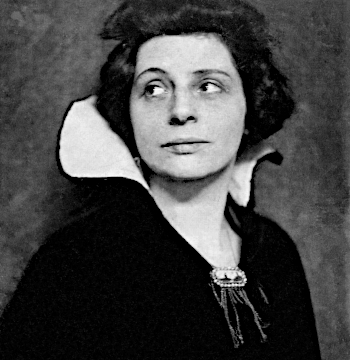
Lou Albert-Lasard, c. 1916 Image: Hanns Holdt
That October Rilke received an anonymous donation of 20'000 Kronen (~€100'000). Rilke was never told, but the money came from that other crazy Austrian, Ludwig Wittgenstein, who was unloading the fortune he had received after the death of his father.
Rilke wisely nominated his publisher Anton Kippenberg as administrator of this money, then came to regret this as, within a few months, only about 10'000 Kronen were left, once Rilke's many outstanding debts had been settled.
It is characteristic of Rilke's monumental ego and disregard for others that, without Kippenberger's upright management, his personal wish was to blow through the money and leave the existing debts and creditors to take care of themselves. As far as he was concerned, the donation had been divinely intended for him and him alone and not his many creditors. A few more months and by October 1915 most of the remainder was gone.
War and revolution 1915-1918
1915 — Munich
By February 1915, after four months of sharing his life with Lou Albert-Lasard he finally tired of her. The relationship fizzled on until the late summer of 1916.
As an aside, she would be one of the seven people who turned up at his funeral on that icy day in January 1927, whether to worship at his grave or dance on it, who knows? She would outlive him, the scoundrel, by forty-three years.
From June until October he invited himself to stay in the apartment of the writer Hertha Koenig (1884–1976, 31) in Munich. At the beginning of October there was a meeting with his mother in a vegetarian restaurant in Munich. It would be their last face-to-face encounter. He took Hertha Koenig along, not wishing to face this still dominant woman alone.
In November the Austro-Hungarian military declared him fit to serve. Weedy little René was quite capable of carrying a gun and being shot or blown to pieces for the Fatherland. In the search for cannon fodder, the Austrian authorities were clearly not too particular about the quality of their warrior heroes. [works: seven 'Phallic Hymns'; D-Elegy 4]
1916 — Vienna, Munich
He was to report for basic training as an infantryman in Vienna on 4 January. After three weeks of this mild horror he was assigned to the War Archive in Vienna, writing propaganda texts. It was clear from the beginning that Rilke was spiritually incapable of even this task and so he was set to ruling tabulation lines on sheets of paper for payment records.
His time in the service of the Emperor lasted about four months. After some string-pulling by his friends he was demobilised from the army on 9 June and from the War Archive on 27 June. It had all been just as Ismene had told her mother long before: 'René is a Nichtsnutz', a 'good-for-nothing'. He returned to Munich in mid-July.
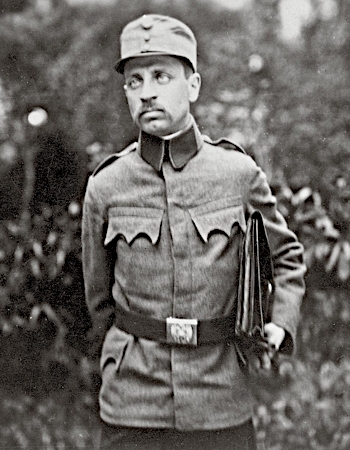
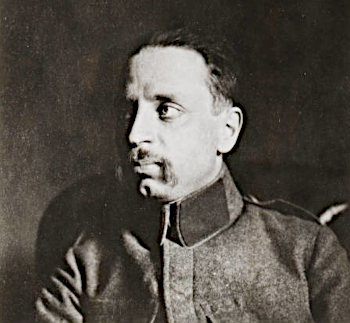
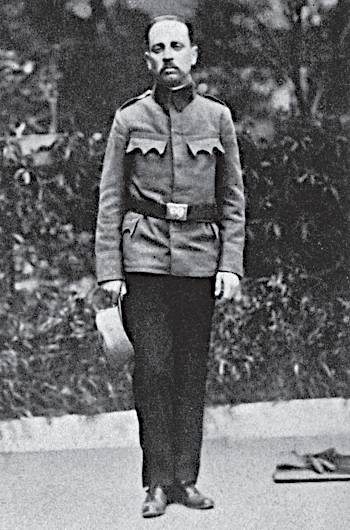
Rilke in uniform 1916, ready to strike terror into the enemies of the Emperor.
1917-1918 — Munich
Rilke stayed in Munich from mid-July 1916 until 1919. After the nomadic life of the pre-war and war years he was able to settle down in some places he could call his own – except, of course, they were not his own but searched out and paid for by friends, who even found him a woman to cook and clean for him.
During his three years in Munich, Rilke had to cope with an astonishingly long queue of sensitive, artistic young women who beat a path to his door. As we have already noted, the pattern was always the same: sensitive chick (they were younger than ever before) writes adoringly to him; receives exorbitantly hyperbolic letters from the master himself; rocks up at his door, gets the 'look deep into my eyes' treatment.
His biographer Manfred Koch believes that when things got hot the limp-wristed Rilke was more likely to be the seduced rather than the seducer. [p. 354] Chick bliss – probably asexual, but who knows? – lasted a few days or a few weeks, until the adoration became tiresome to Rilke and said chick was abruptly dumped Rilke-style. I leave it to the writers of proper Rilke biographies to document this parade of dim young women in detail – I don't care who these dimwits were and what happened to them and nor should the reader. The consequence for Rilke was that his Munich years were relatively unproductive.
1919 — Munich, Switzerland
Great events caught up with Rilke at the beginning of 1919. Arising out of the chaos and humiliation of the end of the First World War, on 6 April 1919 a group of socialists and anarchists established the 'Bavarian Soviet Republic' (Räterepublik). The dream lasted all of six days before being overthrown in a communist putsch. The socialist softies stood no chance against the experience, confidence and brutality of the communists. Hitler and Co. were watching and learning.
Oh, the irony! Only two years before, Germany had transported Lenin and his followers in a sealed train from their asylum in Zurich and injected them, the communist 'bacillus' as Churchill put it, into Russia, intending to precipitate the Russian Revolution.
The group left Zurich on Easter Monday, 9 April 1917; on 16 April they reached Petrograd. Six months later Lenin would be the leader of Bolshevik Russia. On 15 December 1917 a German-Russian armistice was called and on 3 March 1918 a peace treaty was signed – within one year, the job was done and dusted, the bacillus had worked its magic perfectly; another nine months and for Germany the war was over. But, as is the case with bacilli, they seldom go away: one year later the bacillus had returned and flared up in Munich.
The new communist government acted with astonishing rapidity to set up the usual communist ideological apparatus of regulated production and distribution. With equal rapidity the usual results followed: food shortages and popular unrest. The usual playbook was also followed when, on 1 May, the German Army and paramilitary Freikorps, volunteer soldiers without scruples, arrived and put down the Soviet Republic with decisive brutality in street battles that cost the lives of around 600 people. By 6 May Munich was secured and on 14 August the republican Free State of Bavaria resumed office. The leaders of the uprising were shot.
Our little poet, parasite of the aristocracy, had perversely half-sided with the softy socialists in the period before the Bavarian Soviet Republic and now found himself with a very uncertain future. He was interrogated, but he avoided arrest or worse. As it happens, Rilke had the good fortune to have the stabilising influence of Lou Andreas-Salomé at his side during the turmoil, she had come to visit him at the end of March and stayed for about two months.
Switzerland 1919-1926
At the beginning of all this uproar Rilke had received a stroke of great good fortune – although he didn't realise how great it was at the time.
In September 1918 he had been invited to give a lecture for the Lesezirkel Hottingen, the Hottingen Reading Circle, for a fee of 300 Swiss Francs (solid currency!) with the prospect of a paid speaking tour in Switzerland. Switzerland's neutrality had ensured that it could stand aside from the bloodbath of the Franco-Prussian meatgrinder and pursue some sort of normal existence even when the participants had been massacring each other in the millions.
Rilke was not a fan of Switzerland, particularly the north-eastern, German-speaking Cantons. When travelling by train through Switzerland with Magda Hattingberg he had kept the compartment blinds down in order to avoid… well, something or other. He accepted the invitation, but without fixing a date.
The Hottingen Reading Circle
The reader who is not versed in Swiss cultural history can be forgiven for imagining that this invitation was no big deal (apart from the substantial fee, of course); it sounds like a lecture evening attended by a few cultivated ladies d'un certain âge in a public library somewhere. In fact it was a very big deal.
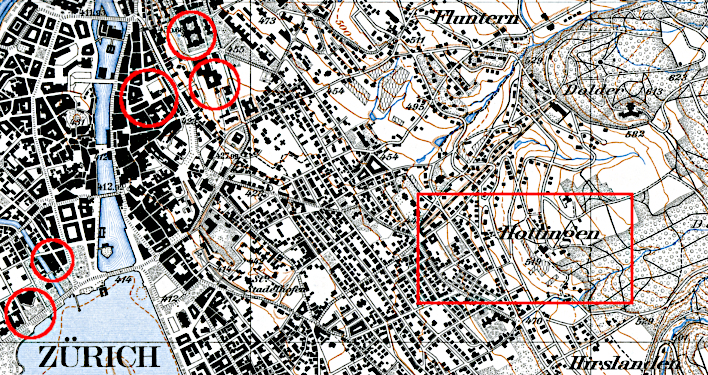
The right bank of the Limmat in Zurich c.1920. Bottom left are the Tonhalle and the Baur au Lac hotel (l-r); the three circles top left indicate the Central Library, the Polytechnic and the University (l-r). In the course of time many of the smaller buildings on the hillside of the right bank were taken over by various learnèd institutes. Hottingen is marked by the red rectangle. Image: Swisstopo/FoS.
As every schoolchild knows, Zurich is split into two by the river Limmat, which flows from the lake northwards before it joins the Aare, which then joins the Rhine. On the left (west) bank are the commercial and financial districts, on the right bank, climbing up the sunny hillside of the Adlisberg, are the academic and cultural quarters; there you find the University, the Polytechnic, the Central Library, the Gymnasium, the Cantonal School and the peripherals, the university hospitals and institutes that cluster around this educational and cultural vortex. On the upper part of this is the quarter of Hottingen, on the edge of the woods that crown the hill and offer a pleasant and desirable place to live for the ants in the cultural ant-heap that could afford it.
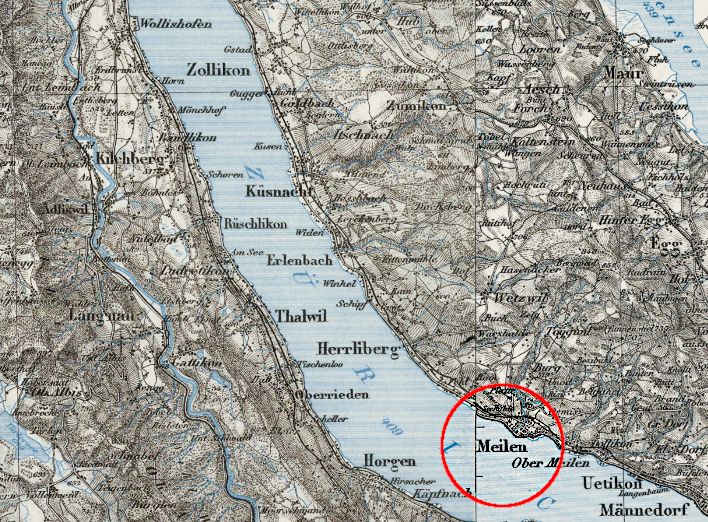
The Lake of Zurich c.1920. The south-east bank is known as the 'Gold Coast'; Meilen is marked. Image: Swisstopo/FoS.
The hills sweep down to the south-east along the edge of the Lake of Zurich, an area known as the Gold Coast on account of its sunny location and its extremely monied inhabitants.
The coat of arms of Hottingen is a large four-leaf clover, which may represent the luck of the blessed ones who live there, but is certainly emblematic for Rilke's good fortune at this moment.
The 'Hottingen Reading Circle' had been founded in 1882. At its height by the turn of the century the Circle had well over a thousand members and its popular readings and lectures were usually held not in some dim library or schoolroom but in the newly built concert hall, the Tonhalle in Zurich.
Rilke would be in illustrious company as a speaker: many of the great names in the German-speaking literature of the age – Hugo von Hofmannsthal, Gerhart Hauptmann, Hermann Hesse, Thomas Mann – took the Circle's cash and performed before large audiences of the monied and culturally advanced who were not afraid of the avant-garde.
The Circle even set up its own well-stocked lending library for its members. The Circle kept going for half a century before running out of money in 1940.
The offer of a Switzerland tour for Rilke with numerous culturally well-established and well-funded institutions tossing hard currency at him was particularly attractive.
The violent events in Munich during the first half of 1919 forced his hand. On 11 June 1919 he set off at five o'clock in the morning for Switzerland. The 'lone ant from a broken ant-hill from the wreckage of Europe' (©Ezra Pound, at the end of another war) was scooped up by the Swiss cultural elite, given money and administrative help with his messy life and space to be that delicate orchid, Rainer Maria Rilke. He was saved.
Inspecting Switzerland
The Hottinger lectures began in October. Rilke had four months to acclimatise himself to Switzerland, visiting Zurich, Geneva and Berne. His deep-seated dislike of Switzerland began to soften – the Swiss had excellent hotels, transport – and people who gave him money, of course. Notable among them was Countess Mary Dobrčensky of Nyon, who gave him a monthly sort-of-loan of 800 Swiss Francs.
At the end of July 1919, his Danish translator, Inga Junghanns, invited him to Sils in the Engadin to discuss the translation of his novel Malte. Friedrich Nietzsche (1844-1900) spent seven summers in Sils-Maria – his house there still stands, has been lovingly restored and is open to visitors as a museum. Rilke spent four days in Sils.
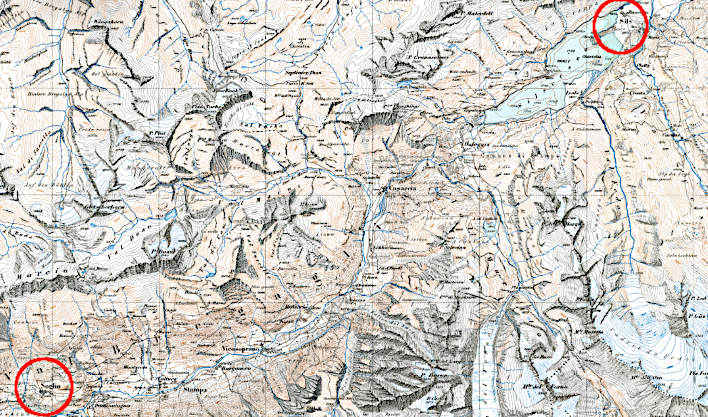
Sils in the Engadin (top right) linked by the Maloja Pass to Soglio in Bragaglia (bottom left) Image: Swisstopo/FoS.
He then followed the Maloja Pass down into the Bregaglia valley to the mountain village of Soglio. He stayed there for nearly two months in the impressive Hotel Palazzo Salis, the former Casa Battista of the important Salis family.
Self-obsessed depressives like Rilke can always find a reason to be unhappy: In this wonderful (and expensive) hotel in an attractive alpine village, the proximity of mountains unsettled him and he restricted his stay to the hotel, its library, its magnificent garden and to walks in extensive chestnut woods in Soglio, laid down by the Romans. He wrote his demented short essay 'Ur-Geräusch' here (dated 15 August). He left Soglio on 22 September 1919.
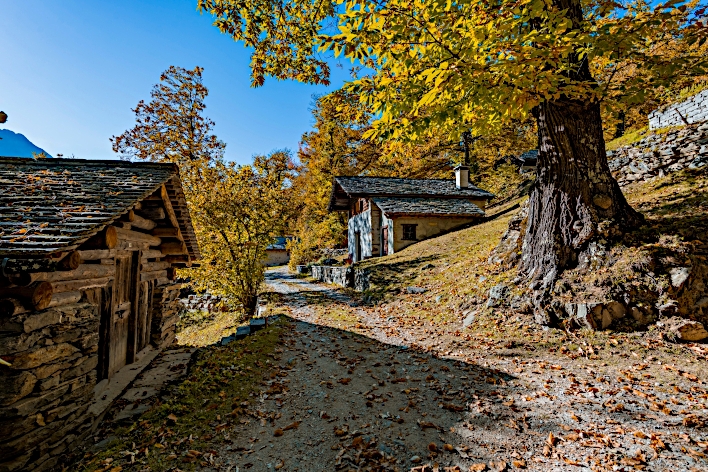
The chestnut trees in Soglio. NB: these are Edelkastanien, Sweet Chestnuts, not to be confused with horse chestnut trees.
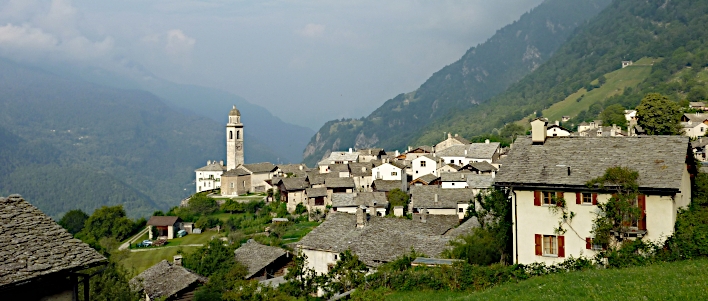
Soglio, in the Val Bregaglia.
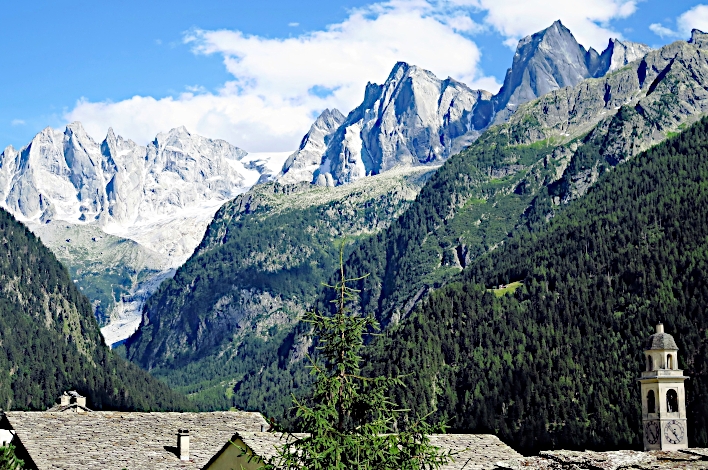
Soglio, hemmed in by mountains without an open horizon, a proximity which disturbed Rilke.
The Hottinger lecture tour
Rilke's Hottinger lecture took place on Monday 27 October in Zurich. It was very well attended: I read somewhere that Rilke's talk pulled in an audience of about 600 people. The talk consisted mainly of readings of poetry from his Paris years (that is, his poems that were still half-way comprehensible) and a few of his translations from French and Italian. This was followed by lectures in five more Swiss cities – St. Gallen, Luzern, Basel, Bern, Winterthur – ending on Friday 28 November.
The delicate orchid needed much support and got it. In Zurich he stayed at the Baur au Lac, a hotel in what hoteliers now call the 'extreme luxury segment' of the market. It is located in the centre of Zurich, in a private park right on the lakeside. Phia would be proud of him! It is perfectly placed not far from the Tonhalle, where Rilke's talk took place.
Rilke was cosseted on every stop of his tour, with a few days at the nearest Grand Hotel. Unsurprisingly, his heart began to soften for Switzerland even more.
His Swiss circle of influential friends was particularly useful in clearing up the mess of Rilke's citizenship. Rilke was born in Prague, the capital of the Kingdom of Bohemia, which itself was a component of Austro-Hungary; after the First World War the entire structure broke apart and ceased to exist. After 1918 Prague became the capital of Czechoslovakia (strictly speaking, the First Czechoslovak Republic) and Rilke became stateless. Switzerland wished to protect itself from the millions of individuals left stateless after the war and would not consider giving residence to these people. Rilke had to acquire Czechoslovakian citizenship and a Czechoslovakian passport in order to get a Swiss residence permit.
It was the search for a solution to this conundrum that caused much of Rilke's dithering in Munich. Many of his new friends and acquaintances were well-placed in the Swiss administration and were able to conjure up a passport and a Swiss residence permit for him in record time, in accord with the long Swiss administrative tradition of 'the one hand washing the other'.
Rilke needed even more financial support than usual. His books in Insel Verlag were selling better than ever, but the collapse of the German Papiermark against the extremely strong Swiss Franc meant that his royalty income was catastrophically reduced in real terms. The situation only began to improve after 1923. Fortunately, his new Swiss patrons had very deep pockets. Unfortunately, Rilke had pockets with large holes.
Perhaps we all need a rebirth in our lives from time to time. When Rilke moved to Switzerland the shutters came down on his former life. He would never meet Lou Andreas-Salomé again; He had had quite frequent contacts with his daughter Ruth during his Munich years, but after moving to Switzerland would never see her again. He never visited Austria or Germany again; he took two trips to Paris and one to Venice. For the six years of life that were left to him, he lived on a biographical island.
Nanny Wunderly-Volkart, his Nike
When he arrived in Switzerland, one further stroke of luck awaited him: yet another rich, middle-aged female devotee with time on her hands and money to spend to sponsor him took up his cause: Nanny Wunderly-Volkart (1878–1962).
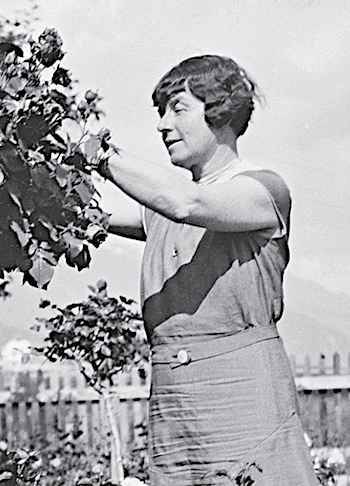
Nanny Wunderly-Volkart, Rilke's 'Nike', working in the rose garden at Château Muzot.
She got to know Rilke at his lecture in Zurich. She came to Winterthur for his last lecture and brought her wealthy cousins with her, the brothers Georg, Hans, Oskar und Werner Reinhart, to get to know her new protegé.
She belonged to a highly successful and wealthy family of Swiss industrialists, merchants and bankers. The Reinharts were running a large import-export business based in Winterthur with a global reach. Nanny and her relations would keep Rilke going throughout his time in Switzerland until the end of his life in 1926.
We note that by now Rilke was getting on: at this moment he was forty-four and he should really have got over the Oedipus thing by now. She was only forty-one, but appeared to be much younger, being small and dynamic, meaning that the mother role was no longer quite as clear as before.
Her principal home was in Meilen, on the so-called 'Gold Coast' of the Lake of Zurich, but she had a part share in a fine Schloss in Kreuzlingen, by the Lake of Constance. As such things are in Switzerland, this rich family was extremely well connected with the layer of wealthy Swiss who, unlike the European nobility, had no need of titles. It was often said of the wealthy Swiss that, should you scratch them, you would find underneath persons who thought they were poor.
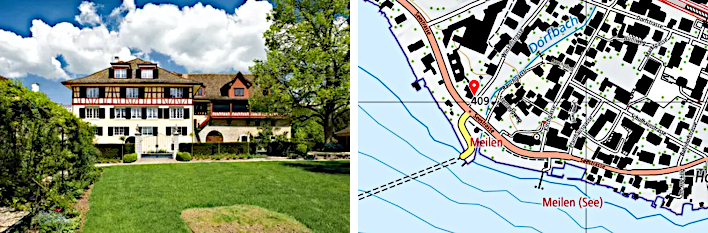
Untere Mühle, Winkelstrasse 22/24, 8706 Meilen, Switzerland. The location was originally a mill. It was bought by Johannes Wunderly-Zollinger in 1862, was rebuilt and from 1913 was the house of Hans and Nanny Wunderly-Volkart. It is now a protected building of regional importance. Image: Photo Thomas Flück/Meilen.
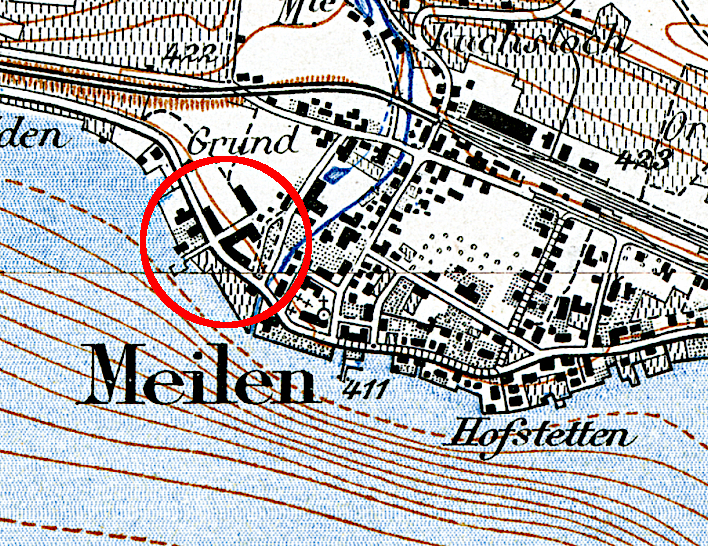
Meilen c.1920, the Wunderly-Volkart house is marked. Image: Swisstopo/FoS.
Letters to Nike
The Swiss National Library is in possession of 444 letters and telegrams that Rilke wrote to Wunderly-Volkart from 26 locations in Switzerland from the time of their first meeting to his death in 1916. She was the only non-medical person that Rilke would permit to be at his deathbed.
In 1951-52 she donated his letters as well as numerous manuscripts, photographs and books to the Swiss Rilke-Archiv in the National Library – but explicitly not her replies. I know of only one photograph of her. She has effaced herself from the Rilke record. Even though we only have half of their communications we can however get something from the Rilke side. His letters to her are the biographers' source for the last years of his life in Switzerland.
I am quite partial to a nice list, so here is a list of the number of letters and telegrams that Rilke sent her in the years they knew each other:
Rainer and Nanny
| Year | ≈Days | No. of letters |
≈Days between letters |
Notes |
| 1919 | 62 | 32 | 2 | Met 11.1919 |
| 1920 | 365 | 119 | 3 | |
| 1921 | 365 | 80 | 4.6 | |
| 1922 | 365 | 64 | 5.7 | |
| 1923 | 365 | 46 | 8 | |
| 1924 | 365 | 36 | 10 | |
| 1925 | 365 | 32 | 11.4 | |
| 1926 | 365 | 35 | 10.5 | Rilke died 12.1926 |
We noted some way above that Rilke's technique was to bombard his new belovèd with letters full of hyperbolic professions of adoration. The mood of the hyperbole began in the manner of a 13th century troubadour, then developed into a 21st century social media stalker.
'Bombard' is a fair description of someone sending, in the first two months, at times one, two and occasionally three letters per day. It was Rilke's technique for the acquisition of a new supporter: when someone writes two letters a day to you, you must be quite special. As the years went by, Rilke's bombardment declined to almost normal proportions – from 1923 onwards hovering around a comfortable frequency of a letter about every ten days or so.
The tone of the letters in 1919 starts off quite respectfully, if a little overwrought, Meine liebe gnädigste Frau, 'My dear most gracious lady', but sinks surprisingly quickly into overfamiliar and rather inappropriate kitsch. Five letters later Nanny is meine vertraute Freundin, 'my intimate friend'; after a few more letters she is simply Liebe, 'darling' and has been christened 'Nike' (usually taken to be the goddess Victory facet of Athena) – does this imply that Rilke sees himself as the hero Odysseus, condemned to wander from woman to woman, driven by fate and setbacks, but now at last under the protection of his new maternal Athena, Nanny Wunderly-Volkart, whom he termed his 'Nike'?
Gimme money
I read through all of Rilke's letters to Nike and really wish I hadn't. Perhaps fabulists such as Rilke have an inbuilt mental mechanism which alerts them to the presence of a susceptible woman.
One letter, however, struck me as particularly noteworthy, since in it we hear Rilke moving in on his victim and getting down – obliquely, of course – to the money question. This is not a struggling poet appealing for aid, but a master manipulator at work. This is what we meant with the phrase 'oblique begging letter'.
Around Christmas 1919, when they had known each other barely two months, after softening up Nanny with two or three letters a day and sending her a Christmas present with much preliminary ceremonial, on 24 December 1919, he wrote from his boarding house in Locarno one of his oblique begging letters to her. It's model of its kind: every confidence trickster would appreciate its quality:
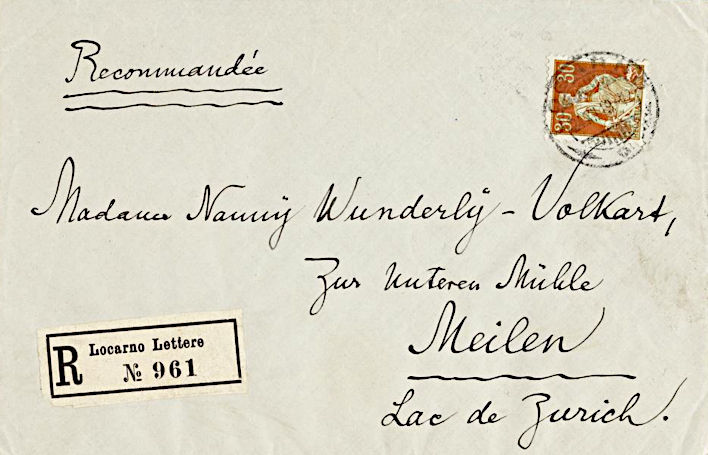
Images in this section: 'Rilke, Rainer Maria an Wunderly-Volkart, Nanny; Korrespondenz'; Locarno, 1919-12-24; Schweizerische Nationalbibliothek (NB), Shelf Mark: SLA-RMR-Ms_B_1/022, e-manuscripta, persistent link.
Firstly, unlike most of the other letters Nanny/Nike has received, this one has been sent by registered post, Recommandée, underlining its importance and urgency. It was too long and intimate for a telegram.
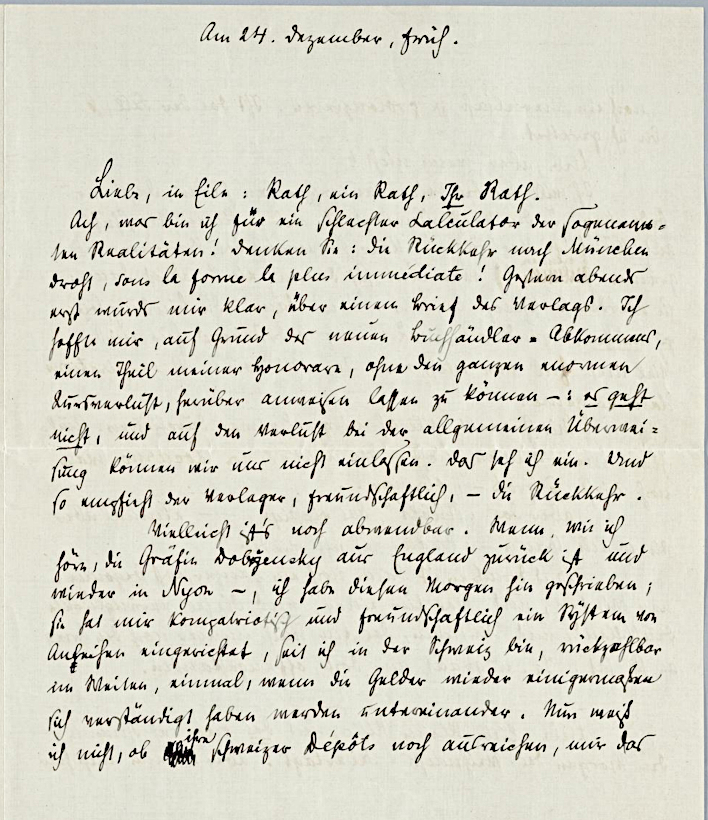
Transcription: Am 24. Dezember, früh
Liebe, in Eile: Rath, ein Rath, Ihr Rath.
Ach, was bin ich für ein schlechter Calculator der sogenannten Realitäten! Denken Sie: die Rückkehr nach München droht, sous la forme la plus immediate! Gestern abends erst wurds mir klar, über einem Brief des Verlags. Ich hoffte mir, auf Grund des neuen Buchhändler-Abkommens, einen Theil meiner Honorare, ohne den ganzen enormen Kursverlust, herüber anweisen lassen zu können –: es geht nicht, und auf den Verlust bei der allgemeinen Überweisung können wir uns nicht einlassen. Das seh ich ein. Und so empfiehlt der Verleger, freundschaftlich, – die Rückkehr.
Vielleicht ist’s noch abwendbar. Wenn, wie ich höre, die Gräfin Dobrzensky aus England zurück ist und wieder in Nyon –, ich habe diesen Morgen hin geschrieben; sie hat mir kompatriotisch und freundschaftlich ein System von Anleihen eingerichtet, seit ich in der Schweiz bin, rückzahlbar im Weiten, einmal, wenn die Gulden wieder einigermaßen sich verständigt haben werden untereinander. Nun weiß ich nicht, ob ihre schweizer Depots noch ausreichen, mir das noch ein…
Rilke first asks humbly for her advice [cynics, of course, realise that he doesn't want advice, he wants money]. He seemingly takes responsibility for the problem by telling her that he is a 'bad calculator of the so-called realities'; this statement catches the interest of us Rilke psychoanalysts: for him the 'realities' are the crackpot ideas which happen to be spooking about in his head at any one moment; things like money, earnings, debts and so on, which may torture us plodders, are to him just 'so-called realities'. Then comes the threat: He may be forced to return to Munich, in the 'most immediate manner!'
He tells her the tale: he was hoping to get his royalty cheque from Insel Verlag in some mysterious way without its being affected by the disastrous exchange rate, but this is impossible. This entire plan is a fantasy and a flat out lie: changing virtually worthless Papiermarke into valuable Swiss Francs at a 1:1 exchange rate is like expecting water to flow uphill. At the time of writing this letter he had been in Switzerland for around six months and could be expected to have worked out the 'so-called reality' of the postwar economic collapse of Germany all on his own. According to him, his publisher has recommended that he return to Germany.
He explains that when he first arrived in Switzerland, Countess Mary Dobrčensky granted him a loan of about 800 Francs monthly, to be paid back at some undefined future date (she clearly has more money than sense; in German such a date is called Sankt-Nimmerleins-Tag, 'Saint Never's Day'). The remainder of the tale about this money is incomprehensible – we suspect deliberately so. The Countess is currently in England, but when she returns, if she falls for this plan, whatever it is, then he 'has been saved'. But what if she doesn't?, he asks Nanny rhetorically. Perhaps a prepayment for future lectures? There are no other possibilities he can think of. When he hears from the Countess he will let Nanny know.
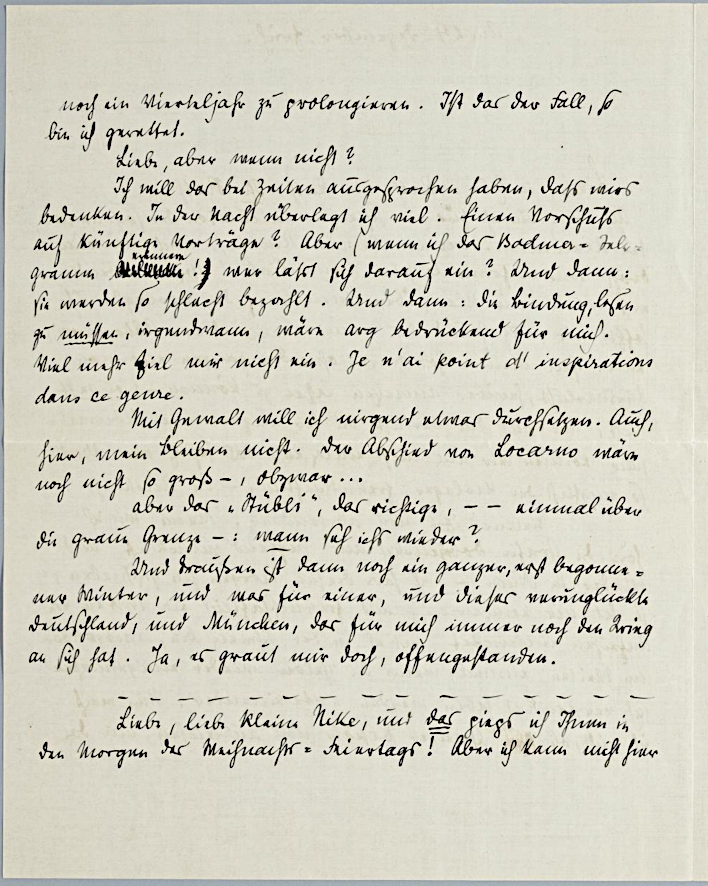
Transcription: … auf ein Vierteljahr zu prolongieren. Ist das der Fall, so bin ich gerettet.
Liebe, aber wenn nicht?
Ich will das bei Zeiten ausgesprochen haben, daß wirs bedenken. In der Nacht überlegt ich viel. Einen Vorschuß auf künftige Vorträge? Aber (wenn ich das Bodmer-Telegramm erinnere!) wer läßt sich darauf ein? Und dann: sie werden so schlecht bezahlt. Und dann: die Bindung, lesen zu müssen, irgendwann, wäre arg bedrückend für mich. Viel mehr fiel mir nicht ein. Je n’ai point d’inspirations dans ce gerne.
Mit Gewalt will ich nirgend etwas durchsetzen. Auch, hier, mein Bleiben nicht. Der Abschied von Locarno wäre noch nicht so groß -, obzwar…
aber das Stübli, das richtige,– – einmal über die graue Grenze -: wann seh ichs wieder?
Und draußen ist dann noch ein ganzer, erst begonnener Winter, und was für einer, und dieses verunglückte Deutschland, und München, das für mich immer noch den Krieg in sich hat. Ja, es graut mir doch, offengestanden.
Liebe, liebe kleine Nike, und das pieps ich Ihnen in den Morgen des Weihnachts-Feiertags! Aber ich kann nicht hier [bedrückt sein, so unmittelbar bedrückt, ohne daß Sie’s wissen.]
But then: 'An advance on lecture fees? … But who would do that? … and they are paid so badly … and the obligation to do readings, at some time, would depress me.' These are the thoughts of a man who wants money without doing anything for it.
'… Dearest, dearest little Nike, and that I chirrup this at you on the morning of Christmas Day! But I cannot be depressed here, so immediately depressed, without your knowing it.'
There follows a lot of fol-de-rol about his Christmas decorations, but the need for money has been not-so-subtly planted in Nanny's head: get some money to me now or we are done; and, by the way, if I have to leave in haste, all your Swiss pals who lent me money will be stiffed, too. We cynics know that they are going to be stiffed anyway.
Lest we forget: Rilke has spent the months since he fled Munich living the high life in some of the most expensive and noble hotels in Switzerland and travelling around in fitting style. In Locarno he rejected the free accommodation he had been offered as being unsuitable and rented rooms in a boarding house instead. Nike was required to furnish the rooms to his taste. Now he's broke (yet again) and needs one of his doting female supporters to give him money. Such a prince!
This is a man who preys on rich women who have little common sense. If necessary he uses them to be the levers that extract money from others in their circle. Is this the manipulative skill he learnt at his mother Phia's knee?
Were they an item?
On a purely formal level, I find it also rather odd that, despite the torrent of love and longing, Rilke and his Nike are still per Sie, that is, he is addressing her as Liebe whilst still using the formal Sie, 'you', not the intimate Du, 'you/thou' form.
She is a married woman, after all, and not one of the flighty kind. It's all rather odd: this coexistence of lovey-dovey kitsch and the formal 'you' just doesn't feel right. The entire tone of his letters to her strikes me as highly inappropriate. But, from Rilke's point of view, Du might be a step too far for the inner distance of the formalist Rilke; besides, should the crunch come, as it almost always did, it is easier to dump a Sie than a Du. A Sie might write it all off to experience and move on; a Du might end up under a train, à la Anna Karenina.
As the chart below shows, Rilke wrote his letters to Nanny in German or French. As his stay in the French-speaking part of Switzerland went on, the proportion of letters written in French increases. His use of the polite form in French, vous, is analogous to his use of the German polite form, Sie.
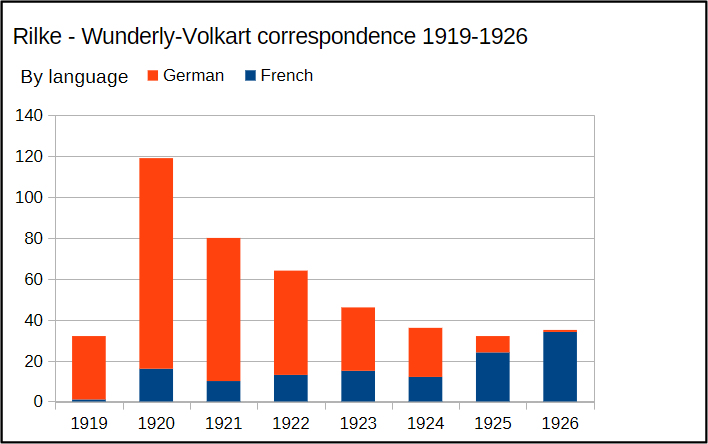
Notes: 1919 contains only two months, November and December; Rilke died in December 1926. Some of the letters are slightly bilingual, containing only fragments of the other language. Image: FoS
Not having access to her letters, I don't know in what language Nanny Wunderly-Volkart composed her replies. If she replied consistently in German, a psychiatrist might find Rilke's language-shifting independently of his correspondent's language to be worthy of examination. Consider: Rilke's mother-tongue is German; Nanny's written mother-tongue is German, her spoken mother-tongue is Swiss-German. Even though she is an educated French speaker, shifting to French in this situation is therefore absurdly affected and egocentric.
The fixer
Nanny Wunderly was no blue-stocking. She had received the practical, not very academic education of the bourgeois woman of her time. In his letters to her, Rilke restricts himself to practical issues – one might say, all the things he was not good at. She was, however a good organizer, whether of her own household or Rilke's complex needs, and an excellent problem-solver. She was part of a known, much-respected and wealthy family.
Rilke arrived in Switzerland broke, stateless, homeless and bringing with him his own array of psychoses. From the moment she took him under her wing soon after his emergence from the chaos of post-war Munich into the stability of Switzerland, all his problems were dealt with one-by-one. His previous noble sponsors had given him status, money, accommodation and contacts. But he didn't need another psychotherapist or clever aesthete; he needed security and money. Nanny Wunderly-Volkart, the Reinharts and the Kippenbergs gave him that.
There will be a few readers who are impatient to have their burning question answered: 'Did they or didn't they?' or, slightly more elegantly, 'Were they or weren't they?'. Sorry to disappoint, but the answer to both questions is a pretty definite 'no'. All Rilke's lovey-dovey nonsense was just epistolic froth; the language of the con man. He would certainly never risk having to dump a rich woman.
In his Foreward to Insel Verlag's collection of the Wunderly-Volkart letters to Rilke, the noted Swiss historian and writer, Jean Rudolf von Salis (1901-1996) recalls a remark that the writer Count Hubert Mittrowsky (1902-1980) made in his obituary of Wunderly-Volkart in the Vienna Presse:
[Mittrowsky], in an outburst of joy, once spontaneously embraced her: 'At a later meeting Nanny Wunderly mentioned, without any reproach, that Rilke would have never expressed his joy in that way by embracing her.'
[Mittrowsky] habe sie einmal im Überschwang der Freude spontan umarmt: «Bei einem späteren Zusammensein erwähnte Nanny Wunderly einmal, jedoch ohne Vorwurf, Rilke hätte nie so seiner freude Ausdruck gegeben und sie in die Arme geschlossen.»
Insel Verlag, Frankfurt am Main, 1977, p.13.
Angela Guttmann
In a bookshop in Locarno, just before Christmas 1919, the almost forty year-old Rilke met the almost thirty year-old Angela Guttmann (05.02.1890-07.04.1985). She led an astonishingly adventurous and complex life, which is reflected in the many surnames (8) she acquired during its course.
She was born in Znaim, Moravia (in the eastern provinces of the Austro-Hungarian empire) as Angela Müllner. As a young adult she moved in avant-garde artistic circles and also underwent a medical training. Then came by marriage the surnames Hubermann and then Guttmann (a marriage of convenience), which brings us to the moment in the Locarno bookshop.
I do not know how Angela Guttmann managed to end up in the Castello di Ferro in Minusio, Locarno, but that is where she was staying when she met Rilke in Carlson's bookshop in Locarno. The 'Castello' or 'Ca' di ferro' was built in 1558 as a fortified military base. In later, more peaceful times part of the main building was used as apartments with a pleasant view over the lake – if you don't mind the thick iron gratings at the windows, more prison than lakeside paradise.
Rilke at first called her simply die Russin, the Russian. She was scraping along in poverty, like Rilke a victim of the German currency crash. Rilke told Nanny in a letter that Angela received a thousand Marks a month, which was currently barely worth 100 Francs. He went out of his way to organize some financial help for her. She had a spell of illness (chronic tuberculosis) and needed care and attention.
Despite the erotic infatuation Rilke felt for her at first, by February 1920 the time had come for a Rilke-style dumping. He had been invited to leave Locarno and spend the spring months at the Gut Schönenberg near Basel. He left Locarno at the end of February, but Angela turned up in Basel in mid-April. She stayed for five days and then left. There were a couple more short, amicable meetings, after which they never saw each other again.
Let's take a moment to follow the later course of Angela's life; she was a very interesting and determined character, much more interesting than the diaphanous and neurotic Rilke. She returned to Berlin and began to study at the Psychoanalytisches Institut in Berlin. Her talent impressed the staff (among them Sigmund Freud himself) – not a surprise to us, since she had obviously cut her psychoanalytic teeth on the mess that was Rilke. Her bosses were so impressed that the Institute paid for the successful treatment of her tuberculosis.
After this she married the German communist sociologist Wilhelm Rohr (1899-1942). The pair moved to Moscow in 1926 and became Soviet citizens. She travelled in Siberia and the Far East and wrote articles for the Frankfurter Zeitung about the USSR. In 1935 she met and medically treated Bertolt Brecht in Moscow and continued to write articles for the European press. Wilhelm and Angela suffered the fate of many who supped with the devil of the USSR: On 7 July 1941, following the German invasion of the USSR on 22 June 1941, they were arrested along with many others of German origin.
Wilhelm Rohr died in Saratow prison in 1942 (no one knows when, where and how exactly). Angela spent 15 years in some form of captivity, from 1943 in a 'Corrective Labour Camp' in Siberia. In July 1946 she was released from prison but held under Stalin's 'permanent ban' decree for all former Germans. During this time she seems to have dedicated herself to using her medical training to help the Siberian peasants.
After Stalin's death in 1953 the ban was lifted. She was finally rehabilitated in 1957 and returned, now 67 years old, to live in Moscow on a tiny pension. Her writings about the Gulags remained supressed in the USSR and reached the West only shortly before she died on 7 April 1985, aged 95. Despite her hard life, she outlived Rilke by nearly 60 years.
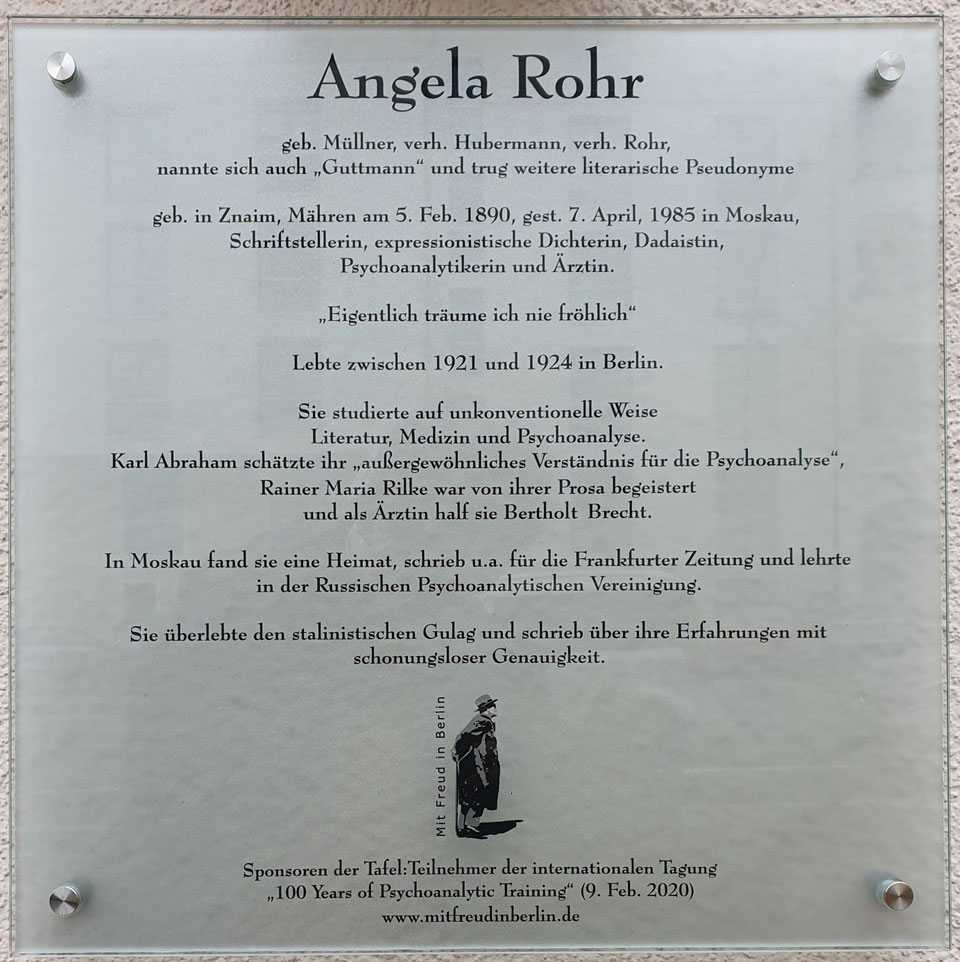
The commemorative plaque to Angela Rohr/Guttmann in Berlin. Double-click on the image to show a larger version in a new tab.
Given her lifelong adoption of some form of revolutionary ideology, from Expressionism to Dada to Marxism to Communism, we have to wonder what she made of Rilke, the refined parasite on the class of aristocrats and capitalists. We have to wonder whether, even in her 'bitter poverty', she took the alms handed down to her from on high. She certainly didn't hang around feeding off the Swiss teat as Rilke did, but moved to decadent Berlin, then on to the USSR.
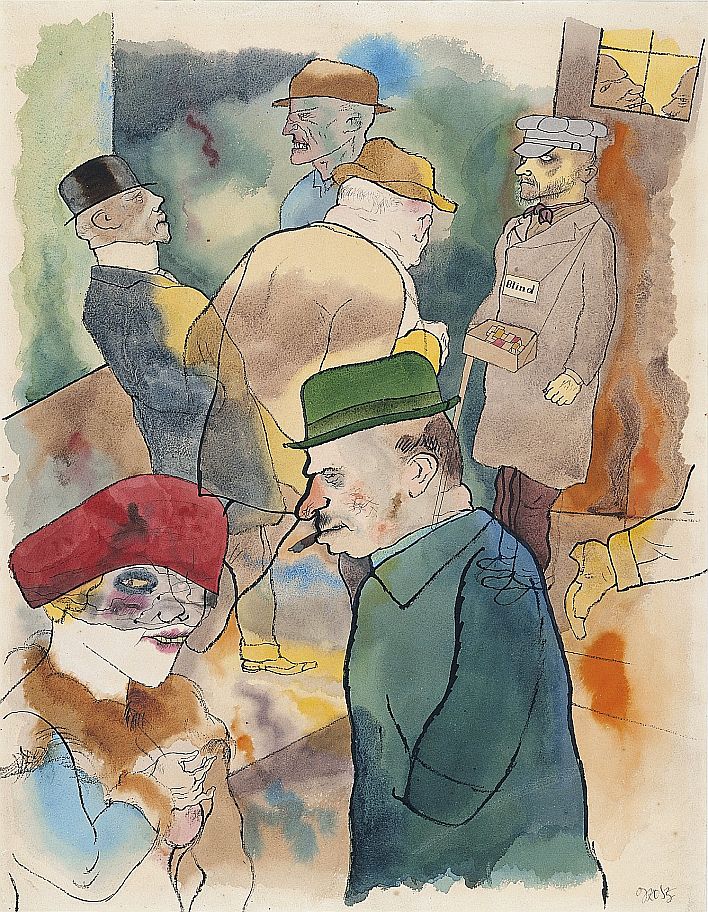
George Grosz (1893-1959), Dämmerung/Twilight, 1922. A collection of ghoulish characters inhabiting the twilight of the Prussian state after the First World War: the bourgeois grotesques; the prostitute; the blind army veteran selling matches. A snapshot of a moment before the great darkness fell and the twelve-year nightmare arose. 'Artists are the antennae of the race'. Image: Museo Nacional Thyssen-Bornemisza, Madrid. Inv. no. 568.a/b (1973.65.a/b).
Back to Rilke (unfortunately).
Basel in springtime
Rilke's three springtime months in Gut Schönenberg are generally uninteresting for us, except in the sense that he was able to add further monied aristocrats to his address list of potential supporters, this time from the Basel branch of the Swiss elite families. Although he was scatterbrained in most practical tasks, he was laser-focussed, as we say nowadays, on his carefully curated addressbook. In this cultivation of the rich and powerful he reminds me of the troubadours of the Languedoc in the late Middle Ages, who were also parasites upon a ruling aristocratic class, the only difference being that they were much better poets.
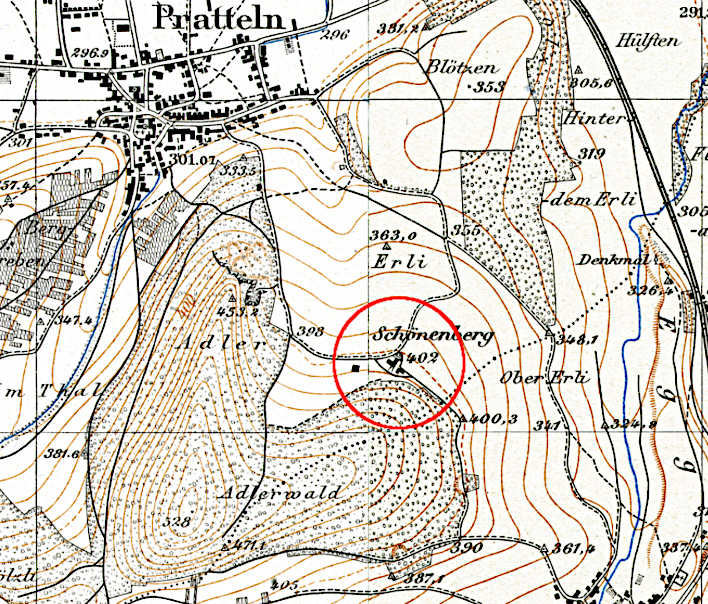
The Gut Schönenberg, in splendid isolation near Basel, c.1920. Image: Swisstopo/FoS.
Well, all good things come to an end and Rilke the nomad took over from Rilke the lover of peace and quiet. In June 1920, with his newly-minted Czechoslovakian passport, he took off for Venice, where he met Princess Marie and stayed for a month in her apartment.
He returned from Venice to Geneva, arriving on 6 August.
Baladine Klossowska
In Geneva he reunited with Baladine Klossowska, née Elisabeth Dorothea Spiro, (1886-1969). He had got to know her in Paris in 1902(?) through Ellen Key, while she was still married to the art historian and painter Erich Klossowski (1875–1949). The couple had two sons, Balthasar 'Balthus' (1908–2001) and Pierre (1905–2001). They divorced in 1917.
At the outbreak of the First World War she and her children, as German citizens (she was born in Breslau), were expelled from France. They entered Switzerland and settled in Geneva. It was a financially hard time for Baladine and her sons since her ex-husband Erich was neither generous nor regular in his support payments. She affected to be called 'Merline' (the female Merlin) and 'Mouky'.
Rilke and Baladine kept in touch in the intervening years. In 1920, shortly after his move to Switzerland, she sent him a Christmas present of a French language translation of Ovid's Metamorphoses together with a postcard image of Orpheus (the Orphic legends are in Book X, 1-85; Book XI, 1-66). This is generally held to have supplied the organizing idea that broke Rilke's writer's block and thus led to the completion of the Duineser Elegien and the Sonette an Orpheus.
The relationship with Baladine had a great importance for Rilke and she must be considered along with Lou Salomé and Nanny Wunderly-Volkart as one of the most significant females in Rilke's life; Nanny herself recognised this and helped to support her financially. It will interest the psychiatrists reading this that Baladine called Rilke 'René': perhaps the love of all things French outweighed the therapeutic function of 'Rainer'.
Baladine had travel plans and on 12 August she left Geneva.
At the beginning of October Rilke and Baladine took a tour into Canton Wallis/Valais. They stayed in the Hôtel Bellevue in Sierre. There, unlike in the Bregaglia, the mountains are not so oppressive, the broad valley of the Rhône keeps them at a distance as far upstream as Brig.
Rilke – the now enthusiastic francophile and francophone – felt that if he couldn't live in France then the Rhone valley above Geneva was the next best thing. In his mind the Rhone seemed to be a kind of umbilical cord that reached down to the Lake of Geneva then down to Lyon and Nimes, Avignon and Arles in Provence and finally to the Mediterranean.
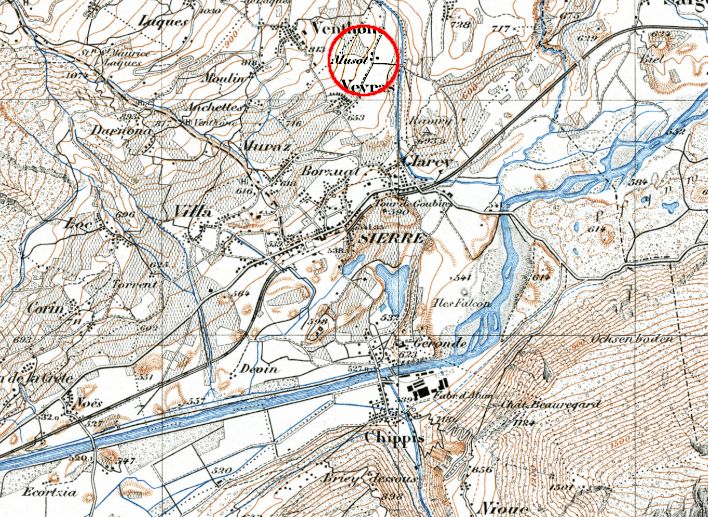
Sierre in Canton Wallis/Valais in 1921. Château Muzot is indicated with a red circle. The modern tourist attraction in the neighbourhood is Crans Montana, currently of ill-repute and just off the left of the map. Image: Swisstopo/FoS.
Berg am Irchel
At the beginning of October Rilke was planning to rent an apartment in Geneva so that he could overwinter there instead of Locarno. However his Nike, Nanny Wunderly, totally organized and competent as ever, had worked her magic and persuaded the owners of the rural manor house in Berg am Irchel, in the north of Switzerland, to allow Rilke to live there for the winter, with staff and heating thrown in – truly an offer he could not refuse.
In the meantime, at the end of October he travelled to Paris, on his own, staying for eight days. Paris appealed to him as ever, but it would be impossible for him to move there and leave the financial support and money fountain he enjoyed in Switzerland. The visit did, however, leave its trace in his new passion for all things Francophone.
After his return from Paris, Nanny Wunderly took him to Berg am Irchel in her car on 12 November 1920. From then until the middle of May 1921 Rilke had his quiet solitude. The housekeeper Leni Gisler adapted masterfully to his food fads and his other idiosyncracies – so well in fact that from then on his name for a competent housekeeper was a 'Leni'.
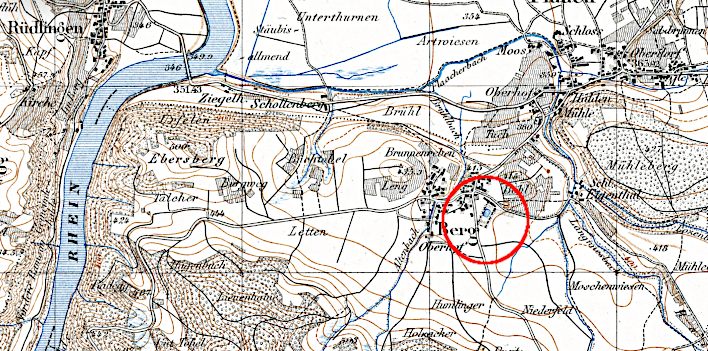
The Schloss in Berg am Irchel c.1920. Berg am Irchel is a pretty and prosperous village in the wine-growing region of Canton Zurich. It is a couple of kilometres from the Rhine and the nearby border with Germany. The little black dot over the road from the manor house is the just-built sawmill. I know the village quite well: for four years my family and I lived only about 10 km away and we were occasional visitors. The memory of the dahlias and chrysanthemums at the roadsides glowing in the the autumn sun is still with me. Image: Swisstopo/FoS.
It was clear that Rilke did not intend Baladine to be part of this rural retreat. Berg was anyway not an easy place to reach by public transport. After the summer of love in Geneva it was a bitter disappointment for Baladine to be told to keep her distance, no matter how many letters protesting his continued love she received.
She had to stay in Geneva and look after her sons; in January 2021 she fell seriously ill, she was running out of money (another Papiermark victim) and in the end, in April, her only option was to leave Geneva and go to stay with her brother in Berlin, taking her children with her. On the way she stopped off in Berg to see Rilke (not as simple as it sounds), which strikes your author as much more than the heartless egomaniac deserved.
While Rilke was floating between free full board accommodation in idyllic parts of Switzerland, Baladine returned to her base in noisy, decadent, tumultuous Berlin (see the Grosz illustration above). In 1923 she managed to relocate to Switzerland for a while, then moved on to Paris, where she would spend the rest of her days.
Fortunately, the fates have a way of dealing with people like Rilke. From the beginning of April his peaceful existence in the Schloss ended when the Fehr Woodwork and Sawmill company, founded in 1889, erected a sawmill in 1920/21. The sawmill was built on the other side of the main road from the Schloss; the company that built it is still flourishing today, five generations later, and the sawmill is still sawing. The noise from the sawmill drove Rilke to distraction.
He didn't have to put up with it for long: the owners of the house announced to him that a paying tenant wanted to rent the house from May or June onwards. In sum, therefore, Rilke's six months of creative isolation in Berg am Irchel produced nothing more than a short foreward in French for a book of cat drawings by Baladine's artist son Balthazar plus a few poems. He could have stayed in civilised Geneva, had a pleasant Christmas and winter with his beloved Baladine and her children and saved everyone a lot of trouble. Those who need to write to keep the roof over their heads, put food on the table and generally support their dependents don't have the luxury of suffering from 'writer's block'.
Château de Muzot
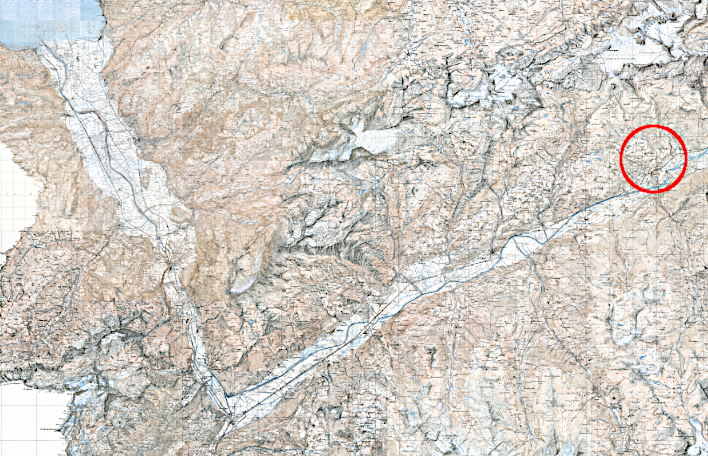
The Rhône valley in 1921, from the Lake of Geneva (top left) until Sierre/Muzot (right, circled). Image: Swisstopo/FoS.
At the end of May 1921 Rilke returned to an apartment in the village of Etoy, on the hillside just above the north bank of the Lake of Geneva, about 20 km from Lausanne. Baladine joined him there, fresh from Berlin, on 17 June. A few days later they set off together on a repeat of their journey into Canton Valais the year before, arriving in Sierre on 28 June and setting themselves up as before in the Hôtel Bellevue.
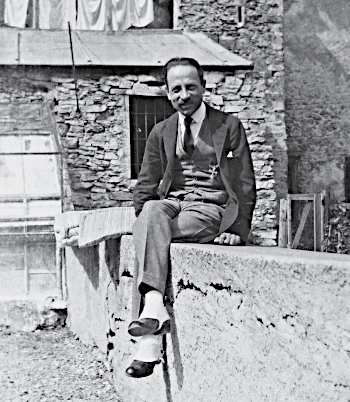
Rilke in Sierre 1921.
Shortly before they were due to leave they saw an advertisement in the window of the hairdresser's salon next to the hotel, advertising the so-called 'Château de Muzot' as being for rent or for sale.
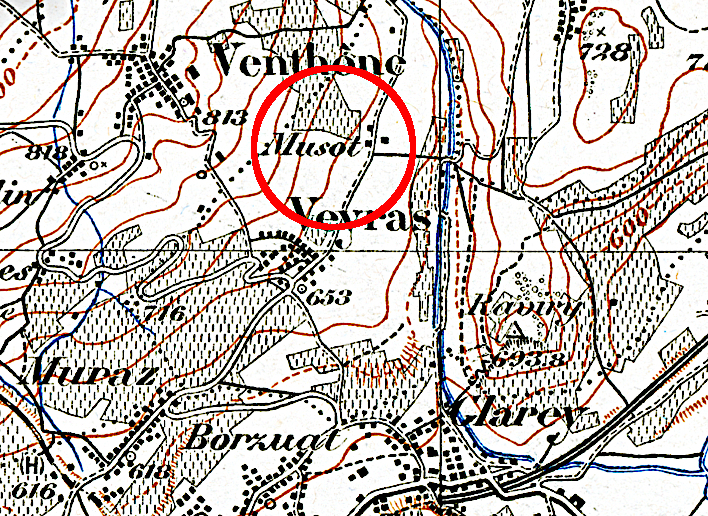
More splendid isolation at the location of Château de Muzot, near Sierre, c.1920. Image: Swisstopo/FoS.
Phia had instilled in little René her love of all things aristocratic: the prospect of living in a genuine 'château' from the 13th century, with a seigneurial view over Sierre and the valley of the Rhône, the region of his current dreams, was not to be resisted.
The 'so-called realities', though, which Rilke preferred to ignore, were very numerous. The 'château' was a stone tower still with all 13th century mod cons: no running water, no electricity, no sewerage; the interior was not so much furnished as used as a dump for the bric-à-brac of the ages. The legally correct description of this property would be 'ruin with a roof'.
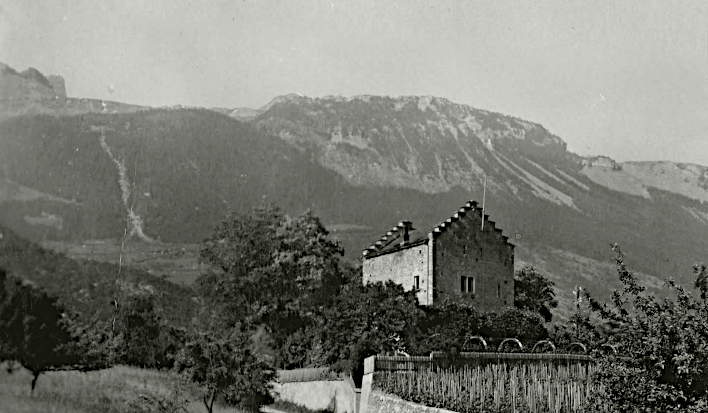
Château de Muzot, ND.
There was a hillside/hilltop castle-building fad in Europe throughout the 12th and 13th centuries. Most of these structures, particularly the small ones such as Muzot, were not really intended as courtly residences but as defensible positions in times of trouble – of which times in the medieval turmoil in Switzerland there were a lot.
In the Muzot tower there was an attic, then three small rooms on each of the two floors beneath and a tiny chapel; enough for a small detachment of troops or a wandering, crazed poet. Once they had got the castle-building out of their systems, the noble families much preferred the more comfortable and civilised life in or near to the towns. These structures remained for some time as power statements with almost no practical use and were usually allowed to disintegrate at their own genteel pace.
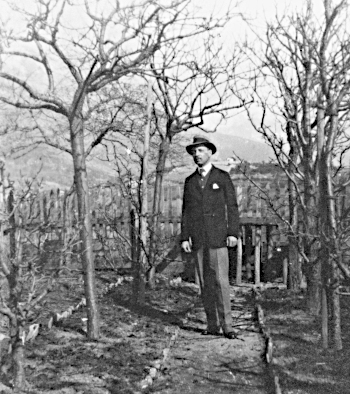
Rilke in the garden at Muzot.
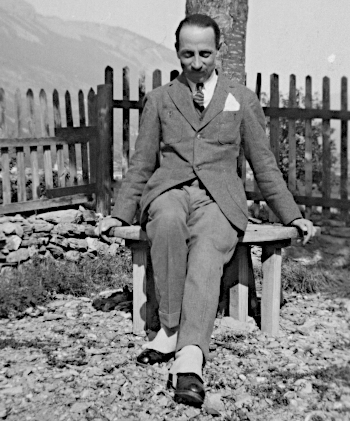
Rilke in the garden at Muzot.
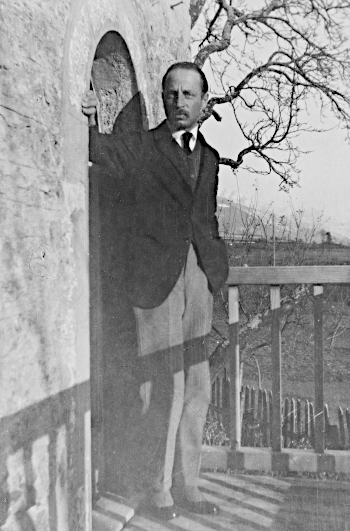
Rilke on the balcony at Muzot.
Despite Rilke's procrastinating nature, all the relics of the ages lying around in the building fuelled his deepest longing with a rush of blood to the brain moment. Men rely on women to intervene to prevent their frequent acts of stupidity; in this case, Baladine, head over heels in love with her poet, instead of telling him not to be such an idiot, seems to have encouraged his mad longing and told him what he wanted to hear. And Phia would be so proud of him! Just as it had been with Wittgenstein's donation, so Rilke's deluded mind viewed the discovery of the 'château' as a miracle from heaven. He had his dream, it was now just up to his support team to make it reality.
Well, with the application of enough of other people's money most things are possible. Rilke and Baladine were effectively penniless, so the solution was the great enabler, Nanny Wunderly-Volkart. Nanny was another woman who should have shaken her head and told Rilke not to be such an idiot, but she had seemingly dedicated her life to supporting unconditionally the parasite's wishes.
Finance was found through an appeal to her rich cousin Werner Reinhart, who brought a businessman's intelligence to Rilke's Muzot dream. He agreed to be the official tenant of the tower and paid the first two month's rent to the rather erratic old lady, a certain Mme. Raunier, who owned the ruin. She had at first insisted that during the rental all the bric-à-brac had to remain where it was – a completely unacceptable condition. So much work had to be done to make the ruin habitable that just renting the property was too much of a risk, so in May 1922 he bought the place from her. He would still be on the hook for the costs of renovation but at least in the end he had an asset that could only increase in value.
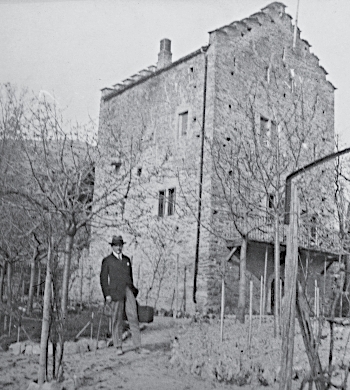
Werner Reinhart in the grounds of Château Muzot, which he bought for Rilke.
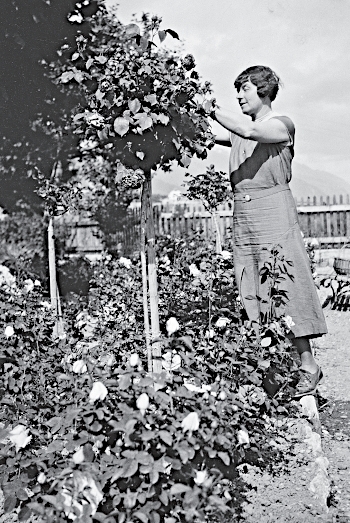
Nanny Wunderly-Volkart attending to the roses in the rose garden of Muzot. ND
For the first time in his adult life, Rilke the nomad was firmly anchored to a fixed abode for the rest of his life – no more sponging off aristocrats for a month or two at a time. The fear of being anchored was one of the commitment-averse Rilke's main worries during the two months of negotiations to acquire the property, but the enchantments of the stone tower overcame his fears, particularly when Werner Reinhart agreed to become the official tenant in his place. This would cut the cord between Rilke and the tower, allowing him to scuttle away should he decide to move, leaving Reinhart to sort out the situation.
At this point let us recall that Rilke had scuttled out of his Paris apartment all those years ago, breaking the lease and owing rent, thus leading to the landlord selling off his furniture and the rest of the things he had abandoned in that 'so-called reality'.
Rilke even wrote to Reinhart, thanking him effusively for his help but explicitly adding that he, Rilke, was in no way bound by the acquisition of Muzot to remain there. Reinhart was a rich man and had secured Rilke's future by buying the tower so he could afford to be generous to the pipsqueak Rilke: 'Do what you like', Reinhart replied.
No good deed goes unpunished. As the owner of the property, Werner Reinhart was now the recipient of a list of repairs and renovations from Rilke. The most urgent of these was the sewage system of the tower: there wasn't one. Since the 13th century the inhabitants had voided their excrement through a hole into a small space next to the housekeeper's room. Solving this problem alone was going to cost Reinhart 500 Francs. It never seems to have occurred to the shameless Rilke that he himself might pay for something.
In the modern phrase: you really can't dislike Rilke enough. The junk was cleared out and disposed of, centuries of grime were scrubbed away and the rooms were made habitable – not, of course by Rilke, who restricted himself to making drawings of the rooms as he wanted them to appear. The clearing and cleaning work was done by four women, Baladine, the daughter of the owner and two cleaning women. Rilke sent Nanny Wunderly lists of household items such as bedding that she had to buy (at her expense, of course). She sent packet after packet from Meilen to Muzot (at her expense, of course). Rilke and Baladine finally moved in on Tuesday, 26 July 1921.
Baladine and Nanny even found a 'Leni' for him, a cook-housekeeper who could cope with his idiosyncratic wishes. Of course, Rilke, being Rilke, set a number of preconditions that made the search extremely difficult: the woman mustn't come from Canton Valais, mustn't be a German, mustn't be educated, should speak French and so on. At the end of September Nanny found Frida Baumgartner, a 26 year-old French-speaking Catholic from Canton Solothurn. She arrived in mid-October.
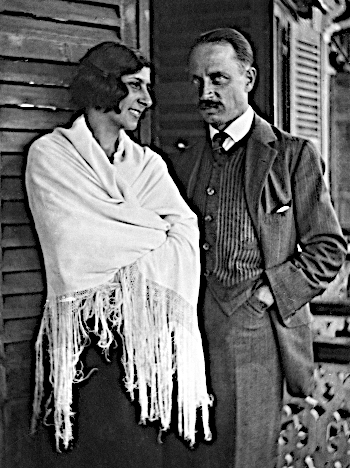
Rilke and Baladine Klossowska on the balcony at Muzot.
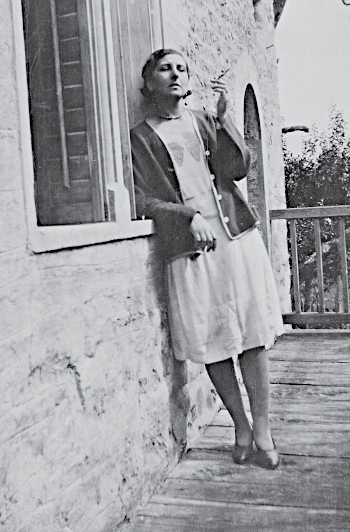
Baladine Klossowska on the balcony of Château Muzot, ND.
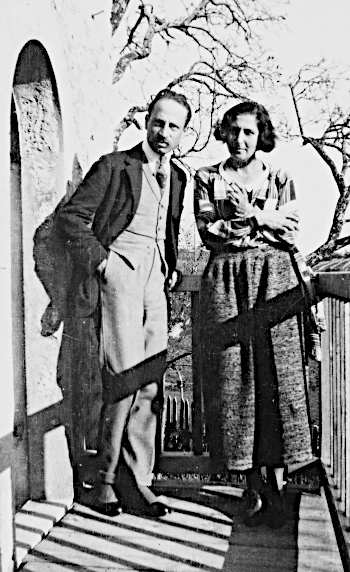
Rilke and Baladine Klossowska on the balcony at Muzot.
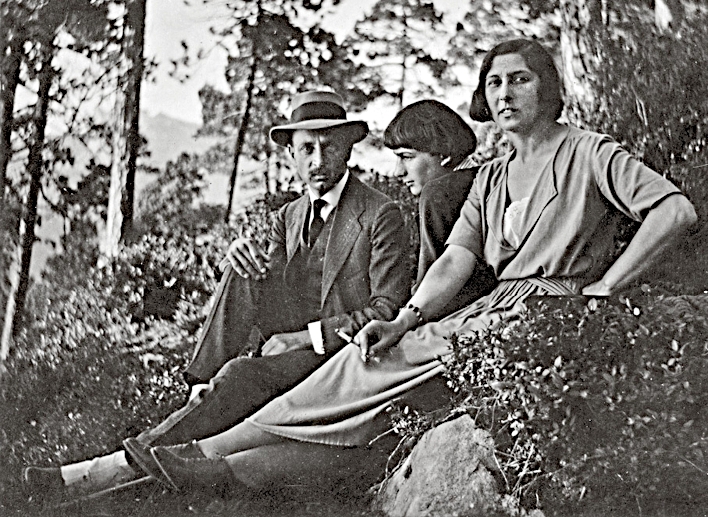
Rilke, Balthazar 'Balthus' Klossowska and Baladine Klossowska, August/September 1922.
After the months of hard work settling Rilke in to Muzot, in November Baladine returned to Berlin.
In fact, Rilke did settle down as far as it was possible for him to settle anywhere; he would make one trip to Paris and there would be numerous stays in Swiss health spas, but Muzot would become his home. Frida Baumgartner left on a few occasions for family reasons, but she was usually lured back, at least for the winters.
Baladine, the dumping
In relationships involving sex with young women, as opposed to just sucking at the financial teats of rich middle-aged women, we point out yet once more that the Rilke pattern was almost always the same with every new acquisition: a period of demented wooing, leading (we suspect) to the act of darkness, some shared activity for a short period of time, then a definitive dumping so that Rilke could return to his self-declared nature of being alone with himself. Until the next chick turns up… .
We can't blame Rilke for wanting his peace and quiet, but knowing himself that he was unable or unwilling to commit to any human male-female relationship, the honourable thing would be not to start off passionate relationships in the first place. But Rilke, almost a definition of a narcissist, simply couldn't help himself when the Goddess Kairos, Opportunity, passed by (as Goethe formulated it). It was the model for his marriage and for every erotic encounter.
The relationship with Baladine Klossowska adhered to the model, but with some false starts. Unlike most of his conquests, she had her uses, a fact which delayed her dumping for several years. When he was restlessy searching for a new abode in Switzerland after Berg am Irchel and Geneva, she was the crutch that supported him during this nerve-racking task. She understood as far as any normal human could the Rilkean logic that took him to Sierre. She helped him in many practical ways to select and acquire Château de Muzot and to make it habitable according to his idiosyncratic needs.
When her considerable labours to make Muzot a residence fit for a poet ended, her utility for Rilke also ended. It took the dumping specialist Rilke a few weeks to make her feel unwelcome enough that should would leave. At the end of November 1921 she took the many hints and went back to a Berlin winter, leaving her loved one to his peace and quiet in his stone tower.
She was in love with Rilke and was not receptive to his hints that she should just go away and leave him in peace. Rilke's mood was not constant and the adoring female heard the passion and overlooked the rejection. She visited him for a second time, arriving around the end of July 1922. She stayed for four months then left at the end of November for Berlin.
In Berlin her desolate emotional situation was reflected in her declining physical health and the depression that accompanied it. Rilke hardened his heart to her desperate case – he understood her misery but could not ignore his own deep need for being on his own; he just didn't want to spend any more time with her.
She returned to Muzot for a third and last time on 20 July 1923. Rilke had unwillingly allowed her to come for a 'painting summer'; even he had not the stony heart to tell her directly that she was not wanted. It was not a happy stay, but at least Rilke was absent for quite long periods taking a number of spa treatments. It ended in Baladine's favour: this time she returned not to the hated Berlin, but a house in Beatenberg in the Bernese Oberland together with her son Balthasar. Rilke had visited her there in August on his way to the Sanatorium. Typically for mixed-message Rilke, having tried to keep her away or get rid of her, he wrote to her saying how wonderful their time together there had been.
Nearly a year passed. In March 1924 her offer to meet him was rejected.
Baladine ended up in Paris. A reunion with Rilke came in Januar 1925, when Rilke, despite his decrepit physical state, visited Paris, his spiritual home, one more time. He stayed in Paris for nearly eight months and Baladine was at his side almost every day. As usual, she did her best to be useful to him in his decrepitude, she nursed him through the times when the metropolitan bustle was too much for his weak body, but there was a mutual acceptance that the flame had finally been put out.
She left Paris with him on 18 August 1925 and accompanied him on the journey back to Muzot. Two weeks later she returned to Paris; with her departure, the now faded arc of a love affair was finally closed. Rilke would live only another eighteen months; she remained in Paris, outliving him by forty-three years and died there in 1969 at the age of 87.
One last non-fling: Erika Mitterer
In 1924, about two months after Rilke had refused to meet Baladine, he received a poetic letter from a young Austrian woman, Erika Mitterer (1906-2001), then all of 18 years old. She was not the ditzy dreamer with a soft spot for poets, but an intelligent, well-educated and gifted young woman, who had the self-confidence to write poems to the poet whose work had so impressed her.
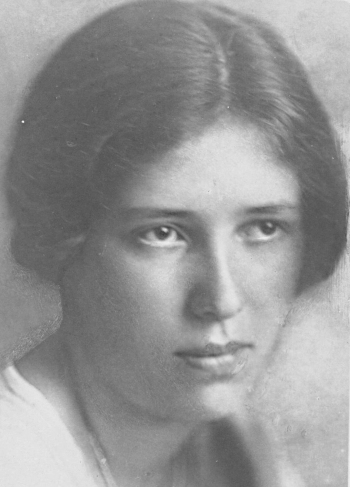
Erika Mitterer, 1923 Image: Erika Mitterer Gesellschaft
Rilke was attracted by her letter and the quality of her poems. She even quoted two lines from Rilke's Die Sonette an Orpheus, which had only been published the year before. In response he wrote thirteen letters to her, containing 49 poems altogether, to which she responded in kind.
As so often, Rilke blew hot and cold in his replies. After a few weeks of poetic titillation, around mid-July, Rilke and Erika – whom he now addressed as 'Heide' – came closer and closer to the idea of a face to face meeting. Rilke, as usual, was never completely clear on this point and wrote with masterful ambiguity. She was desperate to meet him, silly girl, whereas he couldn't quite make his mind up.
From about the middle of 1924 until early 1925 he failed to answer her letters; when he restarted the correspondence she threatened him with a visit, then she announced the end of the correspondence, then it all started up again with a Rilkean barrage: eleven replies in three days (27-30 October 1925). In an act which shows her astonishing self-confidence (respect!), returning from a visit to Italy, on 21 November 1925 she booked into the Hôtel Bellevue in Sierre and turned up unannounced at Château Muzot. Today's social media crowd would call that a boss move.
For the three days of her stay, Rilke, who always adhered to the social formalities, treated her as a favoured guest, spoke at length with her, took walks and escorted her to and from her hotel. It was a platonic visit, possibly because Rilke was a sexual wreck following months of obsessive masturbation. As a parting gift he gave her a poem which said, in essence, 'write to me but stay away' and with that the hottest and smartest young woman he would ever meet went away unsated.
She, foolish girl, didn't cut her losses with her poet but wrote him many letters, all of which remained unanswered until, in August 1926, he learned that she had nearly lost her life following a burst appendix. He sent her a rather dutiful letter. Four months later he was dead and the Mitterer fling was definitively ended. She was one of the few who turned up to his funeral in out of the way Raron. Erika would outlive Rilke by 75 years; she died 95 years old in Vienna in 2001. At least her volume of the poetic Rilke correspondence sold well, so something good came out of it for her.
Your author will never comprehend Erika's fascination with Rilke as a poet or as a man, but once Rilke was under the sod she herself had a remarkable career, even managing to survive the Nazis with the only escape for an actual emigration, an 'inner emigration'.
A chapter of self-abuse
Following our account of Rilke's meeting with the delectable Erika, prurient minded readers will be asking themselves why Erika experienced such a platonic reception; she had been pushing for an in-person meeting with her hero almost since the beginning of their correspondence and Rilke certainly had a track record of seducing or being seduced by young, artistic women. There is, perhaps, a very speculative explanation: Rilke was sexually spent.
During his time in Muzot, perhaps even earlier, he had taken to obsessive, frequent masturbation. Instead of just enjoying it for what it was, steeped in psychoanalytic humbug he hit upon the idea that his masturbation may have a deep-seated cause which was, in turn provoking the psychosomatic reaction of his body which then manifested various physical symptoms. We know now that his malheurs, insofar as they were not merely hypochondria, were probably the early signs of the leukemia that would eventually kill him.
Although it took a long time for us to get to this point, nowadays we believe that masturbation is harmless and just a part of life's rich tapestry. But perhaps the religious miasma in which he had grown up was still haunting his subconscious: what would Phia and Ismene think if they knew what the naughty René was doing to himself? He worried about it, so much so that he consulted doctors about his habit. However, once the bacillus of psychoanalysis has nested in your mind, nothing is ever just what it is. Poor wacky Phia gets the blame for everything.
Masturbation is often associated with isolation and/or loneliness. Rilke certainly had that. It is also a form of sexual release that involves no seduction, no foreplay and above all no relationship tangles before, during or afterwards. Perhaps for Rilke, perversely desperate for isolation, it offered a sexual release which freed him from the emotional entanglements that had always worried him. If that is the case, it may be that Rilke had finally found the formula for sexual calm without interpersonal involvement. The delectable Erika could arrive, spend three days with him and then depart, still intacta. It was only the psychoanalytic woo-woo that prevented him coming to terms with it and instead elevated it to an obsession – one more thing for the introspective René to worry about.
The End
The Angel of Death came to Rilke in the form of one of the many varieties of leukemia, a blood cancer that was at that time incurable. His many ailments from 1922 onwards were probably the early manifestations of the disease.
The definitive diagnosis came only shortly before he died: he had spent much time and a lot of other people's money treating the various symptoms with spa 'cures' in a long series of visits to Swiss clinics. Apart from occasionally cheering him up, the 'cures' had no medical effect on his incurable disease.
The diagnosis, when it was finally made, emphasised that this was 'a very rare form of leukemia', which strikes us cynics as being an excuse made for the years of expensive spa baths and tummy rubs that Rilke underwent before any of these expensive doctors thought of doing a blood test. We can't really complain when Rilke, the parasite of the rich, in turn becomes the host for the medical parasites of the rich: 'big fleas have little fleas upon their backs to bite 'em.'
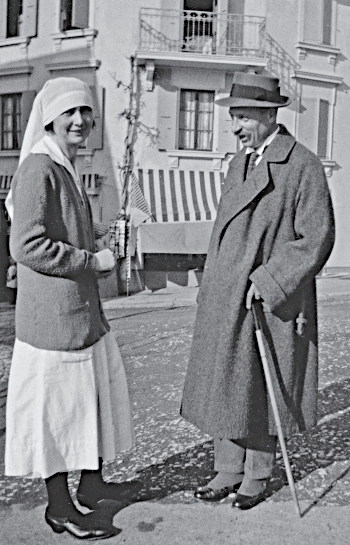
Rilke with his principal nurse Louise Simonin, Clinique Valmont, 1926. Rilke's body was by then a bag of skin and bones holding up oversized clothing.
Rilke really had only himself to blame for his long drawn out treatments. His flirtation with psychoanalysis, which had begun when he met Lou Salomé in 1897, kept him convinced that his ailments all had some psychosomatic cause. He thus spent his last years transferring lots of money to the spa charlatans for their aristocratic waters, baths, massages, dietary fads and all the other medical mumbo-jumbo which kept them in business.
Had he gone to a proper hospital with proper doctors in the first place, just as the common people did, and left the spa treatments to the rich who could afford it, he would have probably saved himself some time and money in his last years.
According to his doctor in Valmont, Rilke didn't believe he was dying until almost the very end, if that. Once your faculties of reason are bogged down in the psychosomatic illness belief, the battle with the Grim Reaper turns into an effort to straighten out the underlying mental disturbance causing the illness.
He died in the Valmont clinic at three-thirty in the morning of 29 December 1926 in the presence of his doctor, his favoured nurse, Louise Simonin and his ever-loyal Nike, Nanny Wunderly.
He was buried in a grave in the churchyard of the castle church in Raron, about 20km up the valley from Sierre, as was his explicit wish. The grave is located against the southeast wall of the church, with a spectacular view over the river valley to the mountains opposite.
The funeral took place on 2 January 1927 in bitter cold. There was a small band of mourners: Nanny Wunderly-Volkart, his 'Nike'; Werner Reinhart, his sponsor; Katharina und Anton Kippenberg, his publishers; Lou Albert-Lasard, the painter and writer (who was living in Switzerland at the time); Erika Mitterer, his most recent devotee; there was also Regina Ullmann, the writer he had supported from his Munich days. Four sponsors and three young women – that sounds about right.
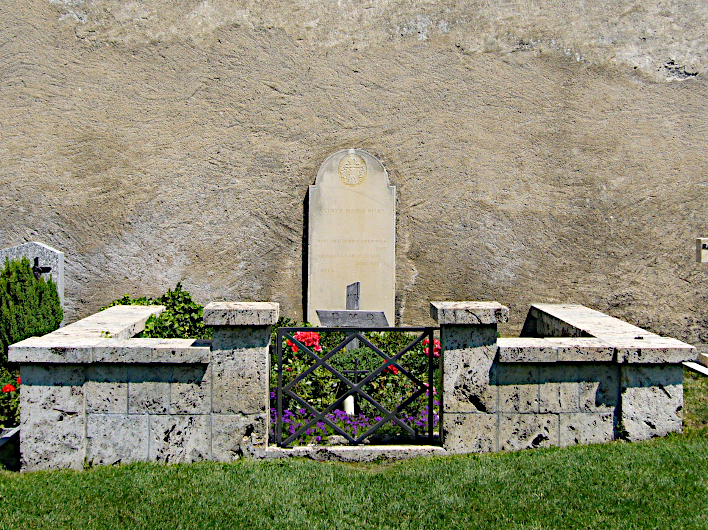
Rilke's grave in the churchyard of the Burgkirche in Raron, Valais. Image: ©Peter Berger, July 17, 2006.
Given the suddeness of his death and the isolation of the church, it is no surprise that some key figures in his life were not there: Phia Rilke, his mother (who was not well at the time, but would visit his grave annually until her own death in 1931); Clara Rilke, his wife, and Ruth Rilke, his daughter; Lou Andreas-Salomé, his therapist-mother-lover; Marie von Thurn und Taxis; Baladine Klossowska, 'Merline' and her sons Pierre und Baltusz Klossowski. This list could be longer, but it appears that no one delayed the funeral by a few more days to allow more mourners to turn up at this distant outpost in the depths of an alpine winter – perhaps the extra time would have made no difference to the turnout.
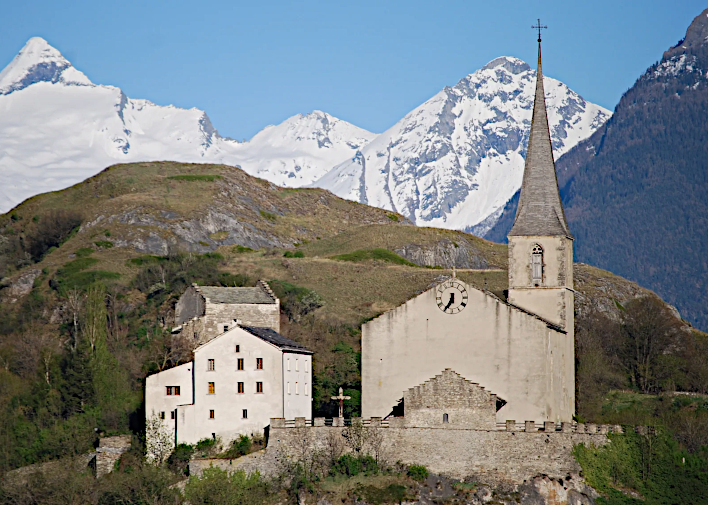
The Burgkirche in Raron, Valais. It is surprising that Rilke chose a place where he would be closely embraced by the surrounding mountains, rather like Soglio.
Postscript: His 'own death'
Nearly all Rilke's crackpot ideas are contained in his near-autobiographical novel Die Aufzeichnungen des Malte Laurids Brigge (1904-1910), 'The Notes of Malte Laurids Brigge'. This work is arguably the hinge around which much of his other works turn. It is above all a reckoning with the childhood that turned the simple soul into the very complicated René Rilke.
Faced with Rilke's Grand Guignol novel, English speakers might think of the much underrated artist and writer Mervyn Peake (1911-1968), particularly his Gormenghast novels, which, unlike Rilke's efforts, at least make comic sense.
Rilke had a bizarre concept of der eigene Tod, 'the own death'. It first appeared in the Stundenbuch III, 1903. I cannot explain it for you, because I don't really understand what he means by this either, but I'll take a run at doing so: It seems to boil down to a death that occurs without the intervention of doctors. According to Rilke, this manner of death is part of the nature of the individual from birth which manifests itself – or should be allowed to manifest itself – in the manner of that individual's death. The intervention of doctors subverts that pre-ordained manner of death.
In Malte he writes of the Hôtel-Dieu, the paupers' hospital in Paris, where down the ages more and more people have gone to die, 559 beds are there now, he tells us. Dying in a hospital bed with medical assistance, strikes him as – how shall I put it? – lacking class. It's the way the masses die, the Lumpenproletariat (not that he uses this word), not the nobs, who do not allow doctors to shape their deaths. It sounds like something he heard from Phia.
This scene is very characteristic of the smart-alec stupidity of Rilke's writing. Read quickly, it leaves an impression of a clever insight. A moment's reflection, however, will expose its vacuity: what is wrong with 559 poor people dying in the relative comfort of a hospital bed and receiving medical care to ease their passage out of this life? Where else shall they or can they die? A noble death alone in their own hovels? In the street? Would he close down this centuries old charitable institution? These 559 bed-blockers must be pitiable people without castles in which they can die 'their own death'. He tells us that the doctors choose the deaths of these unfortunates, which seems to me preferable to just letting the Grim Reaper choose what will happen.
In contrast, the Chamberlain Christoph Detlev Brigge from Ulsgaard dies his 'own death', lying on the carpet on the floor of his room in his castle. For some reason I do not understand, the body on the floor was actually 'Christoph Detlevs Death', which took its time: ten weeks 'Christoph Detlevs Death' was there, during which time the people in the castle, the animals in the fields, the villagers living nearby are beset by the awful screams broadcast from the castle during the ten weeks of agony that Brigge's 'own death' cost him. It turns out that everyone in this family, men, women and children, die their 'own death' when their turn comes. Rilke, carried away by his own fanciful rhetoric, requires more than one thousand words to deal with this Grand Guignol absurdity of ten weeks of screaming.
Personally, I would prefer to float away on a gentle cloud of morphine and not disturb anyone or any animal in the vicinity. Mervyn Peake died of dementia, so never got the chance to die his 'own death'.
When his time to go came round in Valmont at the end of December 1926 Rilke expressly rejected any medication that would dim his consciousness, only accepting analgesics for the pain (which was considerable). Rilke, entitled egotist to the end, only considered his 'own death' and not the feelings of those caring for him, Nanny Wunderly for one, who was by his bedside continually.
One squirt of something could have helped him over the threshold and saved Louise and Nanny two or three days and nights of ministering to the corpse in progress. If he is seeking a noble death, after a certain point of suffering, a certain terminal point, whether he dies on Wednesday 29 December or Monday 27 December or Saturday 25 December makes no difference to Rilke at all – 'As tho' to breathe were life!' (©Tennyson).
Some moist-eyed literary types have described Rilke's 'own death' as something noble – a suffering endured. I consider it the moment when Rilke's lifelong narcissism attained its crescendo, when those around him had to suffer so that he could have the ultimate masochism of his 'own death' in accordance with his crackpot theory.
His concept of the 'own death' is flawed, because the dying person has no agency (as we say these days) to control or curate their manner of dying: when the Grim Reaper is at your side, you have nothing more to say in the matter of what he does, you just have to lie back and enjoy it as best you can – a few little white pills are neither here nor there. 'And when the Angel with his darker Draught / Draws up to Thee — take that, and do not shrink' (©Fitzgerald). There is nothing noble in an 'own death', nor does he tell us why dying the 'own death' is such a moral imperative.
And finally – the reader will certainly have got here before me – Rilke was always free to die his 'own death'. He could have stayed away from the Valmont clinic, or discharged himself after the terminal diagnosis and returned to his tower on the hillside above Sierre. He could have dismissed his helpers, laid himself out on the floor, opened the windows to the winter and screamed to the world, just like Christoph Detlev Brigge. Or perhaps, when it was his turn, an 'own death' was not really what he wanted.
Conclusion
Is my intense dislike of Rilke fair? After all, there have been plenty of writers who were blind to the 'so-called realities'. James Joyce (1882-1941) comes to mind, who even in his most straitened times was partial to a top-class hotel and a fine dinner, usually at someone else's expense. Joyce's end was in no sense his 'own death'. But at least he left the world some indisputably magnificent works that justified every penny spent on his life-support system.
The Austrian author Stefan Zweig (1881-1942) was supporting the great Austrian novelist Joseph Roth (1894-1939) during his Parisian exile from his own capacious pocket. Among his other defects, Roth was an extreme alcoholic with a taste for cognac. Zweig, unlike Roth aware of the 'so-called realities', tried in vain to persuade him to save his (that is, Zweig's) money by buying a bottle of brandy from a shop, rather then ordering it by the glass in expensive bars – to no effect. Roth's death was very much his 'own death', screaming for alcohol, albeit in a Paris hospital. But Roth's writings were worth every centime of Zweig's support.
Zweig and his wife committed suicide in Brazil, of all places, which I suppose might count as an 'own death', or perhaps not, who knows?. Perhaps the Rilke doctrine of the 'own death' would prefer Zweig to have a non-pharmaceutical end in Auschwitz?
But, try as I might, I can think of no other writer who was in Rilke's league for such a blatant disregard of the 'so-called realities'. He was an extreme narcissist who cared nothing for the feelings of others; a parasite whose vanity made him believe that other people's money was his rightful due. He stiffed everyone around him.
The German culture machine, its publishing and academic engines and, of course, his fan club will surely carry his reputation forward for some time to come and nothing I write here will change that.
Let's be kind. 'Issues from the hand of God the simple soul'.
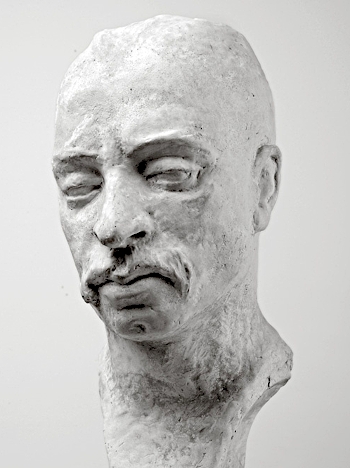
Clara Rilke-Westhoff: plaster bust of Rilke, 1936.
0 Comments
Server date and time:
Browser date and time:
Input rules for comments: No HTML, no images. Comments can be nested to a depth of eight. Surround a long quotation with curly braces: {blockquote}. Well-formed URLs will be rendered as links automatically. Do not click on links unless you are confident that they are safe. You have been warned!