
Winterreise 24
Richard Law, UTC 2026-11-01 11:32
For today's sermon we take as our text the 24th and final poem in Wilhelm Müller's (1794-1827) poem collection Die Winterreise, 'Der Leiermann' [hereinafter simply 'W24']. Our focus is on the text, so we are leaving Franz Schubert's wonderful musical setting of this cycle, Winterreise (no Die), to one side.
The occasion for this sermon is a recent email exchange with Dr Brian Chapman, an Australian pianist and physiologist, who takes his Winterreise very seriously (as one should).
If you are new to Winterreise you can take an overflight in my previous discussion of the song cycle as a whole.
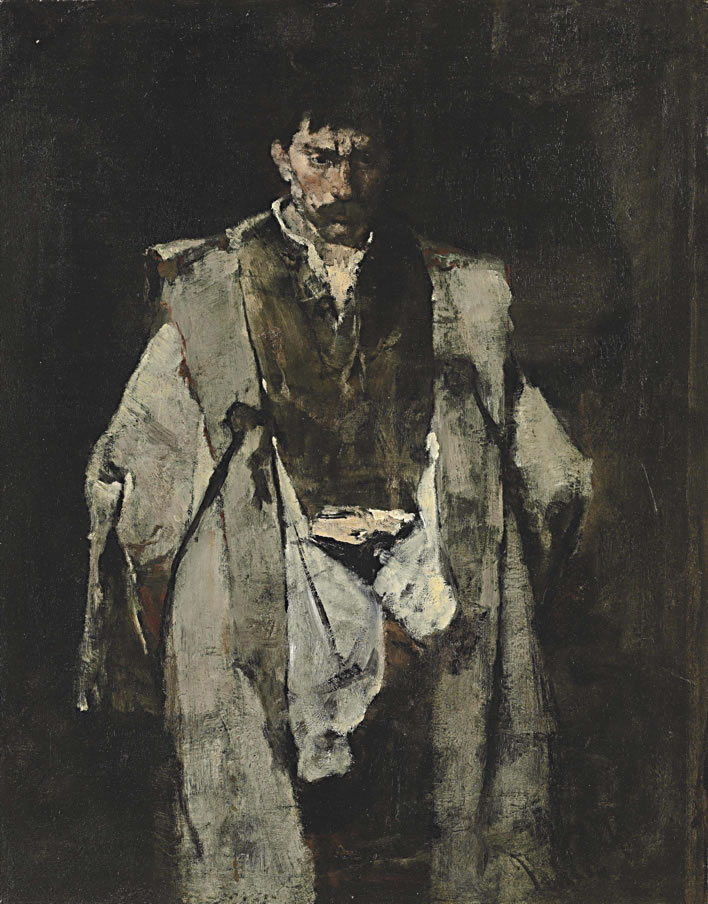
Mihály Munkácsy (1844-1900), A Night Wanderer, c. 1872. This is a study for a much larger work showing a group of beggars travelling at night.
Here is Müller's German text for W24 with my English translation. As is traditional on this website, the translation aims at accuracy, not beauty. I reveal my uncertainties in the notes to the translation – the bright people who turn up at this website will have their own ideas.
Der Leiermann
The hurdy-gurdy man
Drüben hinter'm Dorfe
Steht ein Leiermann,
Und mit starren Fingern
Dreht er was er kann.
Over there, behind the village,
Stands a hurdy-gurdy man,
And with stiff fingers
He cranks out what he can.
hurdy-gurdy man: The old man is playing a hurdy-gurdy, a carryable stringed instrument with a crank, which when turned produces an underlying drone; a tune is played by pressing the keys. In contrast, an organ-grinder cranks a much larger, often wheeled box-like instrument needing no fingering, which is clearly not what is meant here. Traditionally, hurdy-gurdy players were Savoyards, itinerant musicians associated with the Savoy region of south-east France – hence Richard D'Oyly Carte's 'Savoy operas' and the 'wandering minstrel' of the Mikado.
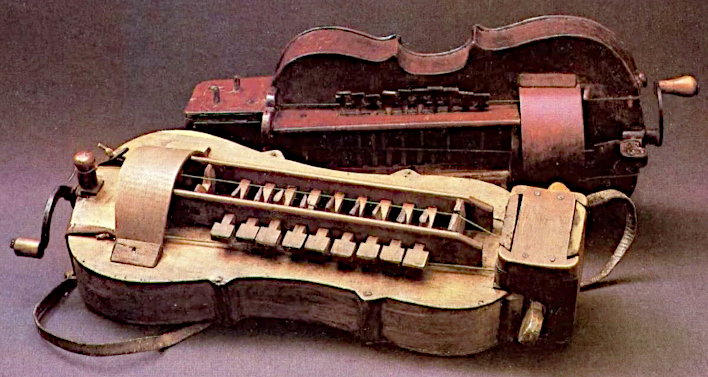
Readers who just can't get enough of hurdy-gurdy music will find everything they desire on YouTube. This is a three minute excerpt from Andrey Vinogradov's four hour (!) playlist, titled 'Breaking Rings Dance. Dark Medieval Dance. Hurdy-Gurdy Solo'. We should probably assume that the old man is not at this skill level.
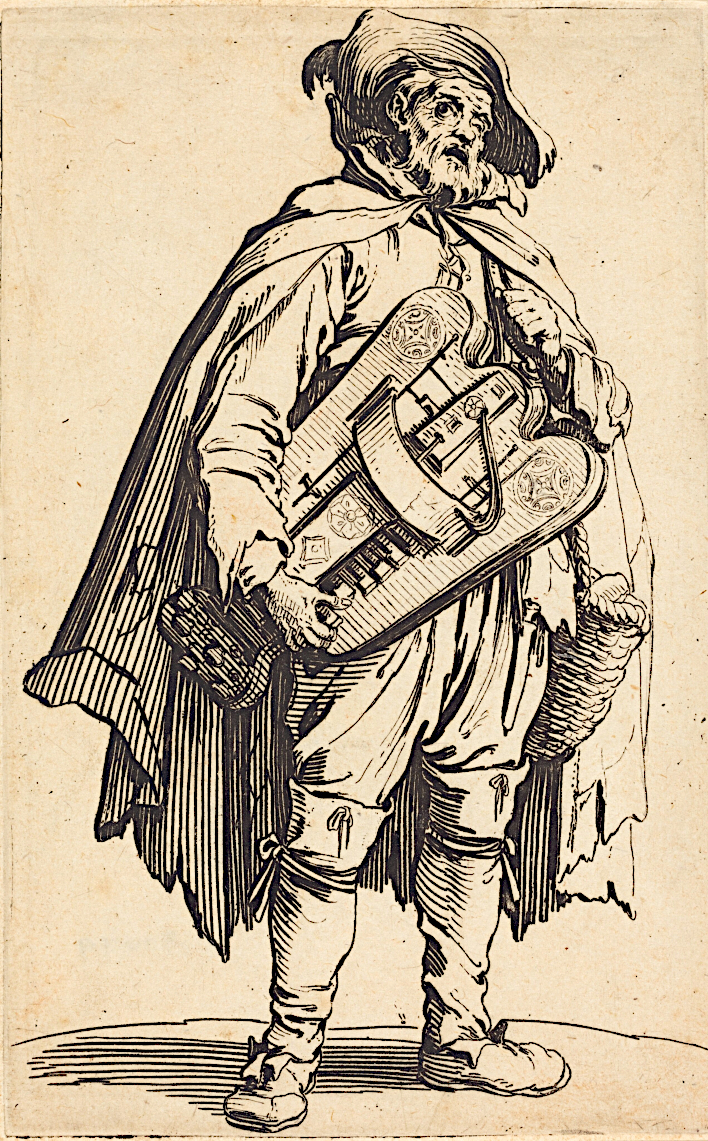
Jacques Callot (1592-1635), 'The Hurdy-Gurdy Player', c.1622. From a series 'The Beggars'. Although he is not explicitly blind, the rendering of the subject's eyes suggest blindness, another traditional characteristic of such beggars. Image: National Gallery of Art, Washington DC.
over there, behind the village: On its face, this statement of the location of the action is unexceptional. However, the translator should always assume that Müller is writing at the highest poetic level: hence very little is 'unexceptional' in this masterfully spare text, five short stanzas each of four short lines, every word carrying its charge of meaning.
Drüben is often mistranslated with some variant of 'up', which is completely wrong and makes no sense. It means, unambiguously, 'over there'. Similarly, hinter'm Dorfe is unambiguously 'behind the village', which is another way of saying that this location is 'off the beaten track'. Away from the centre of the village and away from the road, this would not be a good position for a beggar to catch the passing trade.
Of course it isn't, because it is the first indicator in the poem for the theme of social isolation. The hurdy-gurdy man is not just a beggar, he is just as much a social outcast as the narrator. His useless pitch 'behind the village' is the best he can hope for. Given what we read later of the rejection he receives from humans and the aggression of their dogs, the centre of the village and the high road through it are not places he can be. He is, quite literally, an outsider.
cranks out: The full register of the meanings of drehen in German is unavailable in English; nevertheless I wanted to give some flavour of the active verb rather than just surrender to the flaccid 'play'. The verb drehen, 'to turn, to rotate', is important, since it occurs three times in W24. Translators should not ignore such a strongly indicated preference of Müller's to consistently use the muscular drehen instead of, say, the easy spielen. Admittedly, 'to crank' is a bit unusual and emits an odour of oily overalls, but we must work with what we have.
what he can: The literal translation of was er kann troubled me at first until I realised that the problem would be solved by the addition of something like 'in the circumstances', which picks up on the 'stiff fingers' of the previous line.
But in the search for something better it struck me that one could take kann in a more Germanic sense. English speakers learning German have to cope with the many subtly different meanings of können. Taken in this way kann would refer to the tunes that he knows and which he can play – his repertoire, in other words.
NB: kennen, a particular sense of 'to know', is not meant here; a native speaker of German would say to a musician Können Sie 'La Paloma'? (not Kennen Sie 'La Paloma'?) or to a foreigner, Können Sie Deutsch?.
I originally tried 'what he knows' to express this, which would be semantically accurate but bafflingly odd. A better solution would be something like 'He cranks out his tunes'. I fired up the old ouija board, but Wilhelm Müller was not answering, so we shall leave it at 'He cranks out what he can', faute de mieux.
Baarfuß auf dem Eise
Schwankt er hin und her;
Und sein kleiner Teller
Bleibt ihm immer leer.
Barefoot on the ice
he sways backwards and forwards;
And on his small plate
there is always nothing for him.
nothing for him: This is an admittedly rather clunky attempt to capture the pathos that the dative bleibt ihm immer leer brings to the German. The point is that his collection plate is not only empty, it contains no money that has been given to him. My interpretation is supported by the fact that the passage following is about exactly that lack of recognition and his status as an outsider, a condition he shares with the narrator.
Keiner mag ihn hören,
Keiner sieht ihn an;
Und die Hunde brummen
Um den alten Mann.
No one likes to listen to him,
No one looks at him;
And the dogs growl
around the old man.
the dogs growl: Menacing dogs occur several times in the earlier poems of the cycle, underscoring the rejection from the world of human society from which the narrator has fled: irre Hunde heulen (W1), Es bellen die Hunde … Bellt mich nur fort, ihr wachen Hunde (W13). That the same image occurs here in connection with the hurdy-gurdy man underlines their shared experience as outcasts from a human society guarded by dogs against outsiders.
Und er läßt es gehen
Alles, wie es will,
Dreht, und seine Leier
Steht ihm nimmer still.
And he lets it [all] happen
just as it comes,
Cranks on, and his hurdy-gurdy
is never still.
And he lets it [all] happen: The word 'all' comes from the following line, but English prefers it here.
is never still: Müller's use of the strong verb stehen instead of the weak copula ist is the mark of a poetic mind at work. I wish I could think of something better than 'is'.
never still: There is a sense here of 'never lets him down / never fails him'. At the risk of overthinking this, the hurdy-gurdy man might represent the poet Müller or possibly his Doppelgänger, alienated, lacking recognition. Or possibly even a certain Viennese composer, endlessly productive, ditto, ditto, might have seen in the hurdy-gurdy player something of himself in his dire social situation around 1827. We have discussed Schubert's desperate years on numerous occasions on this website, for example: Schubert the Insignificant, Schubert's downward spiral, 1827, Franz Schubert in search of lost time, The dark years: 1823-1826, The final Schubert years: 1825-1828 and The Schubert trajectory. At least his hurdy-gurdy never fails the old man, unlike all the people around him.
Wunderlicher Alter,
Soll ich mit dir gehn?
Willst zu meinen Liedern
Deine Leier drehn?
Queer old man,
Am I to go with you?
Will you
crank your hurdy-gurdy to my songs?
queer: Under no circumstances 'wonderful'! The hurdy-gurdy man is wunderlich, 'strange, peculiar, odd'. The word 'queer' has been polluted in modern English; if this troubles you, 'strange' would be acceptable, though weaker,
am I to go with you?: or more clearly 'Am I [expected] to go with you?' See the comment below on the interpretation of the modal verb sollen.
you/your: Native speakers of German will note that the narrator addresses the hurdy-gurdy man with the intimate form of the dative 'you', dir, and the intimate form of the possessive 'your', deine. The two men are in the same boat, as it were, and the collegiality and solidarity that the intimate form expresses is appropriate and indicative – it is however a feeling that passes the English speaker by unremarked. I was tempted to write 'Am I to go with thee' and 'thy hurdy-gurdy', but the current year is 2026 and hardly any English speaker would get the point of such affectation.
will you: See the comment below on the interpretation of the modal verb wollen.
crank: Having established 'crank' as the equivalent of drehen, we should respect Müller's consistent preference for the strong verb despite its humorous potential here.
Text: Wilhelm Müller (1794-1827), Die Winterreise, Sieben und siebzig Gedichte aus den hinterlassenen Papieren eines reisenden Waldhornisten. Vol 2, pp. 77-78, 1824, Ackermann Verlag, Dessau.
Interpreting modal verbs in stanza 7
Introduction
Modal verbs such as sollen, wollen, müssen etc. are a nightmare for the translator of historical texts. They extend the main verb, e.g. gehen, with an indication of the modus, the manner or mode of the action or the condition under which it takes place (traditional grammars often write of 'mood', which gets everyone confused).
The trouble is, not only are they mired in subtleties that even native speakers misunderstand, their meaning and use has changed over time in both of the languages under consideration. Thus the translator is shooting at a moving target from a moving platform.
Their careful use has almost died out in English and will shortly be replaced in the spoken language by intonation and gurning, in the written language by emojis and exclamation marks. There was a time in my childhood when children would understand even the nuanced 'You shall go to the ball, Cinders!' (with the stress on 'shall', of course).
As if that weren't bad enough, the most frequent use of modal verbs in modern English is in their subjunctive form. A generation schooled to workplace politeness will avoid 'you must do this now' and substitute 'should' or 'have to' or 'ought to' or, in the USA, the all conquering 'need to', now used in almost every possible situation. 'Shall' has just about disappeared.
Sollen
The modal verb we are encountering here, sollen, is one of the trickiest. The discussion of sollen and its meanings – present and historical – took the brothers Grimm around 35'000 words in their German dictionary. The exemplary modern DWDS entry is compacter but demands strong nerves nevertheless. The use of sollen in German has declined dramatically during the period 1600 to the present, as has 'shall' in English. The discussion of 'shall' in the Oxford English Dictionary is also a monument to the mental faculties and endurance of Dr Johnson's 'harmless drudges'.
In order to avoid a 20'000 word essay on this modal verb alone, I shall cut straight to the problem at hand.
As we have noted, Müller the Germanist is using German very precisely. There are plenty of modals available to him here, all of which would sort of fit and no one would notice: muss ich, darf ich (politely asking permission to accompany him), kann ich (casually asking to accompany him) und soll ich. He chose soll. Ipso facto he rejected the others.
What does sollen bring to the text that the other modals do not?
An important use of sollen is to imply some degree of destiny or external cause, something that is expected or required of someone. Ich muss gehen and ich soll gehen are not the same at all. This feeling was also implicit in the English 'shall': 'You shall go to the ball, Cinders!' is not a simple future tense statement or a simple command, it is a statement implying destiny or some higher power.
In English there was a fad (now thankfully desuete) for declining the standard future auxiliary 'will' in the first persons with 'I shall' and 'We shall', thus destroying the nuance of the most famous first line in English poetry, 'Shall I compare thee to a summer’s day?' (1609).
According to my reading, the narrator of Die Winterreise has met his quasi Doppelgänger in W24 and is asking whether his destiny is to join the hurdy-gurdy man. In modern English this meaning of 'shall' has been largely lost: 'Shall I go with you' is a weak nothing of a statement.
But help is at hand. Christmas is approaching and Händel's (1685-1759) Messiah (1742) will once again be performed, quoting word for word the King James Version (1611) of the Biblical prophecy of Isaiah 9:6:
For unto us a child is born, unto us a Son is given: and the government shall be upon His shoulder: and His name shall be called Wonderful, Counsellor, The Mighty God, The Everlasting Father, The Prince of Peace.
A prophecy and a destiny, not a simple future. Interestingly, Luther's 1545 Bible does not use sollen here (ist auf seiner Schulter; er heißt Wunderbar…).
All the stations of the narrator's wandering suggest some particular destiny – be it suffering, rejection, death or oblivion. The narrator's journey is called die Winterreise, 'the winter journey', for a good reason.
That journey to a terrible conclusion can be seen as an analogue of the 'Stations of the Cross', the Via Dolorosa, which traditionally shows 14 stations of Christ's journey to his crucifixion. Die Winterreise gives us 24 stations, as it were, but the parallel is not to be taken beyond its limits. Each of the stations in the poem represents a particular aspect of the journey and is, in that sense, predestined. The meeting with the hurdy-gurdy man is thus also a destiny and a destination, not simply accidental.
Wollen
Readers haven't escaped their destiny yet, for on the next line we hit another modal verb, wollen.
The transformation of the English verb 'will' down the years is easy to demonstrate using the 'Lobster Quadrille' from Lewis Carrol's Alice's Adventures in Wonderland. Today's English speakers will easily work out what is meant, but, 160 or so years later, will hardly ever say something like this themselves.
'Will you walk a little faster?' said a whiting to a snail,
'There's a porpoise close behind us, and he's treading on my tail.'
See how eagerly the lobsters and the turtles all advance!
They are waiting on the shingle — will you come and join the dance?
Will you, won't you, will you, won't you, will you join the dance?
Will you, won't you, will you, won't you, won't you join the dance?
In the present case we fortunately have only a few options.
- Firstly, 'will' in English is used as an auxiliary verb to denote the basic future tense; in German werden does this job, so we can dismiss this option straight away.
- In German the fundamental meaning of wollen is an expression of will, which in English resolves simply to 'to want something', 'to want to do something'. Ich will fünf davon, 'I want five of them'. 'I will five of them' sounds absurd. Thus a simple resolution of Willst zu meinen Liedern / Deine Leier drehn? could be '[Do you want/Do you wish/Would you like] to crank your hurdy-gurdy to my songs?'.
- The final option arises from a well established usage which expresses a polite request: Willst du mir den Weg zeigen?, for which in English we would also use 'will': 'Will you show me the way?'. In certain circumstances the request can be less polite, as in the occasional cry of parental desperation: 'Will you stop fidgeting! This option gives us a simple resolution of Willst zu meinen Liedern / Deine Leier drehn? as a request by the narrator to the hurdy-gurdy man: 'Will you crank your hurdy-gurdy to my songs'.
Which of these two options you prefer is a matter of taste. Without great conviction, I prefer the second one.
Brief note for singers
Please note that the 'dative-e' after Drüben hinter'm Dorfe and Baarfuß auf dem Eise, which would be quite natural for German native speakers, must be respected by performers as it is essential for the metre of the following lines. The enjambment is very pronounced in this poem – it could be printed as a sequence of couplets, in fact.
General remarks on the text
Why am I being so picky with the translation of W24?
The reason is that, in Die Winterreise Müller is writing carefully crafted poetry to the full extent of his considerable abilities. In Müller's other 'cycle', Die schöne Müllerin, he was parodying for his sophisticated friends in the literary salons of Berlin the craze for bucolic verse. As we pointed out in our articles on that cycle there are many places where Müller makes his yokels sound like half-wits.
In contrast, the poet of Die Winterreise could not be more serious. If you are sceptical of this idea you should consider the fact that the diminutives -chen and -lein, those markers of rustic poetry that so infest Müllerin, are completely absent in W25. The Müller of Müllerin is not the Müller of Winterreise; that Müller would have written Tellerchen,(cutesy) where this Müller gives us sein kleiner Teller (affective). In the whole of Die Winterreise the -chen diminutive occurs only with Mädchen und Liebchen; there is one Bächlein.
Müller experienced his own bouts of deep depression and illness. The depressive Schubert knew another sickly depressive when he encountered him in Die Winterreise. The unfortunates afflicted by deep depression will recognise the hopelessness, indifference and apathy of Und er läßt es gehen / Alles, wie es will, while just carrying on as usual, cranking whatever hurdy-gurdy it is that you crank not only without any public recognition but at the cost of being shunned.
When Schubert performed the freshly composed Winterreise for what was left of his 'circle of friends' by 1827 the reaction was mixed shock and incomprehension – another rejection, in other words. Those present had careers and/or money and/or wives and must have found empathy for the plight of the introverted and introspective composer to be beyond their emotional range.
So that, summa summarum, Müller's seriousness is evidenced by his extremely careful choice of language. It is therefore incumbent upon translators to engage their language antennae in rendering Müller's precise German into another language, however difficult it may be in such a profound, polyvalent work of art.
0 Comments
Server date and time:
Browser date and time:
Input rules for comments: No HTML, no images. Comments can be nested to a depth of eight. Surround a long quotation with curly braces: {blockquote}. Well-formed URLs will be rendered as links automatically. Do not click on links unless you are confident that they are safe. You have been warned!